
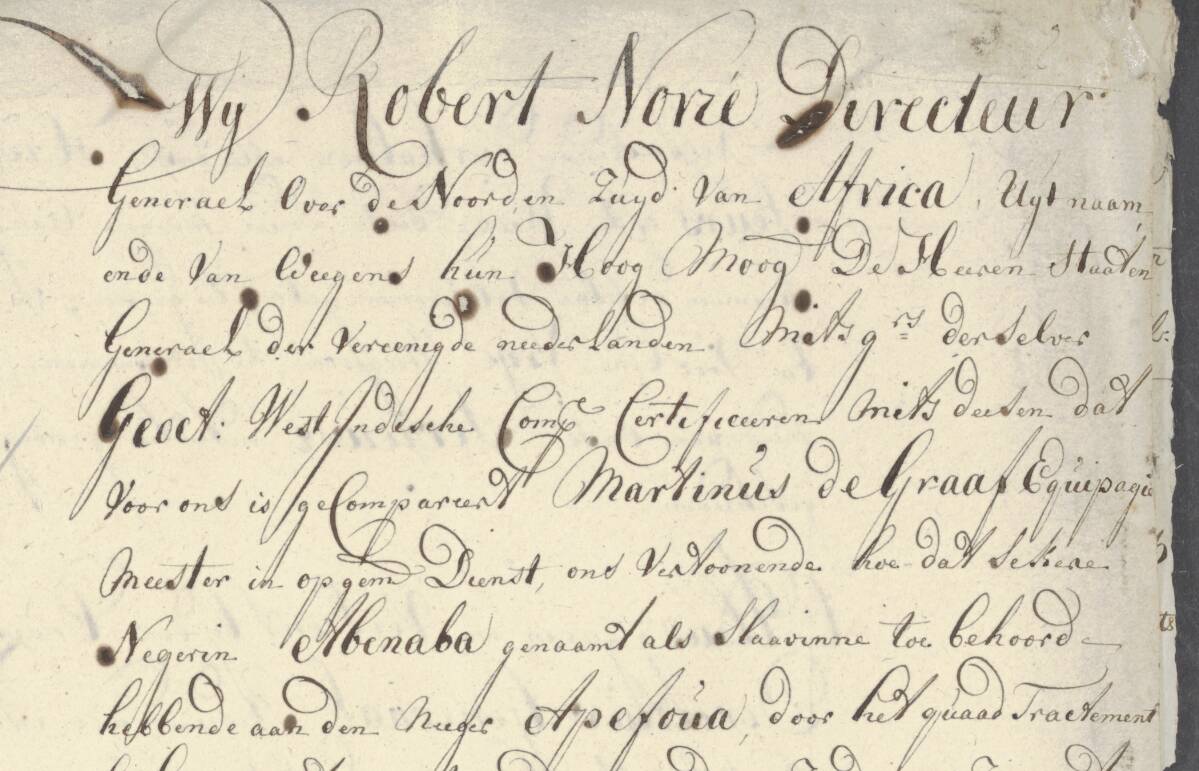
On 15 April 1734 Isaacus Ketelanus, minister at the castle of Elmina on the Gold Coast, baptised a boy who in his estimate was already a good five years old. His name was Arij, and he had been born in Elmina around 1729 or 1730.1 His father, Martinus de Graaff (1700–1733), had been equipagemeester (master of equipment) of the West India Company: the man who managed the stores, the buildings and the ships at Elmina. Martinus came from Rotterdam, where he was baptised in January 1700. He entered the Company’s service as a sailor in 1722, became an under-helmsman and under-foreman of the “train” (the Company’s building gang), and was equipagemeester from 1726 to 1733. On 18 May 1733, almost a year before his son’s baptism, he drowned in the bay of Elmina.2 Arij’s mother was probably Abenaba (born c. 1701). She had been the property of an African, Apefoua, who treated her badly. She ran away from him and, “volgens Lands gebruyk” [according to the custom of the country], gave herself as property to Martinus by “het strooyen van Zout” [the strewing of salt]. That was Martinus’s own statement. He nevertheless had three ounces of gold paid to Apefoua through the broker Abocan, “om alle palabers en oneenigheden voor te komen” [to avoid all disputes and disagreements], and in January 1730, at his request, Abenaba received a letter of freedom, around the time their son was born. The researchers M.R. Doortmont and N. Everts, who published on Arij in De Nederlandsche Leeuw in 1997, suspect that the letter of freedom was connected with her pregnancy.3

One of the witnesses at the baptism made a remarkable promise, which was put on record. The child was baptised
ten overstaan van kapitain Jurriaan Lindenberg als getuigen die ook op zich genomen heeft dat kind […] op te queeken.4
[in the presence of captain Jurriaan Lindenberg as witness, who has also undertaken to bring up the child.]
Jurriaan Lindenberg (1698–1751) was then in command of the Beschutter, a cruiser of the Company that seized ships trading on the coast outside its monopoly, including the trade in people.5 Two months before the baptism he had received orders from Amsterdam to sail to Suriname “met een Armazoen Slaaven” [with a cargo of slaves]. He asked the council at Elmina to spare him this: his ship had been away from home for 28 months, the worm had got into it, and with a crew of 58 he could not carry “7 à 800 Koppen Slaaven na America” [700 or 800 head of slaves to America]. In the end another ship took the enslaved people to Suriname, and the Beschutter went home.6 His objection concerned the ship, not the slave trade: ten years later he himself sailed as captain with enslaved Africans from the Gold Coast to Suriname.7
Martinus left his son nothing, although the estate was considerable: gold and goods worth ƒ5,036 and a further ƒ6,049 in outstanding claims on the Company. He had died unmarried, and his estate was divided in Rotterdam among his brothers and sisters, a family of mostly sailors and servants of the VOC and the WIC.8 For a child from one of the “losse relaties” [loose relationships] that were common on the coast, the future did not look good, the historian P.J. van Winter wrote. That things turned out differently, Arij owed, in his view, to Ketelanus and “vooral aan kapitein Jurriaan Lindenberg” [above all to captain Jurriaan Lindenberg].9

Lindenberg was back in the Republic in 1735. A year later he moved with his family from Amsterdam to Groningen, where he and his wife Geertruyda Schaart bought a house in the Nieuwe Boteringestraat, near the Nieuwe Kerkhof. He lived there until his death in 1751.10 He probably already knew Groningen through his uncle, Thomas van Seeratt (c. 1676–1736). Van Seeratt was born in Sweden, had carried enslaved people from the African coast to America as a captain for the Company, and had then become commies-provinciaal (provincial clerk) and steward of the landed property of the province in Groningen. In 1728 Van Seeratt and his wife Anna Scottaway made each other sole heir in their will; their nephew Jurriaan Lindenberg received a silver lampet bearing the arms of the Aduarderzijlvest. Van Seeratt was buried in Groningen on 30 March 1736, but his widow, Lindenberg’s aunt, lived there until her death in 1755.11

Lindenberg had taken Arij under his wing in 1733 and promised at the baptism to bring the child up in the Reformed faith. Arij probably went with him to the Republic and grew up there partly in Lindenberg’s household. Doortmont and Everts call that an assumption. At any rate Arij did not end up in an orphanage.12 When he later had children of his own, he named the eldest two Geertruy Elisabeth and Jurriaan.13 It can hardly be otherwise than that he saw the Lindenbergs as his family.
Equipagemeester at seventeen
In May 1746 the directors of the Company appointed Arij equipagemeester of Elmina, for the Zeeland chamber. It was the same post his father had held. Arij was about seventeen.14 Martinus de Graaff had started as a sailor and had taken years to become equipagemeester. His son got the office without any experience, while at the same meeting there was a letter from Hendrik Huyting, who had himself asked for the post at Elmina. The minutes do not say why the choice fell on Arij. Van Winter called it “een raadsel in het leven van Arij de Graaff” [a riddle in the life of Arij de Graaff].15
Arij and Huyting solved it with a contract. On 15 December 1746 Arij agreed with Huyting, who now became under-equipagemeester, that Huyting would receive all the emoluments for 1747: the extra income that came with the office. Arij kept only the regular pay. In return Huyting had to instruct him “in alles de voorschreven bediening van equipagemeester betreffende” [in everything concerning the said office of equipagemeester] and make him “tot de bouwkunden soo veel in syn vermogen is bequaam” [as competent in building as lies in his power]. That year they would live together.16
Lindenberg was on the coast at that time too. Arij had sailed out with him: in 1752 he declared that he had arrived on the coast “in den Jaare 1746 met het vrije handel schip de Louisa Margaretta” [in the year 1746 with the free-trade ship the Louisa Margaretta]. The ship arrived at Elmina on 27 November 1746.17 Lindenberg’s ship was a slave ship. On the coast 628 people were taken on board; 543 of them arrived alive in Suriname in September 1747.18

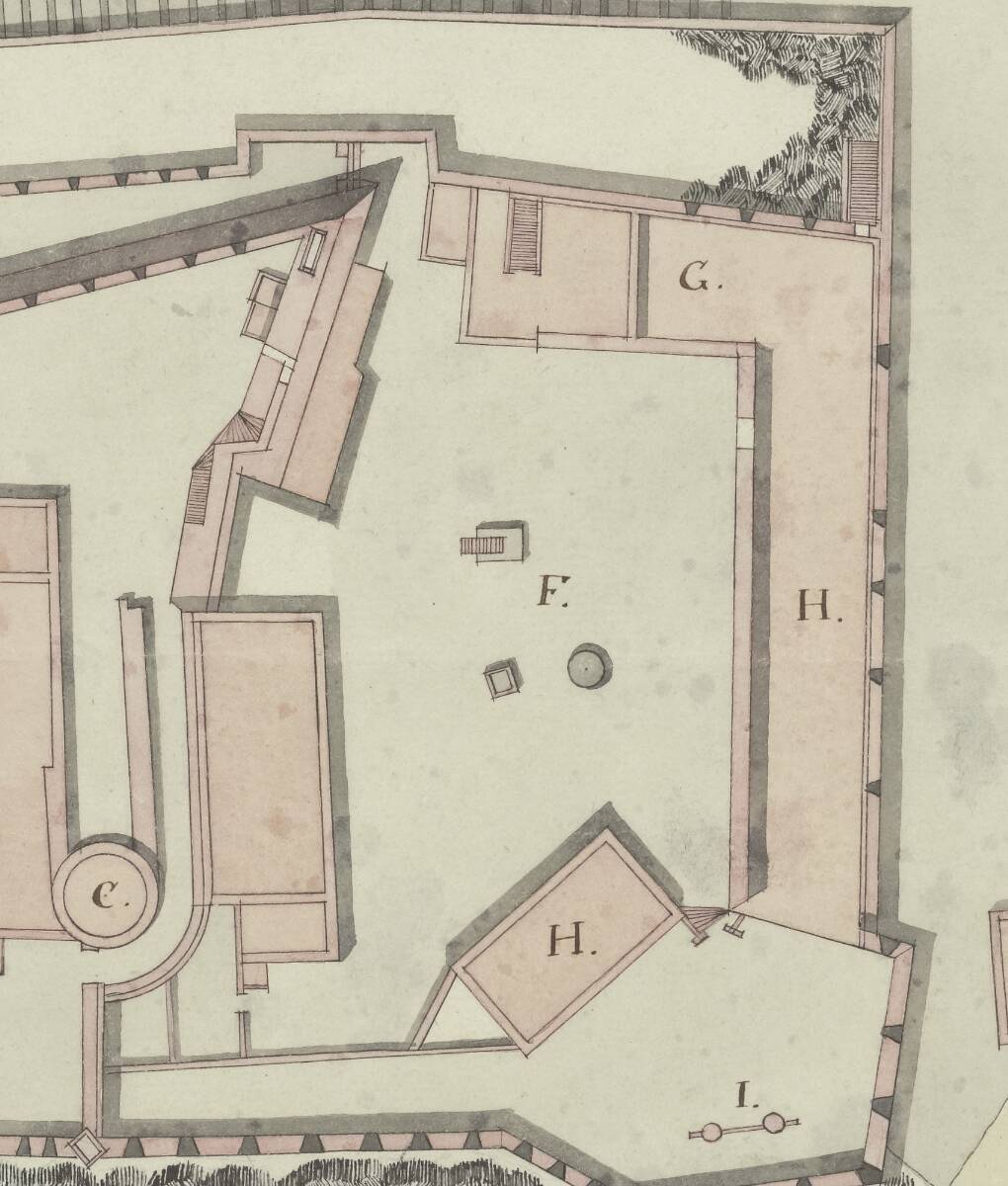
As equipagemeester Arij sat on the Council, the Company’s government on the coast. The director-general chaired it and in practice held almost all power; for him the Council was mainly an advisory body. Arij managed the stores of food and drink, the trade goods and the building materials, looked after the maintenance of the buildings and fitted out the ships for the coastal trade. For this he had a small shipyard at Elmina. A considerable number of people worked under him: Company staff, but also enslaved people. He left the building and maintenance of the forts to the “baas van de train” [master of the train]. This man directed the craftsmen: a smith, carpenters, masons, coopers and sailmakers. Arij held the post for sixteen years, until 1762.19 In Amsterdam, too, people knew who he was. In November 1748 a father in Amsterdam had a notary record that “d’Hr. Arij de Graaff Equipagiemeester op de Kust van Guinea” would keep an eye on his eighteen-year-old son, who was leaving for Guinea as a cadet on a ship of the Stad en Lande chamber.20
The money did not come only from his pay. Arij also traded in enslaved people on his own account.21 According to H. Companjen, who wrote about Arij in 2016 in the journal of the Historische Kring Ubbega, he was, with former governor Roelof Ulzen and Anthony Rühle, an owner of the slave ship De Guineesche Vrienden. He was one from the ship’s first voyage, at the end of 1759. About one voyage of that ship, co-owner Pieter Volkmar had a notary in Amsterdam record in 1761 that some 370 people had been taken on board in Guinea, that the captain had died on the coast, that the between-decks had not been cleaned while people were dying, and that the brandy intended for them had been watered down.22 Arij is not named in that deed.
What he earned, he invested in the Netherlands. In 1756 Nicolaas Geelvinck, lord of Castricum and former burgomaster of Amsterdam, transferred four bonds charged on Holland and West Friesland to “den Heer Arij de Graaff, Equipagie-meester op de Kust van Guinea”.23
In the same years he had four children at Elmina: Geertruy Elisabeth (1750), Jurriaan (1752), Wilhelmina (1754) and Martinus (1759).24 The deed that names them does not name their mother. In 1760 an enslaved woman owned by the Company, Efba (born c. 1723), received a letter of freedom at Arij’s request, on 23 September 1760. In return Arij gave the Company two other enslaved women. Efba (also spelled Efiba) may have been the mother of Martinus, who had been born shortly before.25 So what had happened a generation earlier repeated itself: Martinus de Graaff, too, had asked for a letter of freedom for the mother of his son.
The eldest two children were baptised at Elmina and sent to the Netherlands at an early age.26 Jurriaan Lindenberg was buried in Groningen on 14 August 1751. The burial register calls him “Oppercommies van Nederlands Afrika” [chief merchant of Dutch Africa], but the Company’s muster rolls do not confirm that title.27 Arij remained tied to the Lindenberg family. In 1752 Lindenberg’s estate still included a claim “wegens gesondene goederen aan Ary de Graaf na de West Indien” [for goods sent to Ary de Graaf to the West Indies]: Lindenberg had sent him merchandise, and Arij still had to settle the proceeds with the estate. In that same year Arij authorised Lindenberg’s widow to collect his pay in the Netherlands.28
Via Suriname to Amsterdam
In 1762 Arij asked the WIC for his discharge. He had served the Company for more than fifteen years and would “nog voor eenige tijd geerne zouden hebben willen volharden; Dog de begeerte, om weder na Europa te keeren, niet langer kunnende wederstaan” [gladly have persevered for some time yet, but could no longer resist the desire to return to Europe]. On 26 October 1762 the director-general and council agreed.29 Letters of 1 November 1762 brought word from Elmina that someone else had provisionally become equipagemeester “in plaats van den repatrieerenden Heer A. de Graaf” [in place of the repatriating Mr A. de Graaf].30 On 22 November he received his passport.31
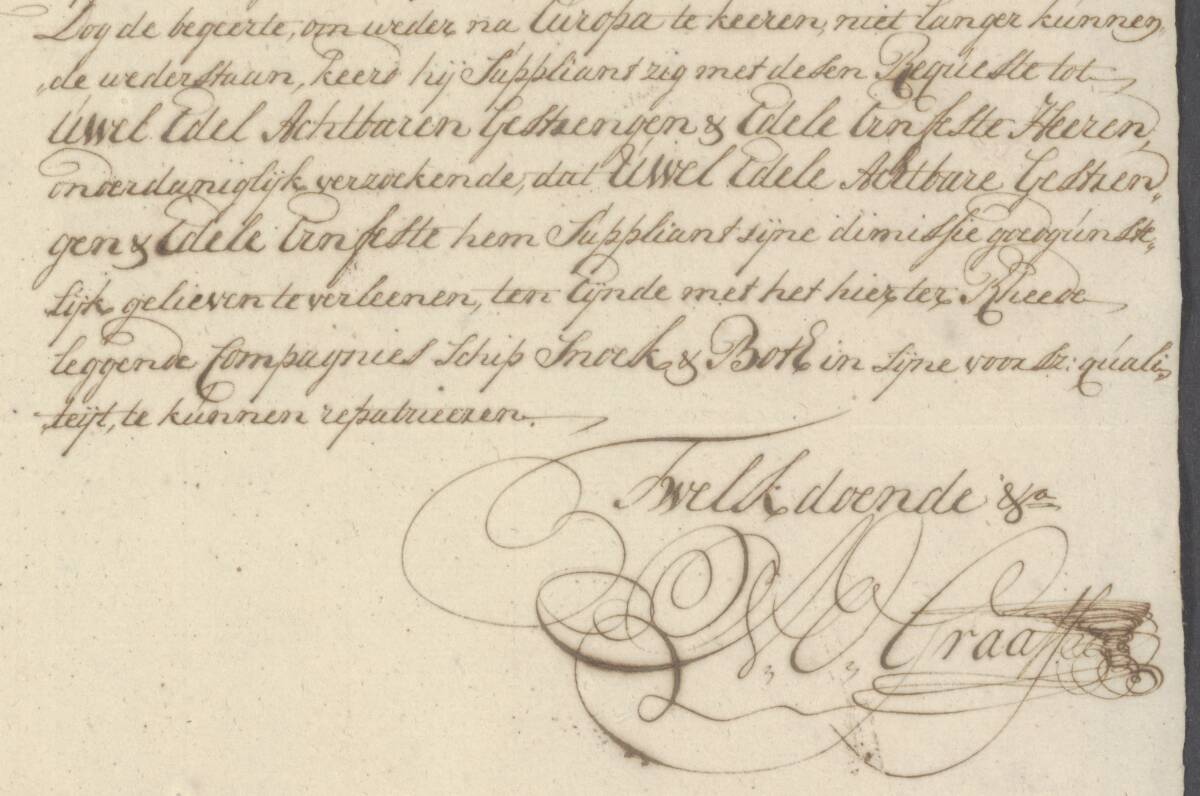
He did not go straight to the Netherlands. The Company ship Snoek & Both under captain Jacob Thymens Weerstand first sailed to Suriname, with on board “de Ed. Heeren Gerard Willem Blydenberg, Opper Commies en Raad, en Ary de Graaf, Equipagiemeester”.32 Arij took his two youngest children with him, Wilhelmina and Martinus, aged eight and three.33 The passenger list on arrival does not mention the children; they are named only at the departure from Suriname on 14 May 1763, on the ship of captain Godlieb Zielkens to Amsterdam. Enslaved people also went along: “Domesticquen” [domestic servants] of Blydenberg and De Graaff, who were sold in Suriname “op hun speciaal versoek” [at their special request]. The party of Arij, Blydenberg and four other passengers brought 23 domestiques with it, “zoo mulatte als negers” [mulattos as well as negroes]; sixteen of them belonged to Blydenberg and De Graaff. The Amsterdam chamber investigated the matter, because the ship’s owners had no permission to carry slaves, but in the end let it rest: nothing could be done about it “met eenig Succes” [with any success].34
One woman whom Arij owned in Suriname we do know by name. When Arij left Suriname in 1763, he left “zyn … slavinne genaamt Aquissiba alias Gogo” [his … slave woman named Aquissiba alias Gogo] in the care of Elisabeth Samson.35 Samson was born free in Paramaribo, the daughter of a woman whose freedom had been bought, and had built up a large fortune as a merchant and planter; she too owned plantations worked by enslaved people.36 In November 1763 Arij authorised her from Amsterdam to free Aquissiba and have this registered, “indien zy … oordeelen zy zulks meriteerde” [if she … judged that she deserved it].37 So he left the decision to Samson. Whether Aquissiba received her freedom, we do not (yet) know.

In Amsterdam Arij settled his affairs. In March 1764, when he sold five bonds to Nicolaas Geelvinck, he already intended to move out of Amsterdam soon.38 He invested part of his fortune in Suriname: in February 1765 he took over from Jacob Fabrice Burman a share of ƒ20,000 in a mortgage of ƒ60,000 on the plantation Rac à Rac on the Suriname River, charged to Jan Willem Pichot.39 In the spring of 1765 he gave that share to his four children from Elmina, ƒ4,000 each. Two of them had been sent to the Netherlands years before; the two youngest he had brought over himself, “ten eynde dezelve in de gereformeerde Religie op te brengen” [in order to raise them in the Reformed religion].40

In April 1765 he also arranged where the children would stay. Pieter Volkmar and Pieter van der Wyttenhoven were authorised to take Geertruy Elisabeth, Wilhelmina and Martinus into their care, to board them somewhere, to clothe them and to send them to school. Arij himself left, for the north: he was about to settle in Groningen, and in that deed he already calls himself “Heere van Wetzing en Sauert”, more than a year before he bought the borg. The same day he also made Volkmar his general attorney: Volkmar could collect his interest and capital in Amsterdam, reinvest it and look after all his business.41 Arij knew Volkmar from the slave trade: he was co-owner and boekhouder (managing owner) of the slave ship De Guineesche Vrienden.42
Lord of Wetsinge
On 11 May 1765 two people registered their intention to marry in Groningen: “Arij de Graaff Heer van Wetsinge en Sauwert, van d’Elmina” and Gesina Barlinckhoff of Groningen (1748–1771), for whom her father, the taalman (advocate) Cornelis Barlinckhoff, acted.43 On 28 May they married in the church of Wetsinge. The minister entered the bridegroom as “De Wel Eed: Gestr: Heer Arij de Graaff Heer van Onstaborgh Wetzinghe Souwert &c &c: van d’Elmina”.44 Gesina was sixteen; she had been baptised on 29 May 1748.45 Her family may already have known the Lindenbergs. Her father was also a printer, and according to Van Winter his father had bought paper from the paper mill outside the Herepoort, of which Jurriaan Lindenberg owned half from 1741 to 1743.46
Arij called himself lord of Wetsinge before the borg was his. Margaretha Bouwina Tjarda van Starkenborgh, who had inherited the Onstaborg from her mother in 1754 and also owned Farmsum and Oosterwijtwerd, did not transfer the house with its “aanklevende rechten” [attached rights] to him until 6 May 1766, for ƒ43,700. He accepted the borg on 12 May 1766. Doortmont and Everts therefore let his lordship begin in 1766 and last until his death in 1788.47 Those rights were the most important possession. Whoever held the Onstaborg held the jurisdiction over Wetsinge and Sauwerd, appointed the minister and the schoolmaster there, and was opperschepper (head of the board) of the Wetsinger Zijlvest.48 On the great map of Stad en Lande that Theodorus Beckeringh published in 1781, the Onstaborg appears in the border, with “de Heer A. de Graaf” beneath it.49

Arij and Gesina had four children: Aurelia Cornelia in 1767, Arij Martinus in 1769, Gesina Allegonda in 1770 and Pieter in 1771. Only Aurelia was baptised in Wetsinge; the other three were baptised in Adorp, although Arij himself had called the minister of Wetsinge. This suggests that relations with that minister were poor.50 In 1771 Gesina died in childbirth with her fourth child, aged 23.51 Arij was left with four children; the eldest was four.
In that same year his eldest daughter, Geertruyda, married Michael Esser in Amsterdam. Arij was briefly in Amsterdam himself in April 1771 (“thans alhier” [now present here]). There he authorised Pieter Nessing to assist her on his behalf with the marriage contract; evidently he was no longer there himself when it was signed.52 Of the children from Elmina, Martinus stayed closest to him. He was in Suriname from May 1775 to May 1777, made his profession of faith in Adorp in 1778 as “zoon van den WelEd. Seer Gestr. Heer A. de Graaff Heer van Onstaborgh” [son of the Honourable Mr A. de Graaff, lord of Onstaborgh], and married in Wetsinge in 1784. In the marriage register he appears, like his father in 1765, as “van D’Elmina” [of Elmina].53 In 1775 Arij had instructed an Amsterdam firm to buy a coffee plantation in Suriname for him, for 60,000 to 100,000 guilders. The purchase did not go through.54
In Groningen Arij never really became part of the elite who lived on borgs. In the city he acquired only the lesser citizenship, not the greater one that gave access to the higher offices. He never attended the landdag (the assembly of the Ommelanden), and in the Wetsinger Zijlvest he had no fellow board members of his own rank.55 He lived on a borg and bore the titles that went with it, but he remained an outsider. His origins will have played a part in that; Van Winter already speculated about this in 1978.56
In the 1780s there are also signs that his finances were getting worse. In May 1784 “De Heer A. de GRAAF Heer van Wetzinge” had a notice placed in the Groninger Courant that no one was to supply anything in his name without his written signature.57 In December heavy elms were offered for sale at the borg, and in 1785 he sold a house with 8½ grazen (a local land measure) of land in Wetsinge.58
The estate
Arij de Graaff died on 2 April 1788 at the Onstaborg, after an illness of six days, “in de ouderdom van 58 Jaaren” [at the age of 58 years]. On 9 April he was buried in Wetsinge. On the following Sunday the minister W.E. Smit preached a funeral sermon on Judges 8:32: “Ende Gideon, de zoone van Joas, stierf in goeden ouderdom” [And Gideon the son of Joash died in a good old age]. At 58 that was something of an overstatement; the minister mainly urged on his congregation “de kortstondigheid van dit menschelyke leeven” [the brevity of this human life].59 No death notice can be found in the Groningen newspapers.60
His heirs did place other advertisements that summer. They did not accept the inheritance outright, but under benefit of inventory: this way they would not have to answer for debts that the estate did not cover. Doortmont and Everts call the capital left behind considerable. In the Groninger Courant and in the Haarlem newspaper they called on creditors of “Wylen de E.E. Heer A. de GRAAF Heer van Wetzinge en Sauwert” [the late Mr A. de Graaf, lord of Wetsinge and Sauwerd] to come forward before 9 September.61 The guardians of his minor children put the borg up for sale. On 22 October 1788 the “Adelyk HUIS ONSTABORGH” [noble house Onstaborgh] was auctioned in the house of lieutenant J.R. Sicman on the Brede Markt in Groningen, “te Verkoopen of Verpagten” [to be sold or leased], with the jurisdiction over Wetsinge and Sauwerd, the right of collation (to appoint the minister) and eight heemsteden (farmsteads with seigneurial rights) in Wetsinge and Sauwerd.62 The buyer was Johannes Bebingh, for 33,100 guilders and 50 stuivers. It was a second auction, at which the guardians kept the pews, graves and burial vault in the churches of Wetsinge and Sauwerd for themselves.63 On 5 November the livestock was sold: cows, oxen, sheep, three old horses and two pigs.64 On Monday 27 April 1789 the sale of the household goods began; it lasted several days. On offer were “Kabinetten, Ledikanten, Tavels, Stoelen, Spiegels, Beddegoederen, Koper, Tin en Yzerwerk, Linnen, Tavelgoed, Porcelein en Zilver” [cabinets, bedsteads, tables, chairs, mirrors, bedding, copper, pewter and ironwork, linen, table linen, porcelain and silver].65
Of his children, Aurelia Cornelia is the easiest to follow. She remained a member of the church in Wetsinge until December 1789. Then she married Antonius Pott (1763–1808), doctor of medicine, and left for Leens. At the marriage contract two representatives acted “van der Bruids nog minderjarige Broeders” [of the bride’s brothers, still minors], Arij Martinus and Pieter.66 The couple had seven children in ten years in Leens. One of the sons was called Pieter de Graaf Pott (1795–1814). Aurelia was buried on 29 September 1800, shortly after the birth of her youngest daughter; she was 33.67 Antonius Pott died in 1808, leaving five children.68
Two generations after the lord of the borg, his descendants worked with their hands. His grandson Nicolaas Henderikus Pott became a tailor and died in 1842 in Wetsinge, the village where his grandfather had been lord. His brother Henderikus (1799–1853) was a baker’s journeyman, their sister Aurelia Cornelia a maidservant.69
Of the other children the trail goes cold. Martinus, who was still living in Groningen in 1785, does not appear with certainty in the sources after that.70 Of Jurriaan, Wilhelmina, Arij Martinus and Pieter we know nothing for certain after their childhood. And of the people who were sold in Suriname in 1763, and of Aquissiba, we know only what is in his deeds.
Johannes Bebingh lived at the Onstaborg for a few more years. In 1800 he had the borg sold for demolition; the trees were auctioned in January 1801, the demolition itself in June 1802.71 Where the house stood, the provincial road now runs. A few ditches still mark out the site.72 Only the vignette on Beckeringh’s map remains: a manor house with a small tower, two little figures on the path, and beneath it “de Heer A. de Graaf”.

Notes
-
P.J. van Winter, De Westindische Compagnie ter kamer Stad en Lande (Den Haag 1978), p. 236. The date 15 April 1734 in H. Companjen, “Arij de Graaff, borgheer te Wetsinge”, Diepgang (Historische Kring Ubbega) 4, no. 12 (November 2016), p. 6–7, http://ubbega.nl/wp-content/uploads/2018/05/Diepgang-12.pdf. Birth around 1729/1730 and baptism on 15 April 1734 (witness Lindenberg; report by Ketelanus, 20 May 1734) also in M.R. Doortmont and N. Everts, “Arij de Graaff (ca. 1729/‘30-1788): weeskind, W.I.C.-dienaar en Gronings borgheer, zijn voor- en nageslacht”, De Nederlandsche Leeuw 114 (1997), p. 197–218, here p. 207–208.↩
-
Companjen, “Arij de Graaff”, p. 6; Sporen van het slavernijverleden, p. 121. Martinus’s career (baptised Rotterdam 28 January 1700, sailor from 1722, equipagemeester from 1726, drowned 18 May 1733): Doortmont and Everts, “Arij de Graaff”, p. 206–207, based on the Company’s muster rolls.↩
-
Letter of freedom for “den Negerin Abenaba”, January 1730, Nationaal Archief, Nederlandse Bezittingen ter Kuste van Guinea (NBKG, 1.05.14), inv. 290, nr. 40, https://www.nationaalarchief.nl/onderzoeken/archief/1.05.14/invnr/290/file/NL-HaNA_1.05.14_290_0205. That she was Arij’s mother: Sporen van het slavernijverleden, p. 121. Doortmont and Everts (p. 206–207) call her his probable mother, with as indication a letter from Huydecoper of 1760 in which Arij is described as “né d’Une Negresse”. The letter of freedom is dated 11 January 1730 (next scan, NL-HaNA_1.05.14_290_0206: “deesen 11 Januarij … Een Duijzend Zevenhondert en dertig”). According to the deed Abenaba belonged to “den Neger Apefoua”; because of his ill-treatment she gave her body, according to the custom of the country, as a gift and property to Martinus, and Martinus had three ounces of gold paid to Apefoua through the broker Abocan “om alle palabers en oneenigheden voor te komen”. She then received her letter of freedom “in ontslag van slavernij” [in release from slavery].↩
-
Baptismal entry, quoted in Companjen, “Arij de Graaff”, p. 7.↩
-
Van Winter, Westindische Compagnie, p. 236; Nationaal Archief, Tweede WIC (1.05.01.02), inv. 129, scan 22 (“Lyst der aangehaalde goederen” under Jurriaen Lindebergh). A kruisschip (cruiser) was an armed Company ship that patrolled the coast to seize smugglers, known as lorrendraaiers. Whatever it found on board was confiscated: these are the “aangehaalde goederen” (seized goods).↩
-
Request of J. Lindebergh and resolution of the director-general and council, 12 February 1734, Nationaal Archief, Tweede WIC (1.05.01.02), inv. 129, https://www.nationaalarchief.nl/onderzoeken/archief/1.05.01.02/invnr/129/file/NL-HaNA_1.05.01.02_129_0013; resolution of 30 March 1734, idem, scan 19.↩
-
Lindenberg was captain of the Duinvliet (1743–1744, 370 people embarked, 340 arrived in Suriname): SlaveVoyages, voyage 10534, https://www.slavevoyages.org/voyage/10534/variables. In Suriname he was called “de Slaefhaelder Joriaen Lindeberge” [the slave-fetcher Joriaen Lindeberge]: ’s Gravenhaegse Courant, 22 March 1745, p. 2, https://resolver.kb.nl/resolve?urn=ddd:010722843:mpeg21:a0010.↩
-
Van Winter, Westindische Compagnie, p. 235 and 238 note 61, referring to the old notarial archive of Rotterdam, 2177/947–949, and the Weeskamerarchief Rotterdam 1B, 6 December 1734. The estate (gold and goods ƒ5,036, outstanding claims ƒ6,049) and the family of sailors and servants of the VOC and WIC: Doortmont and Everts, “Arij de Graaff”, p. 199–207.↩
-
Van Winter, Westindische Compagnie, p. 236.↩
-
Van Winter, Westindische Compagnie, p. 236; inventory of the estate of Jurriaan Gustaaf Lindeberg, 30 October 1752 (“Het Huys in de Nieuwe botteringe Straat door haar Ed. selfs bewoont”), Groninger Archieven, toegang 1462 (Weeskamer), inv. 65, https://www.openarchieven.nl/gra:6ac6f6f4-8d06-1b45-479d-f13d9bb01ba6. His wife’s name: intention to marry of “Gertruda Schaart van Amsterdam, weduwe van Jurrien Georg Christoph Lindenberg” with Hitzerus Themmen à Mees, Groningen 1755, Groninger Archieven, toegang 124, inv. 180, fol. 238v.↩
-
Burial of “Tomas Seeratt”, Groningen, 30 March 1736, Groninger Archieven, toegang 124, inv. 194, fol. 373. Burial of “Anna Schottewij”, widow of “Tidorus Zeerat”, Groningen, 19 February 1755, Groninger Archieven, toegang 1329 (diaconie Hervormde Gemeente Groningen), inv. 954, fol. 31. Will of Thomas van Seeratt and Anna Scottaway, 1 November 1728, Groninger Archieven, toegang 1534 (Volle Gerecht van de stad Groningen), inv. 3563, quoted in F. Bootsma, B. van der Heide and W. Tannemaat, “Thomas van Seeratt: zijn levensloop uitgediept”, Stad en Lande (2024). A lampet is a ewer with a matching basin. Steward: map by Henricus Teijsinga, “gemeten op Ordre van den Wel Ed. Heer T. van Seeratt Rentm: deser Provintie Vaste goederen”, 20 May 1734, Groninger Archieven, 1536_1094, https://www.beeldbankgroningen.nl/beelden/detail/ced44a95-cfe4-bc32-06d7-ffb2f04be3bb/media/d391907c-d23f-1d19-967e-f3ebd7bc02c8. The steward (rentmeester) managed the lands and houses of the province and collected the rents.↩
-
Van Winter, Westindische Compagnie, p. 236. Doortmont and Everts, “Arij de Graaff”, p. 207–208, 214: Lindenberg took Arij under his wing in 1733 and was baptismal witness; that Arij then grew up in Lindenberg’s household is an assumption on their part. Lindenberg moved to Groningen only in 1736 (see note 10).↩
-
Authorisation by Ary de Graaff on behalf of “de vier op d’Elmina geborene kinderen”, 13 April 1765, Stadsarchief Amsterdam, toegang 5075 (notaris J. Beukelaar), inv. 11177, akte 317491, https://www.openarchieven.nl/saa:a3cb51cc-4fe7-50ee-e053-b784100a6caf.↩
-
Resolution of the Vergadering van Tienen, 7 May 1746 (“tot Equipage Meester Arie de Graaf”), Nationaal Archief, Tweede WIC (1.05.01.02), inv. 11, fol. 240v, https://www.nationaalarchief.nl/onderzoeken/archief/1.05.01.02/invnr/11/file/NL-HaNA_1.05.01.02_11_0274; Zeeland chamber, 13 May 1746, inv. 681, https://www.nationaalarchief.nl/onderzoeken/archief/1.05.01.02/invnr/681/file/NL-HaNA_1.05.01.02_681_0076. His age follows from the baptism in 1734 (“wel vijf jaar”) and his age at his death (note 59); Doortmont and Everts, “Arij de Graaff”, p. 208, reckon with a birth around 1729/1730, so about seventeen in 1746. An equipagemeester (from “equipage”, the fitting out of ships) managed the stores, the trade goods and the building materials of the Company, looked after the maintenance of the buildings and fitted out the ships for the coastal trade (see note 19).↩
-
Van Winter, Westindische Compagnie, p. 238. Huyting’s letter: Tweede WIC, inv. 11, fol. 239v, https://www.nationaalarchief.nl/onderzoeken/archief/1.05.01.02/invnr/11/file/NL-HaNA_1.05.01.02_11_0273.↩
-
Contract of 15 December 1746, Nationaal Archief, NBKG (1.05.14), inv. 294, fol. 154, https://www.nationaalarchief.nl/onderzoeken/archief/1.05.14/invnr/294/file/NL-HaNA_1.05.14_294_0671. An under-equipagemeester was the assistant and deputy of the equipagemeester. Doortmont and Everts, p. 208–209, give a contract of 15 December 1745. The year is not on the page, but in the contract Arij is already equipagemeester and it runs “met den eerste Januarij 1747”; hence 1746.↩
-
Power of attorney of Arij de Graaff, Elmina, 12 April 1752, Nationaal Archief, NBKG (1.05.14), inv. 296, fol. 6, https://www.nationaalarchief.nl/onderzoeken/archief/1.05.14/invnr/296/file/NL-HaNA_1.05.14_296_0023. Lindenberg at Elmina in December 1746: NBKG, inv. 294, fol. 158, https://www.nationaalarchief.nl/onderzoeken/archief/1.05.14/invnr/294/file/NL-HaNA_1.05.14_294_0687. Arrival of the Louisa Margaretha at Elmina on 27 November 1746: Doortmont and Everts, “Arij de Graaff”, p. 214 (Nationaal Archief, WIC, OBPX 1737–1746, fol. 44).↩
-
SlaveVoyages, voyage 10803 (Louisa Margarita, captain J. Lindenberg), https://www.slavevoyages.org/voyage/10803/variables.↩
-
Van Winter, Westindische Compagnie, p. 235. H. den Heijer, De geschiedenis van de WIC (3rd edition, Zutphen 2002), p. 125–127, referring to the instruction for the equipagemeester (Nationaal Archief, WIC, inv. 97). The “baas van de train” was the overseer of the Company’s building crew (the “train”) on the coast.↩
-
Authorisation by Harmanus Dreesing, 4 November 1748, Stadsarchief Amsterdam, toegang 5075 (notaris J. Beukelaar), inv. 11111, akte 260783.↩
-
Companjen, “Arij de Graaff”, p. 7; Sporen van het slavernijverleden, p. 121.↩
-
Companjen, “Arij de Graaff”, p. 7. Declaration by Anthony Ruhle and Barent Vogel at the request of Pieter Volkman, “meede Reeder en Boekhouder van ’t schip de Guineeze Vrinden”, 24 August 1761, Stadsarchief Amsterdam, toegang 5075 (notaris J. Beukelaar), inv. 11162, akte 358015, https://www.openarchieven.nl/saa:a3cb51cc-a447-50ee-e053-b784100a6caf. That Arij was a co-owner from the first voyage, at the end of 1759: M.R. Doortmont, N. Everts and J.J. Vrij, “Tussen de Goudkust, Nederland en Suriname. De Euro-Afrikaanse families Van Bakergem, Woortman, Rühle en Huydecoper”, De Nederlandsche Leeuw 117 (2000), col. 496.↩
-
Transfer of 28 June 1756, Stadsarchief Amsterdam, toegang 5075 (notaris C. van Homrigh), inv. 12338, https://archief.amsterdam/indexen/deeds/9d6d21e3-23b2-666d-e053-b784100a1840.↩
-
Authorisation of 13 April 1765 (see note 13), which names four children. Doortmont and Everts, “Arij de Graaff”, p. 210, name only Wilhelmina and Martinus at the departure from Suriname in 1763.↩
-
Companjen, “Arij de Graaff”, p. 7. The suggestion that Efba was the mother comes from Doortmont and Everts: L. Jongsma, Slavery Dynasty (MA thesis RUG 2015), p. 51. Doortmont and Everts, “Arij de Graaff”, p. 208, call her Efiba, a Company slave woman, freed on 23 September 1760 for Arij, who supplied two other “goede slavinnen” [good female slaves] to the Company (Nationaal Archief, NBKG 121, journal of Elmina 1760); that she was the mother is only a possibility to them.↩
-
Authorisation of 13 April 1765 (see note 13).↩
-
Groninger Archieven, DTB Groningen, Breukdodenboek 1729–1794 (toegang 124, inv. 194), fol. 223. On the muster rolls: Van Winter, Westindische Compagnie, p. 238–239 note 61. An oppercommies (chief merchant) held one of the highest ranks in the Company’s trading service on the coast.↩
-
Estate inventory of Lindeberg, 30 October 1752 (see note 10); power of attorney of 12 April 1752 (see note 17).↩
-
Request of A. de Graaff for discharge, with apostille of 26 October 1762, Nationaal Archief, NBKG (1.05.14), inv. 298, fol. 184, https://www.nationaalarchief.nl/onderzoeken/archief/1.05.14/invnr/298/file/NL-HaNA_1.05.14_298_0956.↩
-
Oprechte Haerlemsche Courant, 17 May 1763, p. 1, https://resolver.kb.nl/resolve?urn=ddd:011230606:mpeg21:a0005.↩
-
Journal of Elmina, 22 November 1762 (“Stelden wij den Edele Heer Blydenberh en Arij de Graaff haar Edelens paspoorten ter hand wijl haar Edelens met Captijn Jacobs Thymens Weerstand over Surinaamen wilde vertrekken om van daar na Uropa te Retourneeren”), Nationaal Archief, NBKG (1.05.14), inv. 123, https://www.nationaalarchief.nl/onderzoeken/archief/1.05.14/invnr/123/file/NL-HaNA_1.05.14_123_1389.↩
-
Amsterdamse Courant, 7 May 1763, p. 1, https://resolver.kb.nl/resolve?urn=ddd:010710064:mpeg21:a0005. The news came with a ship that left Suriname on 24 February 1763. Doortmont and Everts, “Arij de Graaff”, p. 210, read the captain as J.F. Weersland. The government journal of Suriname, 16 February 1763, has “Capt. J.F. Weerstand, voerende ’t Schip Snoek en Both van Amsterdam, over de kust van Guiné” (Nationaal Archief, 1.05.03, inv. 205, fol. 420); the Elmina journal (note 31) and the newspaper also have Weerstand.↩
-
Authorisation of 13 April 1765 (see note 13).↩
-
Resolution of the Amsterdam chamber, 16 August 1763, Nationaal Archief, Tweede WIC (1.05.01.02), inv. 418, fol. 220–222, https://www.nationaalarchief.nl/onderzoeken/archief/1.05.01.02/invnr/418/file/NL-HaNA_1.05.01.02_418_0241. Companjen, “Arij de Graaff”, p. 7, speaks of 23 people, “zoo mulatte als negers dienende tot domestiques”; The government journal of Suriname, 16 February 1763 (inv. 205, fol. 420), also has it: it lists as passengers G.W. van Bleydenberg, Arij de Graaf, Johan Koning, Nicolaas Jurgens, a Reijger and Fred. Wolfing “en 23 stuks zoo mulatte als negers, dienende tot domestiques”: the whole party. The resolution says that sixteen of them belonged to Blydenberg and De Graaff. Arij’s departure with Wilhelmina and Martinus on 14 May 1763 with captain Godlieb Zielkens: Doortmont and Everts, p. 210.↩
-
Power of attorney from Ary de Graaff to Elisabeth Samson, 14 November 1763, Stadsarchief Amsterdam, toegang 5075 (notaris J. Beukelaar), inv. 11171, akte 313102, https://www.openarchieven.nl/saa:a3cb51cc-02f4-50ee-e053-b784100a6caf.↩
-
M. Otto, “Samson, Elisabeth (1715–1771)”, Digitaal Vrouwenlexicon van Nederland, https://resources.huygens.knaw.nl/vrouwenlexicon/lemmata/data/Samson.↩
-
Power of attorney of 14 November 1763 (see note 35).↩
-
Transfer of 2 March 1764, Stadsarchief Amsterdam, toegang 5075 (notaris C. van Homrigh), inv. 12365, akte 82868, https://www.openarchieven.nl/saa:9d6d21e2-eced-666d-e053-b784100a1840. In the deed: “voornemens zich eerstdaags met er woon buiten deze stad te begeven”.↩
-
Transfer of 2 February 1765, Stadsarchief Amsterdam, toegang 5075 (notaris J. Beukelaar), inv. 11176, akte 324914, https://www.openarchieven.nl/saa:a3cb51cc-7f68-50ee-e053-b784100a6caf; authorisation of 13 April 1765 (see note 13). In the deed the plantation is called “Raccara”; the mortgage had been executed in Paramaribo on 12 March 1761 before the Raad van Civiele Justitie (Council of Civil Justice). Location: map of the Suriname River (Leupe), Atlas of Mutual Heritage, https://www.atlasofmutualheritage.nl/en/id/9774.↩
-
Authorisation of 13 April 1765 (see note 13); gift of 15 May 1765, Stadsarchief Amsterdam, toegang 5075, inv. 11177, akte 363425, https://www.openarchieven.nl/saa:a3cb51cc-9232-50ee-e053-b784100a6caf.↩
-
Authorisation of 10 April 1765, Stadsarchief Amsterdam, toegang 5075 (notaris J. Beukelaar), inv. 11177, akte 340682, https://www.openarchieven.nl/saa:a3cb51cc-419d-50ee-e053-b784100a6caf. General power of attorney to Pieter Volkmar, the same day, idem, akte 332019, https://www.openarchieven.nl/saa:a3cb51cc-9e9a-50ee-e053-b784100a6caf.↩
-
Deed of 24 August 1761 (see note 22); deed of 27 October 1763 about the pay of a deceased sailor of De Guineesse Vrinden, parties Anthonij Rühle and Pieter Volkmaar, Stadsarchief Amsterdam, toegang 5075 (notaris J. Verleij), inv. 11952, akte 32916, https://www.openarchieven.nl/saa:9d6d21df-cdc1-666d-e053-b784100a1840. The boekhouder was the owner who managed the ship’s affairs on behalf of all the co-owners: fitting out, crew and settlement of accounts.↩
-
Groninger Archieven, toegang 124 (DTB Groningen), inv. 182 (ondertrouwboek 1763–1769), fol. 105, https://www.openarchieven.nl/gra:46bd2174-dea7-3435-dca6-6b26100cf08e. In Groningen a taalman was an advocate who spoke for parties before the court.↩
-
Groninger Archieven, toegang 124, inv. 534 (trouwboek Wetsinge en Sauwerd 1661–1811), fol. 21, https://www.openarchieven.nl/gra:68ced481-f9b6-9c88-e96d-a3853f1864c4.↩
-
Groninger Archieven, toegang 124, inv. 150 (algemeen doopboek 1733–1754), baptism 29 May 1748, daughter of Cornelis Barlinkhof and Aurelia Schepel, https://www.openarch.nl/show.php?archive=gra&identifier=11ad420a-fd3e-d482-c0fa-8b6f1c9e0c6a.↩
-
Van Winter, Westindische Compagnie, p. 236–237.↩
-
Formsma et al., De Ommelander borgen en steenhuizen (Assen 1973), p. 475; Companjen, “Arij de Graaff”, p. 8. Doortmont and Everts, p. 217–218: transfer on 6 May 1766, purchase price ƒ43,700, acceptance on 12 May 1766. The deed of acquisition of 1766 is in the Groninger Archieven, toegang 619 (Borg Farmsum), inv. 228, https://hdl.handle.net/21.12105/3370EAD0C6BE45EFB729006A0BCD156B.↩
-
Formsma et al., Ommelander borgen, p. 475–476; Companjen, “Arij de Graaff”, p. 8; Van Winter, Westindische Compagnie, p. 235. A zijlvest was a water board that regulated drainage through a zijl (outlet sluice). Its board members were called schepperen; the opperschepper was the first of them, the head of the board. Sporen van het slavernijverleden speaks of “opperste schepper”; Companjen writes “Opperschepper”. In the list of church members of Wetsinge of 1766 Arij is called “Unicus Collator”, the only one who could call the minister there: Groninger Archieven, toegang 124, inv. 533, https://www.openarchieven.nl/gra:4f19ae44-623c-44db-8af2-898629909af5.↩
-
Th. Beckeringh, Kaart of landtafereel der provincie van Groningen en Ommelanden (1781), Groninger Archieven, 2849-3, https://hdl.handle.net/21.12105/23fd52f3-b80d-cdb9-e802-ad0d0f6fc740. See the story Beckeringh’s map of the borgs.↩
-
Van Winter, Westindische Compagnie, p. 237; Companjen, “Arij de Graaff”, p. 8.↩
-
Companjen, “Arij de Graaff”, p. 8; Van Winter, Westindische Compagnie, p. 237 and 238–239 note 61: receipts of the deaconry, 15 July 1771, Groninger Archieven, toegang 328 (Hervormde gemeente Wetsinge-Sauwerd), inv. 45.↩
-
Power of attorney of 17 April 1771, Stadsarchief Amsterdam, toegang 5075 (notaris J. Beukelaar), inv. 11201, akte 337854, https://archief.amsterdam/indexen/deeds/a3cb51cc-cd46-50ee-e053-b784100a6caf.↩
-
Companjen, “Arij de Graaff”, p. 9; church members Adorp, 10 September 1778, Groninger Archieven, toegang 124, inv. 1, fol. 172, https://www.openarchieven.nl/gra:ddc49267-27aa-60f3-b52f-a65438bc55c1; marriage register Wetsinge en Sauwerd, 20 June 1784, toegang 124, inv. 534, fol. 24, https://www.openarch.nl/show.php?archive=gra&identifier=1be567ef-1307-2d22-8e94-124bd62de3ef.↩
-
Van Winter, Westindische Compagnie, p. 237–238.↩
-
Van Winter, Westindische Compagnie, p. 237; Companjen, “Arij de Graaff”, p. 8.↩
-
Van Winter, Westindische Compagnie, p. 237.↩
-
Groninger Courant, 4 May 1784, p. 1, https://resolver.kb.nl/resolve?urn=ddd:010107238:mpeg21:a0003.↩
-
Groninger Courant, 10 December 1784, p. 2, https://resolver.kb.nl/resolve?urn=ddd:010107315:mpeg21:a0006; deed of sale to Jacob Gerrits and Trijntje Cornellis, 1785, Groninger Archieven, toegang 833, inv. 1210.↩
-
Maandelyke uittreksels, of Boekzaal der geleerde waerelt 146 (1788), p. 619, https://books.google.nl/books?id=_eBSAAAAYAAJ&pg=PA619. That he died “op den Huise Onstaborg”: Oprechte Haerlemsche Courant, 5 August 1788, p. 2 (see note 61).↩
-
Searched in Delpher: Groninger Courant and Ommelander Courant, April–July 1788.↩
-
Groninger Courant, 15 July 1788, p. 2, https://resolver.kb.nl/resolve?urn=ddd:010107705:mpeg21:a0011; Oprechte Haerlemsche Courant, 5 August 1788, p. 2, https://resolver.kb.nl/resolve?urn=ddd:010801673:mpeg21:a0009.↩
-
Groninger Courant, 1 August 1788, p. 2, https://resolver.kb.nl/resolve?urn=ddd:010107710:mpeg21:a0009, and 23 September 1788, p. 2, https://resolver.kb.nl/resolve?urn=ddd:010107725:mpeg21:a0009; Formsma et al., Ommelander borgen, p. 475–476. In Groningen the guardians of minor children were called voorstanders.↩
-
Formsma et al., Ommelander borgen, p. 476; Doortmont and Everts, “Arij de Graaff”, p. 215–217 (sale by the guardians on 20 October 1788 at lieutenant Sicman’s, second auction, “Mr. Johannes Bebing”; the sellers retained pews, graves and burial vault, after the Groninger Courant of 23 September 1788). They also mention that the judges of Wetsinge and Sauwerd secured the house of the deceased on 2 April 1788 and that the household goods were auctioned on 27 April 1789.↩
-
Groninger Courant, 31 October 1788, p. 2, https://resolver.kb.nl/resolve?urn=ddd:010107736:mpeg21:a0013.↩
-
Groninger Courant, 21 April 1789, p. 2, https://resolver.kb.nl/resolve?urn=ddd:010107785:mpeg21:a0009, and 28 April 1789, p. 2, https://resolver.kb.nl/resolve?urn=ddd:010107787:mpeg21:a0010; Formsma et al., Ommelander borgen, p. 476.↩
-
Church members Wetsinge, 7 May 1786, with in the margin “vertrokken na Leens d. 12 Dec. 1789”, Groninger Archieven, toegang 124, inv. 533, fol. 37v, https://www.openarchieven.nl/gra:9dddce14-9378-4dad-86df-f90afbbe080c; G. Boonstra, “Nazaten van borgheer Arij de Graaff in Sauwerd en Wetsinge”, Diepgang (Historische Kring Ubbega) 4, no. 12 (November 2016), p. 9–10. Marriage contract of 11 December 1789, Groninger Archieven, toegang 734, inv. 440, fol. 180, https://www.openarchieven.nl/gra:8d5ec4a4-98bc-e720-36af-760df5dede76; marriage in Wildervank, toegang 124, inv. 542, fol. 91, https://www.openarchieven.nl/gra:962da558-4cc9-858d-82e3-45188390ae95.↩
-
Baptisms Leens 1790–1800, Groninger Archieven, toegang 124, inv. 249; buried 29 September 1800, Overlijdensboek Leens 1797–1802, fol. 10, https://www.openarchieven.nl/gra:4ca01456-d12e-34ec-1982-d1e94ac1ccd7.↩
-
Burials Leens, 20 February 1808, Groninger Archieven, toegang 124, inv. 252, fol. 13, https://www.openarchieven.nl/gra:75a80744-db1c-e11e-c4b3-d6e506262b84.↩
-
Marriage of Nicolaas Hendericus Pott, tailor, Ten Boer 1822, https://www.openarchieven.nl/gra:f68cf6e8-946f-275c-8582-9f350e620b33; death Wetsinge 1842, https://www.openarchieven.nl/gra:06be0590-5d0d-d26f-baeb-8a9fa4b76cbf; marriage of Henderikus Pott, baker’s journeyman, Leens 1826, https://www.openarchieven.nl/gra:4393552f-80a3-b560-e7e2-f2193adc14f7; death of Aurelia Cornelia Graaf Pott, maidservant, Thesinge 1825, https://www.openarchieven.nl/gra:10709883-de62-9d26-a49c-99a9c602745d. See also Boonstra, “Nazaten”, p. 9–10.↩
-
Power of attorney of “Martinus de Graaff woonende te Groningen”, 5 October 1785, Stadsarchief Amsterdam, toegang 5075 (notaris L. van Rijn), inv. 16992, https://archief.amsterdam/indexen/deeds/e557c10e-c005-7dcb-e053-b784100a971b; Companjen, “Arij de Graaff”, p. 9.↩
-
Formsma et al., Ommelander borgen, p. 476; Ommelander Courant, 14 June 1796, p. 2, https://resolver.kb.nl/resolve?urn=ddd:010214917:mpeg21:a0014; Groninger Courant, 20 January 1801, https://resolver.kb.nl/resolve?urn=ddd:010159199:mpeg21:a0012, and 22 June 1802, p. 1, https://resolver.kb.nl/resolve?urn=ddd:010159343:mpeg21:a0005.↩
-
Sporen van het slavernijverleden, p. 121.↩