
Pigs, beer and a slave kettle
In the autumn of 1714 it was the Groningen chamber’s turn again. The chambers of the West India Company took turns sending a ship to Africa, and the Heren X (the national board of the WIC) had decided that Stad en Lande was to send out a slave ship on 1 April 1715, to Angola and then Curaçao.1 The chamber chartered a ship for it: the Nieuwe Post.2
On 3 November 1714 the directors (the board of the chamber) bought 8,250 pounds of bacon. Then came oxen, rye, wheat, barley, 250 mud (almost 25,000 litres) of beans and peas, vinegar and butter. The beer came from two brewers. One of them was Gerardus Nanninga (1684–1737), a brewer in the Oosterstraat. He supplied 6 barrels of heavy beer and 46 of small beer, and also dried 90 mud (almost 9,000 litres) of beans and peas.3 The widow Dinkgreve filled the chest of the surgeon (the ship’s doctor) with medicines.3 Most of it probably went to Amsterdam by cargo ship: the account lists a freight “van Groningen” [from Groningen].3
The food was for the crew, but also for the people the captain would buy in Africa. Beans and peas were the standard food of the captives on slave ships. For them a “Slaaf ketel” [slave kettle] of 538 pounds was also bought in Amsterdam, to cook their meals in. The same account lists a smith, Berent Mulder, who was paid “voort maken van de brantijsere” [for making the branding irons].4 With those irons the people who were bought were marked, as on every voyage of the Company.
The chamber bought the trade goods in Amsterdam: 6,000 annabasses (pieces of striped cotton or linen cloth) and 420 pieces of blue Guinea cloth, chintzes (printed and painted cotton cloths from India), 6,700 pounds of copper basins, 300 flintlock muskets and 100 short sabres, more than 1,500 pounds of gunpowder, knives, coral, mirrors, jugs and brandy. For the African traders there were two red cloaks and two hats with gold trim. Together this cost ƒ 33,047. What it was for is stated plainly: “tot inhandelinge van 500. P
Slaven” [for the purchase of 500 pieces of slaves].5 A pieza was the unit of account of the slave trade: a healthy adult counted as one pieza, a child or a sick person as a fraction of one.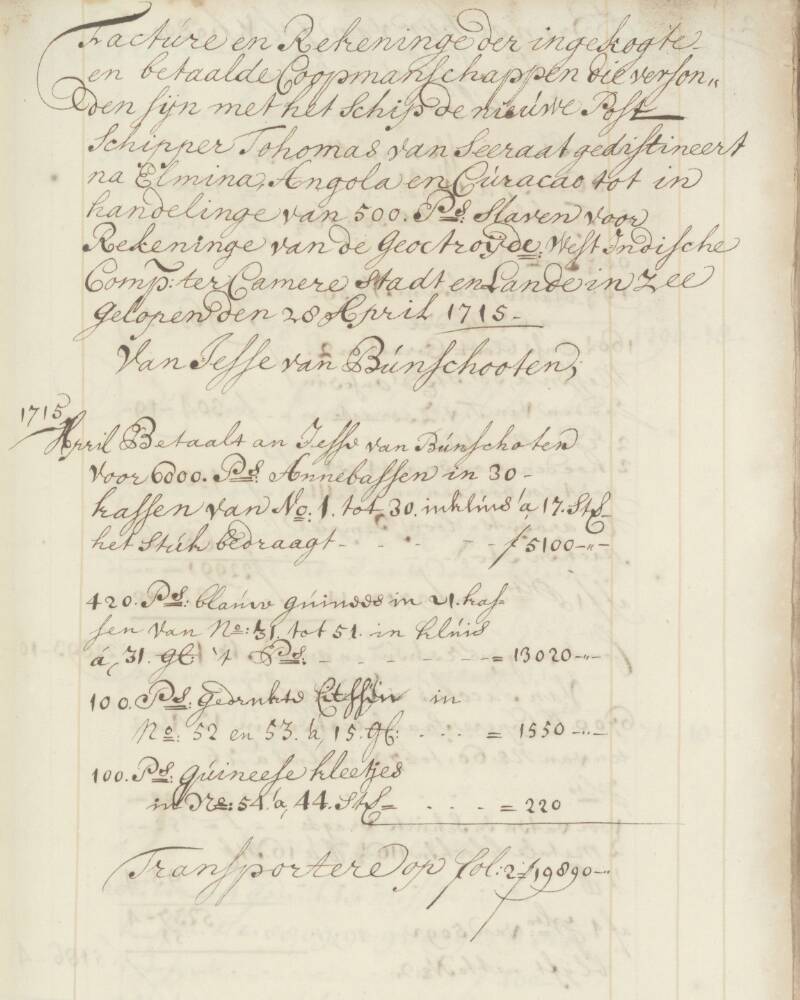
On 28 June 1715 two directors in Groningen signed for both accounts: Cornelis Schaij (1656–1732) and Eilco Tamminga (c. 1655–1721).5 Together they had spent almost ƒ 59,000. By the time they signed, the Nieuwe Post had been at sea for two months. The ship had left Texel on 28 April 1715, under captain Thomas van Seeratt (c. 1676–1736).
The captain and his crew
Thomas van Seeratt was not a Groninger. He came from Sweden; when he registered his marriage in Amsterdam he stated that he came from Stockholm.6 He lived in Amsterdam with his wife Anna Scottaway (baptised in 1689), whose parents were English. When he was at sea, she managed his affairs. He had sailed for the Company for years, and not for one chamber: Amsterdam hired him one time, Groningen the next.7 In April 1708 he lay off Elmina with the yacht (a small, fast sailing ship) Eva Maria, with enslaved people worth 256¾ pieza on board, bound for Curaçao. When he returned in the summer of 1710, a few of his sailors turned out to come “van Greuningen” [from Groningen].8 In 1713 he lost his ship, the Africaanse Galeij, “op de Moorse custe”, the coast of north-west Africa.9 Two years later he was given the Nieuwe Post.
We know only in part who sailed with him. There is no muster roll (the list of crew for the voyage); the archive of the Groningen chamber has been lost, and on the account the boxes for the number of crew and guns were left empty. The provost, who kept order on board, was paid “voor 56. Coppen” [for 56 heads].10 That was probably the whole crew. We know a few names from statements they made later. The first mate was Jacob Jansz Tijl. The second mate was Adam Riefft, the boatswain Simon Robbe. The mates were in charge of navigation and were the highest officers on board after the captain; the boatswain directed the work of the sailors. The chief surgeon, Lubbertus Kloot, supplied some medicines for his chest himself.11 We do not know where the crew came from. So we also do not know whether there were Groningers among them.
There were passengers too. For Elmina there was an ensign (a junior officer), Gerrit Dijkman, and three under-clerks, young officials of the Company. In addition the Amsterdam chamber had put nineteen men on board, with their provisions, for De Faam, a ship that patrolled the coast to intercept smuggling ships.12 Hunting smugglers would also come to matter for Seeratt.

“Plenty of masters”
The Nieuwe Post was sent to Angola. On the way Seeratt was allowed to call briefly at the fort of Axim on the Gold Coast (Fort Saint Anthony, in the west of present-day Ghana) to take on water and firewood; the Groningen chamber had put this in his instructions.13 But Seeratt started earlier. On 25 June 1715 a Portuguese barquentine (a small three-master), the S. Isabella from Brazil, lay off Cape Lahou on the Ivory Coast to buy people. The WIC claimed the trade on this coast for itself, and Seeratt seized the ship. On 7 July he had 32 people taken off it: eight men, eight women, seven boys and nine girls. He also took tobacco and gunpowder, and twelve pieces of Portuguese linen to make a French flag from. A mate and eleven sailors took the ship to Elmina, with the other people who were still on board.14 There 21 were put ashore: one man, eleven women, four boys and five girls. Three of the women were seriously ill and rejected, eight were old, and one of them had an infant with her.15 Seeratt also bought people on the Upper Coast, the western part of the Gold Coast: 14 pieza.16

On 6 July the Nieuwe Post anchored off Axim. The mason and the carpenter of the fort came on board to fit out the ship for the people who were to be locked up in it. They built a separate galley to cook for them, a latrine, and wooden sleeping platforms on which they had to lie in the hold.16 After that, according to his orders, Seeratt should have sailed straight to Angola. He did not. He sailed along the coast to Elmina, where he arrived on 20 July. In Elmina they were not pleased. Director-General Haring, the highest official of the WIC on the African coast, and his council found his permission to trade before reaching Elmina a strange business, “ontleend … vande Engelse” [borrowed … from the English]. They had seen a copy of his instructions through the chief merchant (the head of trade, after the director) William Butler (1686–1731), who later became director-general himself and in 1724 bought Seeratt’s country house Overwater near Hoogezand.17
They told Seeratt how “groflijk” [grossly] his conduct went “tegens de meninge vande Camer Groningen” [against the intention of the Groningen chamber], and that they would inform that chamber and the Heren X. Seeratt was not intimidated. He replied “dat hem heel wijnigh differeerde wie hij diende, en dat hij Meesters genoegh konde bekomen” [that it made very little difference to him whom he served, and that he could get masters enough].18 On 30 July he left, also carrying trade goods of his own, which he meant to sell “volgens zijn appetijt” (as he saw fit) at the forts further along the coast. At the Volta, a river that flows into the sea in the east of present-day Ghana, he came across a second Portuguese ship, the N.S. das Angustias e S. José. It even had a licence from the Company to trade on the coast, which Portuguese ships paid for in Elmina. Seeratt raised the French flag, posed as a Frenchman and took 51 people off the ship. Further east, at Jaquin on the Slave Coast (in present-day Benin), he posed as an interloper: a smuggler who traded outside the Company.18


Seeratt later defended himself before the Heren X. He had taken only half of the people from the first Portuguese ship, and he was blamed for that. With statements from his crew he argued that the others “seer slegt ende de cost niet waerdig waeren” [were very poor and not worth their keep]. The Heren X accepted this. They only decided that in future all people from such ships were to be kept for the Company.19
The capture at Cape Bende
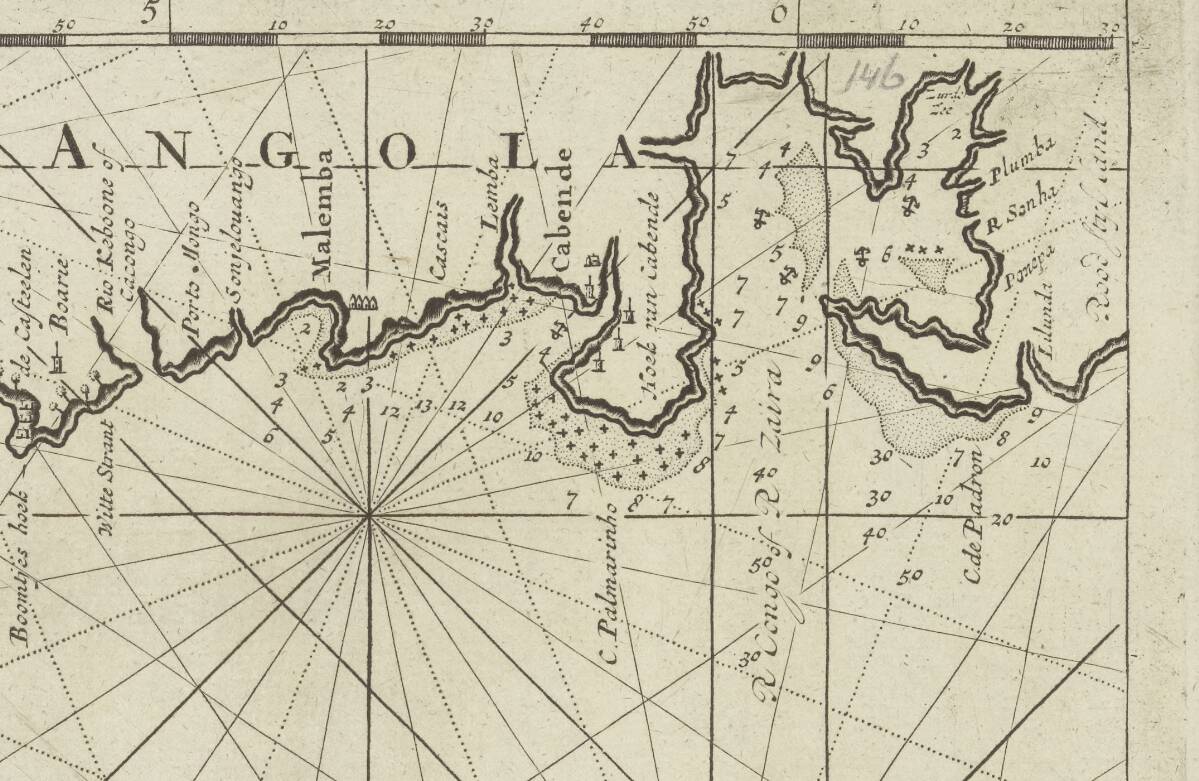
In the autumn of 1715 the Nieuwe Post lay off Loango, on the coast north of the Congo River (in the present-day Republic of the Congo). Seeratt bought people there, but he was not the only one. French and English ships also lay in the roadstead, and further south, at Cape Bende (Cabinda, now a small part of Angola on the north side of the Congo estuary), lay a Zeeland ship: the Vlissings Welvaren of captain Jacob Guepin. It was an interloper. That was the WIC’s name for Dutch ships that traded in Africa without its permission, while the Company held the monopoly there. Under its charter the Company was allowed to seize such a ship.
But Seeratt did not dare to do it alone. The Zeeland ship was heavily built and well armed. So he made an agreement with the French captain of L’Heureux Retour from Le Havre. On 11 November first mate Jacob Tijl, the boatswain and a few sailors from the Nieuwe Post went on board the French ship. They acted on the commission (the written authority) that Seeratt held from the Company. On 22 November they reached Cape Bende. According to Seeratt they were just in time: two days later the Zeeland ship would have left with its captives for St Thomas, the Danish island in the Caribbean where Zeeland smugglers sold their people.20 Tijl claimed the ship in the name of the directors. Guepin had his anchor cables cut to escape, but the French shot down the yard of his foremast, the crossbeam from which the sail hung, and he struck his flag.21
The Zeelanders told it differently later. According to them the French ship at first sailed under the French flag, but as it came closer it raised the Dutch flag, so that it looked like a friendly ship. When the Zeelanders tried to get away, the French ship fired a broadside (a salvo from all the guns on one side). The mate of the Nieuwe Post called out to them not to fire back: then they would keep their goods and their wages.22 In Zeeland they found it outrageous that a Company captain, with the help of foreigners, had robbed his own countrymen.
On 2 December the Vlissings Welvaren joined the Nieuwe Post. Seeratt also wanted to seize Guepin’s journal (the logbook) and trade book and have him make a statement under oath, so that he would not tell the Company any “leugenachtige praetjes” [lying tales].20 He took over the cargo: 312 elephant tusks, 640 pieces of Angolan dyewood, 219 copper kettles, and the 156 people the Zeelanders had already bought. First mate Tijl was given command of the Zeeland ship. He stayed another two months at Loango and between 12 December and 29 January bought another 194 people there for the Groningen chamber.23 The chamber now had two slave ships on the coast.
How Seeratt came by the 559 people on the Nieuwe Post is recorded in a list drawn up on Curaçao. He had bought about 180, on the Upper Coast and at Loango. 156 came from the Vlissings Welvaren. The other 223 he had taken from four Portuguese ships: the S. Isabella and three others.24
Seven months on board
The first people came on board in July 1715, the last in December. The Nieuwe Post did not reach Curaçao until February 1716. For those taken from the S. Isabella at Cape Lahou, that meant more than seven months locked in the hold of a ship that first wandered along the coast for months and then crossed the ocean. How they fared we can read in a list the officers kept: every death, with date and cause, “voor reeken van de Camer van Groeningen” [for the account of the Groningen chamber].25
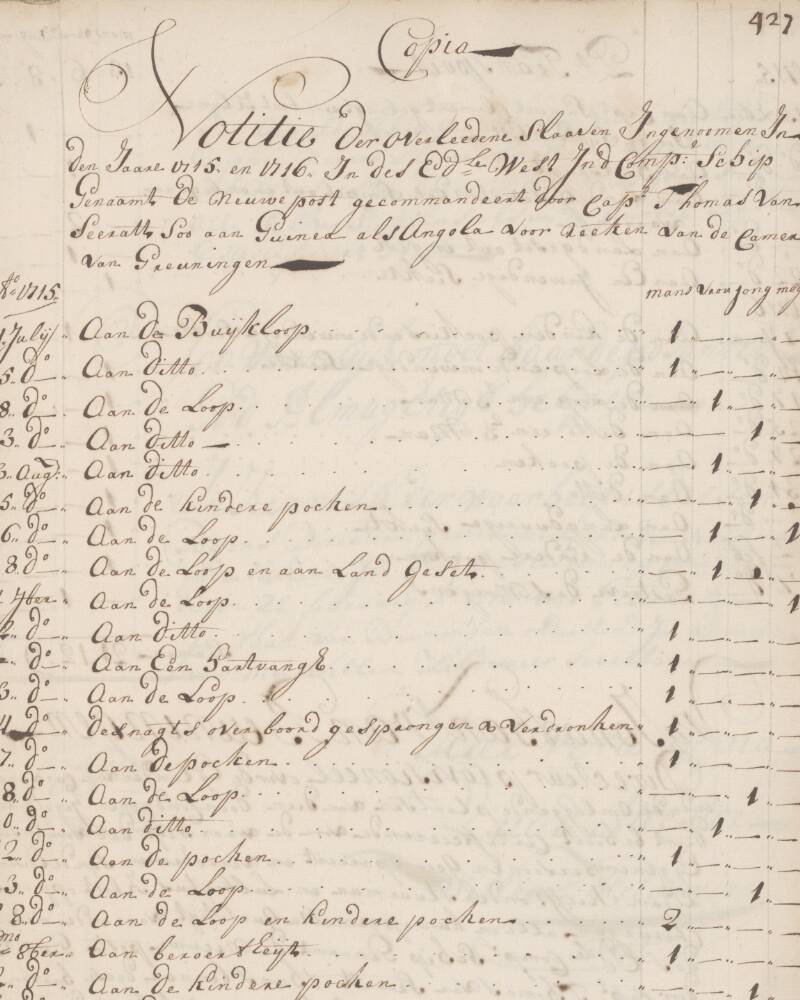
The first death came on 14 July 1715, a week after the people were taken from the S. Isabella. He died of the “buikloop”, dysentery. That disease recurs throughout the list: about twenty people died of it. Then came smallpox, mainly among children. Others died of fever, of a stroke, of gangrene (the death of tissue), or of “een Langduurende siekte” [a long illness]. On the night of 14 September a man jumped overboard and drowned.25


Places and dates
- Texel 28 April 1715
Departure for Elmina, Angola and Curaçao, equipped to buy 500 people. - Cape Lahou 25 June 1715
Seeratt seizes the Portuguese barquentine S. Isabella. - Axim 6 July 1715
The carpenter and the mason fit out the ship to carry enslaved people. - Elmina 20–30 July 1715
Headquarters of the WIC. Twenty-one people from the S. Isabella are brought ashore here. - Mouth of the Volta August 1715
Under a French flag, Seeratt takes 51 people from the Portuguese N.S. das Angustias e S. José. - Jaquin August 1715
Here Seeratt poses as an interloper, a trader outside the Company. - Loango autumn 1715
In the roads of Loango, Seeratt buys 165 people. - Cape Bende (Cabinda) 22 November 1715
With the help of a French ship, first mate Jacob Tijl captures the Zeeland ship Vlissings Welvaren. - Curaçao 9 February – c. 14 March 1716
Arrival at the WIC's island, where the survivors are sold. - Texel 1 June 1716
Back in the Dutch Republic.
Not everyone on the list was dead. In August a sick woman was put ashore. In December, while the ship still lay off Loango, Seeratt left behind a man and a boy who were lame and incurably ill, and then three women, who according to the list were “dol, simpel, out en onbequaam” [mad, simple, old and unfit]. On Curaçao they would fetch little, and on the way they cost food. A “heel kleyne jonge” [very small boy] he handed over to an English captain, Samuel Clement, who had also been present in November at the agreement with the French captain.26
On 22 February 1716 second mate Adam Riefft and chief surgeon Lubbertus Kloot declared under oath on Curaçao that since the purchase “vier a veertigh Coppen” [four and forty heads] had died on board.25 Of the 559 people that was about eight per cent. On Dutch slave ships in those years an average of about fifteen per cent of the people died. On the Leusden, which sailed for the same chamber twenty years later, more than half died.
Letter F
On 9 February 1716 the Nieuwe Post entered the harbour of Curaçao. Two days later three appointed inspectors, the Curaçao burghers Jan Ellis, David Redoch and Bartholomeus Tribier, examined the 513 people who were still alive. They counted as the Company was used to: not in people, but in pieza. A healthy man counted as one, a boy as a half or two thirds. That way they came to 281⅔ pieza for 344 people. The other 169 they entered as sick or manqueron: too old or with a defect.27
Only the sick and the manquerons were auctioned. On 14 February 162 people were sold at public auction, “voetstoots”: “as is”, without any guarantee. Among them was a woman with an infant. Together they fetched 7,135 pesos, an average of less than 45 per person: under half of the 108 pesos the Company asked for a healthy adult. There were dozens of buyers, from merchants to captains. At a second auction, on 19 March, the director of Curaçao, Jonathan van Beuningen, bought two more himself.28

For the 344 healthy people there was no buyer. Van Beuningen had predicted this as early as 1715: there was “bijna geen debiet”, hardly any demand.29 The sick were sold to the highest bidder; for the healthy the Company held on to a fixed price. And the most important buyers, Spanish merchants for the colonies on the mainland, had dropped away: since the Peace of Utrecht in 1713 the English South Sea Company held the asiento, the exclusive right to supply enslaved people to Spanish America. So the Company put them to work on its own plantations, such as Hato, Piscadera and Santa Maria, and sold them in small groups directly to buyers, for 108 pesos per pieza. On 12 September 1716 one Jonathan Sisson bought 34 children in one go, 23 of whom had come on the Nieuwe Post. Van Beuningen also bought a few again. At least ten people died on the plantations. In January 1717, 53 were sent on two small ships to the colony of Berbice. On 19 April 1717, more than a year after their arrival, 131 were still unsold.30
In the Company’s books they had long since lost their names. Each cargo was given a letter, and those who had come on the Nieuwe Post were from then on called “L
F”: letter F, “voor Reek: [rekening] van de Camer Stad & Lande” [for the account of the Stad en Lande chamber].27 The 194 people Tijl brought in on the Vlissings Welvaren on 13 March became letter G. Of them too the sick were auctioned, and in April 1717, 96 were left.30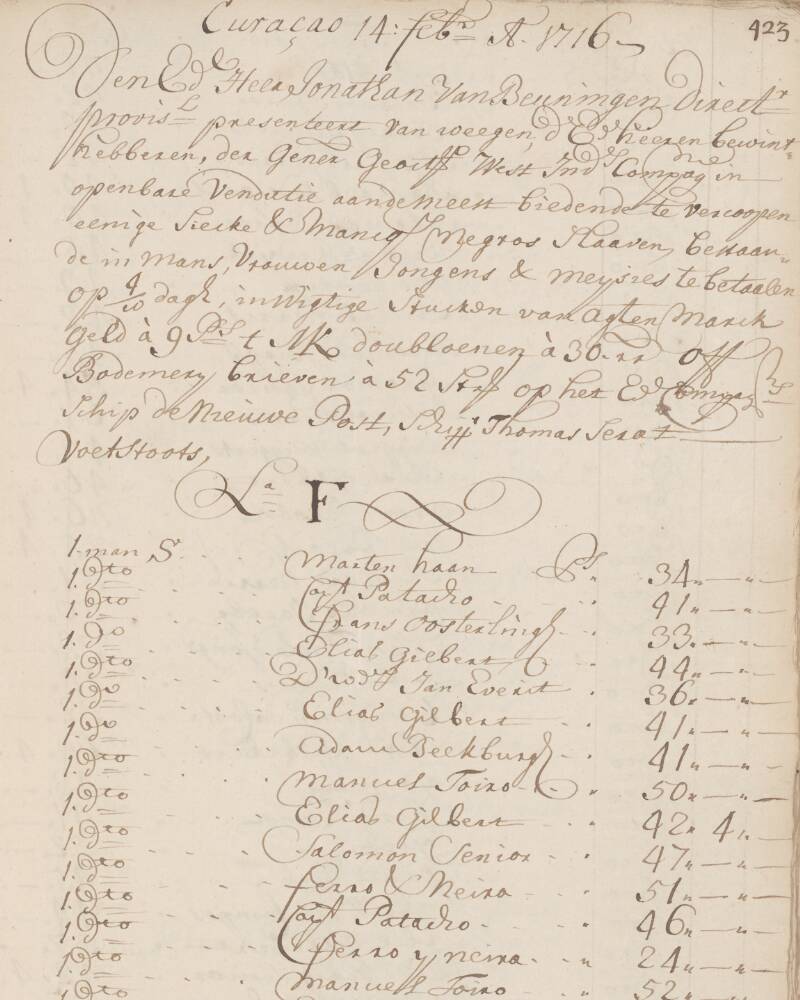
Seeratt had also brought something for himself: three boys, whom he meant to sell on his own account. That was against his instructions, and the council of Curaçao confiscated them. One of the three died. The director and the fiscal (the Company’s prosecutor, who also collected fines and confiscated goods) divided the proceeds of the other two between them.31
Seeratt also took a passenger back. Gerhard de Mepsche (1683–1733), a Groninger, was captain-lieutenant of the militia on Curaçao. In August 1715 he had five members of the Jewish community locked up without cause. Then he forced a Jewish soldier, who had permission to keep the Sabbath, to report for duty on the Sabbath of all days, and demanded 200 pesos for his discharge. When the community settled this through the director, he took revenge on the whole community, according to its complaint. Other burghers also complained that he beat and insulted them. On 10 March 1716 the council declared him “inhabiel”, unfit for his office, and dismissed him. He had to go home on the Nieuwe Post.32 On 14 March Seeratt signed his bill of lading: dyewood, salt and lime juice for the Stad en Lande chamber.33 He left soon afterwards. De Mepsche did not stay home for long: the directors sent him back as early as 1717, to Sint Eustatius.32
The reckoning
On 1 June 1716 Seeratt was back at Texel.34 In the Netherlands a conflict awaited him. The owners and insurers of the Vlissings Welvaren had complained to the States of Zeeland. That a Company captain, with a foreign ship and under a French flag, had attacked and robbed a countryman, they called “een Vuijl ongehoord Stuck” [a foul and unheard-of act]. The States of Zeeland agreed with them and ordered the Zeeland directors of the WIC to compensate them within six weeks. The Company defended itself before the States General with its charter (the monopoly the States General had granted it): anyone who sailed on the coast without its permission forfeited ship and cargo. In June the crews of both ships made their conflicting statements before Amsterdam notaries.35 In 1718 the case had still not been decided. I have not yet found out how it ended. Meanwhile the Zeeland ship simply sailed for the Company, as the Compagnie’s Welvaren.36
Seeratt too had to account for himself, for the people he had left behind in the S. Isabella. The Heren X cleared him in October 1716.19 He himself asked for a reward, a “douceur”, for the captured ship and for the “omtrend twee hondert slaeven” [some two hundred slaves] from the Portuguese ships. The Heren X postponed the decision, and then again, in 1717 and in 1718, when first mate Tijl and the Groningen delegate also asked for a reward. Whether Seeratt ever received anything, I do not know.37
He no longer needed it anyway. In the autumn of 1716 he became commies-provinciaal in Groningen, the official in charge of the province’s dykes, bridges and sluices. He kept a journal of his work. On 24 December 1717 he was at Reide on the Ems, where the water stood strangely low. He saw the sky grow “hoe langer hoe swaarder” [heavier and heavier], “gelijck in de West-Indies als daar Orkanen komen” [as in the West Indies when hurricanes come], and hurried back to Groningen. The next day, Christmas Day, the sea water stood up to the city ramparts.38 After the Christmas Flood of 1717 he led the repair of the dykes, and in 1721 he became rentmeester (steward of the province’s revenues and property). He bought the peat-colony manor Overwater near Hoogezand, which he sold on to William Butler in 1724, and lived until his death in 1736 in the Calmershuis in the Oude Boteringestraat, one of the largest (and oldest) private houses in the city of Groningen.


In Groningen he was remembered as the man of the dykes. From 1925 there was a water board named Thomas van Seeratt, for the polders behind the dyke he had repaired after the Christmas Flood, and a brewery in Zoutkamp brews a blond beer bearing his name. In 2012 the province named a new work vessel after him. In 2021 GroenLinks asked for a different name, because “bloed en mensenrechtenschending” [blood and human rights abuse] clung to it. The Provincial Council agreed: the name would change when the ship was replaced. But the replacement was slow in coming, and two years later the ship still sailed as the Thomas van Seeratt. Only after new questions, from history students and from GroenLinks and Volt, was it given another name in October 2023: PW17.39
Notes
-
Nationaal Archief, Tweede WIC 1.05.01.02 inv. 838 (minutes of the Heren X), scan 167, c. 8 October 1714: the “8e Tourbeurt voor de Camer van stad en Landen … na Angola en Curacao in zee te brengen primo April 1715”.↩
-
The account has an item for “’t schrijven van de Cherte partij vant schip” [writing the charter party of the ship] (inv. 1296, scan 214); on Curaçao the Nieuwe Post was called “een gehuert schip” [a hired ship] (inv. 1297, scans 80 and 83).↩
-
Nationaal Archief, 1.05.01.02 inv. 1296, scans 209–217: “Rekeninge van den incoop en betalinge der Natte en droge Vivres” for the Nieuwe Post, total ƒ 25.919-7, https://www.nationaalarchief.nl/onderzoeken/archief/1.05.01.02/invnr/1296/file/NL-HaNA_1.05.01.02_1296_0210. Nanninga: “6. ton Swaar en 46. ton kleinbier comt met het drogen van 90. Mudden, boonen en arften” (scan 211); see also P.J. van Winter, De Westindische Compagnie ter kamer Stad en Lande (1978), p. 232. Heavy beer was strong beer, brewed with a lot of malt; it contained more alcohol and kept longer. Small beer was thin and light, the ordinary everyday thirst-quencher, on board as well. Because it spoiled more quickly, on a long voyage it was mostly drunk at the start. ↩ ↩2↩3
-
Inv. 1296, scan 216, May 1715: “betaalt an Berent Mulder Smidt voort maken van de brantijsere de A
1712. en 1715.”, ƒ 21, https://www.nationaalarchief.nl/onderzoeken/archief/1.05.01.02/invnr/1296/file/NL-HaNA_1.05.01.02_1296_0216. The kettle is on the same account (scans 212–217). Whether “de A 1712. en 1715.” means that the irons of 1712 were reused (probably made for the St. Clara) or that these were two irons bearing a year is not clear.↩ -
Inv. 1296, scans 200–203: “Facture en Rekeninge der ingekogte en betaalde Coopmanschappen die versonden sijn met het schip de nieuwe Post Schipper Thomas van Seeraat gedistineert na Elmina, Angola en Curacao tot inhandelinge van 500. P
Slaven”, ƒ 33.047-4, signed Groningen 28 June 1715, https://www.nationaalarchief.nl/onderzoeken/archief/1.05.01.02/invnr/1296/file/NL-HaNA_1.05.01.02_1296_0200. A pieza (P, pieza de India) was a unit of account: a healthy adult counted as one pieza, children, old people and the sick as a fraction of one. ↩↩2 -
Stadsarchief Amsterdam, DTB, marriage registration of Thomas van Seeratt and Anna Scottaway: “van Stokholm, oud 32”. Baptism of Anna, daughter of John and Mary Scottaway, English Presbyterian Church Amsterdam, 21 September 1689, Stadsarchief Amsterdam, DTB (5001) inv. 137, https://www.openarchieven.nl/saa:c409d46a-0603-45c4-9a45-93d237cede9d. Bootsma et al. take the baptism of an earlier Anna of the same parents, on 14 January 1682 (same inventory). That the parents had another daughter Anna baptised in 1689 suggests that the first had died young; we therefore assume 1689.↩
-
Van Winter, De Westindische Compagnie ter kamer Stad en Lande, p. 196 n. 36.↩
-
Nationaal Archief, 1.05.01.02 inv. 485, fo 50 and 52v, Elmina 22 and 26 April 1708; Stadsarchief Amsterdam, notarial archive (5075) inv. 6790, deeds 626 and 705 (5 and 18 December 1710, notary Pieter van der Meulen). See F. Bootsma, B. van der Heide and W. Tannemaat, “Thomas van Seeratt: zijn levensloop uitgediept”, Stad en Lande (2024). The source gives “256 slaaven ¾”: the Company counted in pieza, in which a healthy adult counted as one and children, old people and the sick as a fraction. So there were more than 256 people on board. Bootsma et al. read the ¾ as “three quarters of the cargo”.↩
-
Nationaal Archief, 1.05.01.02 inv. 368, resolutions 1713, fo 290v: request by Seeratt for the return of “pampieren en bescheijden” [papers and documents], lost when the ship was wrecked; Bootsma et al., “Thomas van Seeratt”.↩
-
Inv. 1296, scan 215: “Ian Suel provoost voor 56. Coppen a 6. st.” The provost was in charge of discipline on board: he held prisoners and carried out punishments.↩
-
Tijl: inv. 1296, scan 212 (“Jacob Jansen Tijl voor water”); inv. 485, scan 522 (statement of the ship’s council, 7 July 1715, with Riefft); States General 1.01.02 inv. 5775, scan 44 (Robbe). Kloot: inv. 1296, scan 215. The chief surgeon was the ship’s doctor; he also had to examine the captives before the captain bought them.↩
-
Nationaal Archief, 1.05.01.02 inv. 919, scan 555 (letter from Elmina, 11 November 1715); inv. 485, scan 516; inv. 1296, scans 198–200 (provisions for De Faam). On the WIC’s cruisers, which were ordered to bring in interlopers: R. Negrón, “Dubbelspel: Zeeuwse lorrendraaiers en hun banden met de WIC”, Tijdschrift voor Zeegeschiedenis 40
(2021), p. 60.↩ -
Letter from Elmina to the Amsterdam chamber, 11 November 1715: “dien schipper door de heeren ter Camere groningen gelicentieert is geweest om tot Axim zijn waater & brandhout in te neemen”, Nationaal Archief, 1.05.01.02 inv. 485, scans 515–516 (fo 495).↩
-
Statement of the ship’s council of the Nieuwe Post, 25 June and 7 July 1715, signed by Thomas van Zeerad, Jacob Jansz Tijl, Adam Rievt and three others, inv. 485, scan 522 (fo 501), https://www.nationaalarchief.nl/onderzoeken/archief/1.05.01.02/invnr/485/file/NL-HaNA_1.05.01.02_485_0522. A barquentine was a small sailing ship with three masts. The division list on Curaçao also counts 32 people from the S. Isabella: 15 men and 17 women (inv. 572, scan 425); the breakdown into men, women and children differs.↩
-
“Factura der Slaaven &a dewelke gelost zijn uijt de Portugees S: Isabelle Capt Juan peris d’Lima”, Elmina 20 July 1715, inv. 485, scan 521 (fo 500). On the women: “3 geheel siek en macron en 8 oud waar bij 1 suijgelingh”.↩
-
Letter from Director-General H. Haring and council to the Heren X, Elmina 11 November 1715 (copy), Nationaal Archief, 1.05.01.02 inv. 919, scan 558, https://www.nationaalarchief.nl/onderzoeken/archief/1.05.01.02/invnr/919/file/NL-HaNA_1.05.01.02_919_0558. In the letter: “de slaven Combuijs, secreet, beddings”. ↩↩2
-
Inv. 919, scans 555 and 557. That the chief merchant is William Butler, the later director-general (1718–1722), is almost certain: he had worked in Elmina since 1705.↩
-
Inv. 919, scan 559, https://www.nationaalarchief.nl/onderzoeken/archief/1.05.01.02/invnr/919/file/NL-HaNA_1.05.01.02_919_0559. On Jaquin: he arrived there “onder de naam van een Lorrendraaier” [under the name of an interloper]. Van Winter (p. 187 n. 8) summarises the letter as trade “volgens zijn zeggen op last van de heren in Groningen” [by his own account on the orders of the gentlemen in Groningen]; that is not what it says. ↩↩2
-
Resolution of the Heren X, 17 October 1716, Nationaal Archief, 1.05.01.02 inv. 838, scan 275 (fo 269v–270), and inv. 4, scan 208 (fo 173). ↩↩2
-
Letter from Thomas van Seeratt to the WIC, 1716, Nationaal Archief, 1.05.01.02 inv. 827, scans 105–106, quoted in R. Negrón, “Dubbelspel: Zeeuwse lorrendraaiers en hun banden met de WIC”, Tijdschrift voor Zeegeschiedenis 40
(2021), p. 56–57. Seeratt writes “St. Thomas”. An interloper could not sell his people in a WIC colony; Danish St Thomas was the obvious choice. Portuguese São Tomé in the Gulf of Guinea, where ships did take on water and provisions, was not a market for selling people. ↩↩2 -
Notarial statement of Jacob Tijl, “gewesen opper stuerman op hett Schipp de Nieuwe Post”, boatswain Simon Robbe and three sailors, notary J. van Geuns, Amsterdam, 11 June 1716, Nationaal Archief, States General 1.01.02 inv. 5775, scans 44–45, https://www.nationaalarchief.nl/onderzoeken/archief/1.01.02/invnr/5775/file/NL-HaNA_1.01.02_5775_0044; report of the directors to the States General, 25 July 1716, ibid. scans 11–16. The fokkenra is the horizontal spar on the foremast from which the foresail hangs.↩
-
Statement of the crew of the Vlissings Welvaren, notary L. Noblet, Amsterdam, 13 June 1716 (the day cannot be read with certainty), inv. 5775, scans 46–47. A letter from Curaçao of 13 February 1716 even says that “een fransschip” [a French ship] had captured the Zeeland ship (Nationaal Archief, 1.05.01.02 inv. 572, scan 405).↩
-
Claim of the fiscal on Curaçao, 6 March 1716, inv. 5775, scans 17–18; “Notitie van slaven die aen Loango Bowary int schip Vlissings Welvaren syn gecoomen”, 12 December 1715 – 29 January 1716, and the arrival list of 13 March 1716, Nationaal Archief, 1.05.01.02 inv. 572, scans 490–491 and 503.↩
-
Division list of the Nieuwe Post, Curaçao, February 1716, inv. 572, scan 425, https://www.nationaalarchief.nl/onderzoeken/archief/1.05.01.02/invnr/572/file/NL-HaNA_1.05.01.02_572_0425. The other ships are the N.S. de Piedade, the N.S. da Conceição e S. António and the N.S. das Brotas. The ship Seeratt robbed at the Volta (section 3) does not appear under that name.↩
-
“Copia. Notitie der overleedene slaaven ingenoomen in den Jaare 1715 en 1716 in des Ed
West Ind: Comp schip genaamt de Nieuwe post gecommandeert door Cap Thomas van Seeratt soo aan Guinea als Angola voor reeken van de Camer van Groeningen”, with the sworn statement of Adam Riefft and Lubbertus Kloot, Fort Amsterdam (Curaçao) 22 February 1716, Nationaal Archief, 1.05.01.02 inv. 572, scans 430–431 (fo 427–428), https://www.nationaalarchief.nl/onderzoeken/archief/1.05.01.02/invnr/572/file/NL-HaNA_1.05.01.02_572_0430. The average is my own calculation from Slave Voyages (Trans-Atlantic Slave Trade Database, 2019): 360 Dutch voyages arriving between 1700 and 1740, average mortality 15%; on 8 of them more than half died, including both voyages of the Leusden. ↩ ↩2↩3 -
Inv. 572, scans 430–431. Johannes Postma, The Dutch in the Atlantic Slave Trade 1600–1815 (Cambridge 1990), p. 242, mentions the five people Seeratt considered “worthless”. According to the claim of the fiscal on Curaçao (6 March 1716), an English captain Clements was also present at the agreement about the capture (States General 1.01.02 inv. 5775, scans 17–18); probably the same man.↩
-
Division list and inspection by Jan Ellis, David Redoch and Bartholomeus Tribier, Curaçao 9 and 11 February 1716, inv. 572, scan 425. Ellis and Tribier were also officers of the civic guard (inv. 572, scans 476–477); Ellis himself also bought people at the auction of 14 February. The list reads “Siek & mang
”; in this hand g and q look the same, so it can also be read as “manq”. The auction list has “Siecke & Manq” (scan 426), and in the margin of the letter of 13 February another hand wrote “maq:” and “macq:” (scan 405). Manqueron (also macron): an enslaved person who did not count as a full pieza at the inspection because of illness, age or a defect. The word probably derives from French manquer, to lack. At Elmina the clerk wrote it out: “macron” (note 15). Van Winter, De Westindische Compagnie ter kamer Stad en Lande, p. 185; H.R. Jordaan, Slavernij en vrijheid op Curaçao (PhD thesis Leiden 2012), p. xii, https://hdl.handle.net/1887/19083. ↩↩2 -
Auction list 14 February 1716, signed by auctioneer W. Kerckrinck, inv. 572, scans 426–428; sale of 19 March 1716, inv. 572, scan 505.↩
-
Letter from Director Jonathan van Beuningen, 1715, inv. 572, scan 204; arrival letter 13 February 1716, scans 404–405; letter 14 March 1716, scan 410.↩
-
Private sales: inv. 572, scans 490, 659, 753–754, 780–781; inv. 573, scans 49–51; deaths on the plantations: inv. 572, scans 661 and 781; shipment to Berbice with the barques Sonnestijn and Juffrouw Sara: inv. 573, scan 50; remainder on 19 April 1717: inv. 573, scan 95. Vlissings Welvaren: inv. 572, scans 503–505. ↩↩2
-
Inv. 572, scan 412: Seeratt had “voor syn reeck: mede gebragt 3 neger jongens”, which was “strydende tegens d’instructie van de ed: Comp:”; cash book 25 May 1716, scan 648.↩
-
Resolution of the council of Curaçao, 10 March 1716, inv. 572, scans 482–483; complaint of the parnassim and church council of the Jewish community to Director Van Beuningen, scans 460–462 (“tegens de gehele Natie te revangeeren” [to take revenge on the whole Nation]); complaints against De Mepsche, scans 460–481; inv. 573, scans 40 and 147; Van Winter, De Westindische Compagnie ter kamer Stad en Lande, p. 241. ↩↩2
-
Bill of lading of Thomas van Seeratt, Curaçao 14 March 1716, inv. 572, scan 440; cargo: scans 434–435.↩
-
Bootsma, Van der Heide and Tannemaat, “Thomas van Seeratt”; Slave Voyages, voyage 10231.↩
-
Petition of the “Geinteresseerdens soo asseuradeurs als Reeders en eigenaers” and resolution of the States of Zeeland, 28 May 1716; report of the directors to the States General, 25 July 1716; statements 10 and 11 June 1716: Nationaal Archief, States General 1.01.02 inv. 5775, scans 11–19 and 42–53.↩
-
Van Winter, De Westindische Compagnie ter kamer Stad en Lande, p. 188; resolutions of the Heren X, 25 November 1717 and 29 October 1718, Nationaal Archief, 1.05.01.02 inv. 4, scans 289 and 379–380.↩
-
Resolutions of the Heren X, 16 October 1716, 25 November 1717 and 29 October 1718, Nationaal Archief, 1.05.01.02 inv. 838, scans 263, 347 and 412; inv. 4, scans 289 and 379–380.↩
-
Thomas van Seeratt, “Journaal” on his work as commies-provinciaal 1716–1721, Groninger Archieven, toegang 1 (Staten van Stad en Lande) inv. 818, p. 20 (scan 0001_0818_0023–0024); transcription Het journaal van Thomas van Seeratt (Groninger Archieven, Maak Geschiedenis: Kerstvloed 1717).↩
-
Robert Pastoor, “Provincie past naam van schip aan vanwege slavernijverleden”, RTV Noord, 18 October 2023; “Andere naam voor provinciaal werkschip Thomas van Seeratt”, provinciegroningen.groenlinks.nl, 17 September 2021; “Thomas van Seeratt (waterschap)”, nl.wikipedia.org; “Thomas van Seeratt”, Solt/Soltmen (Zoutkamp) with Baxbier, untappd.com/b/solt-thomas-van-seeratt/2131708; Bootsma, Van der Heide and Tannemaat, “Thomas van Seeratt”.↩