
On 21 October 1750 the notary Albertus Domburg came to the house of Gustaaf Willem van Imhoff (1705–1750), a baron from East Frisia who had been governor-general of the VOC since 1743. Van Imhoff handed the notary a packet with four seals and an open sheet of paper: his will, which he had written in his own hand a year and a half earlier, and the additions he had made to it since.1 Eleven days later he was dead, at the age of 45.
The second article of that will concerns Helena Pieters (†1759), the mother of his children. He left her jewellery, gold and silver, money, a house in the city and a number of enslaved people, whom he would put on a separate list. He also confirmed her freedom, “in zoo verre dat nodig mogte weesen” [in so far as that might be necessary]. Where she came from is mentioned in a subordinate clause: the queen of Bone had given her to him as a present in 1743.2 Helena Pieters is the baptismal name she was given in Batavia.
A gift from Bone
Bone (in VOC sources Boni) was a kingdom of the Bugis in the south-west of Sulawesi, the island the VOC called Celebes. Since the war against Makassar in the 1660s Bone had been an ally of the Company. In 1743 it was ruled by an old woman; the High Government in Batavia called her “de oude vorstinne” [the old queen].3 That she sent the new governor-general a woman fits the way the trade in people worked on Sulawesi: enslaved people were sold there, but rulers also gave them away, to each other and to the Company. In December 1744 the High Government gave the rulers of Celebes permission to bring 25 enslaved people to Batavia free of duty.4
Van Imhoff could not simply keep the gift. Under the rules of the VOC, gifts from local rulers belonged to the Company, not to the servant who received them. So he paid the VOC for Helena.5 On paper, that made her his property.
Van Imhoff was a widower at the time. His wife Catharina Magdalena Huysman (1709–1744), whom he had married in Batavia in 1727, died in July 1744. Of their children, probably none was still alive in the 1740s.6 With Helena Pieters he had four more. Jan Willem was born on 3 April 1747, Isabella Anthonia on 8 May 1748 and Wilhelmina Sophia in 1749. When Van Imhoff died, Helena was pregnant again: Gustaaf Hendrik was baptised in March 1751.7 Helena and Van Imhoff never married. In his will he acknowledged the children as his own and asked the stadholder to legitimise them.8 Helena herself was allowed to remarry after his death, but only a Protestant with at least the rank of junior merchant, the will stated. Otherwise she would lose part of her inheritance.9
Sixty people

In the additions Van Imhoff became more and more generous towards Helena. In the last codicil, of 21 October 1750, she received 10,000 rixdollars, the house in the Nieuwpoortstraat in Batavia, the garden at Mangadoa outside the city, and “nog 60 slaven oud en jong groot en kleijn zuijgelingen niet te tellen” [another 60 enslaved people, old and young, big and small, infants not counted].10 The woman who had arrived as a gift seven years earlier thus became the owner of at least sixty people, babies not included.
For the people he himself held in slavery, his death changed little. “Dat van mijne slaven niemand vrij zal weesen” [that none of my enslaved people shall be free], he wrote in the same codicil, with two exceptions: Tsjindra, a woman from Mandar on Sulawesi, would be free on his death, and Poetie after three years.11 The others were divided up. Helena received the sixty. Each child received five, among them their own aja, the nursemaid.12
What position Helena had in Batavia appears from a letter by a Groninger. Willem Fockens (1727–1779) worked as a clerk at the secretariat of the High Government. In September 1751 he explained to a relative in Groningen why his father Nathan (1695–1780) had not been given a post in Batavia. According to him, Van Imhoff let himself be guided too much by “zijner swarte concubine, voormaals slavinne van den selven” [his Black concubine, formerly enslaved by him]; whoever won her favour and showered her with gifts was helped.13 It is the judgement of a disappointed family, but it shows that Helena had influence in the governor-general’s household.
Wilhelmina Sophia died on 24 October 1750, thirteen months old, three days after the notary’s visit. Van Imhoff died on 1 November in his garden house on the Jacatraweg; Gustaaf Hendrik died in January 1752, not yet a year old.14 Helena Pieters later married Jan Andries Duurkoop (1722–1792), a lieutenant of the bodyguard. They had two children. On 3 September 1759 she died in her house in the Nieuwpoortstraat, the house Van Imhoff had left her. She was buried in the Hollandse Kerkhof. In Batavia she was known as “juffrouw Leentje” [Miss Leentje]. Under that name Jacob Fockens (1736–1777) reported her death to his parents in Groningen more than a year later, in November 1760.15 Her heirs were her husband, the two Duurkoop children and the two Van Imhoff children.16 Jan Willem, then twelve, had been living in the Dutch Republic for years, and Isabella Anthonia had probably followed him. There relatives kept an eye on them: their father had appointed, among others, his sister in Oudeschans and Jacob Boreel Janszoon, a cousin of their father and advocate-fiscal (public prosecutor) of the Amsterdam Admiralty, as supervising guardians.
The governor-general
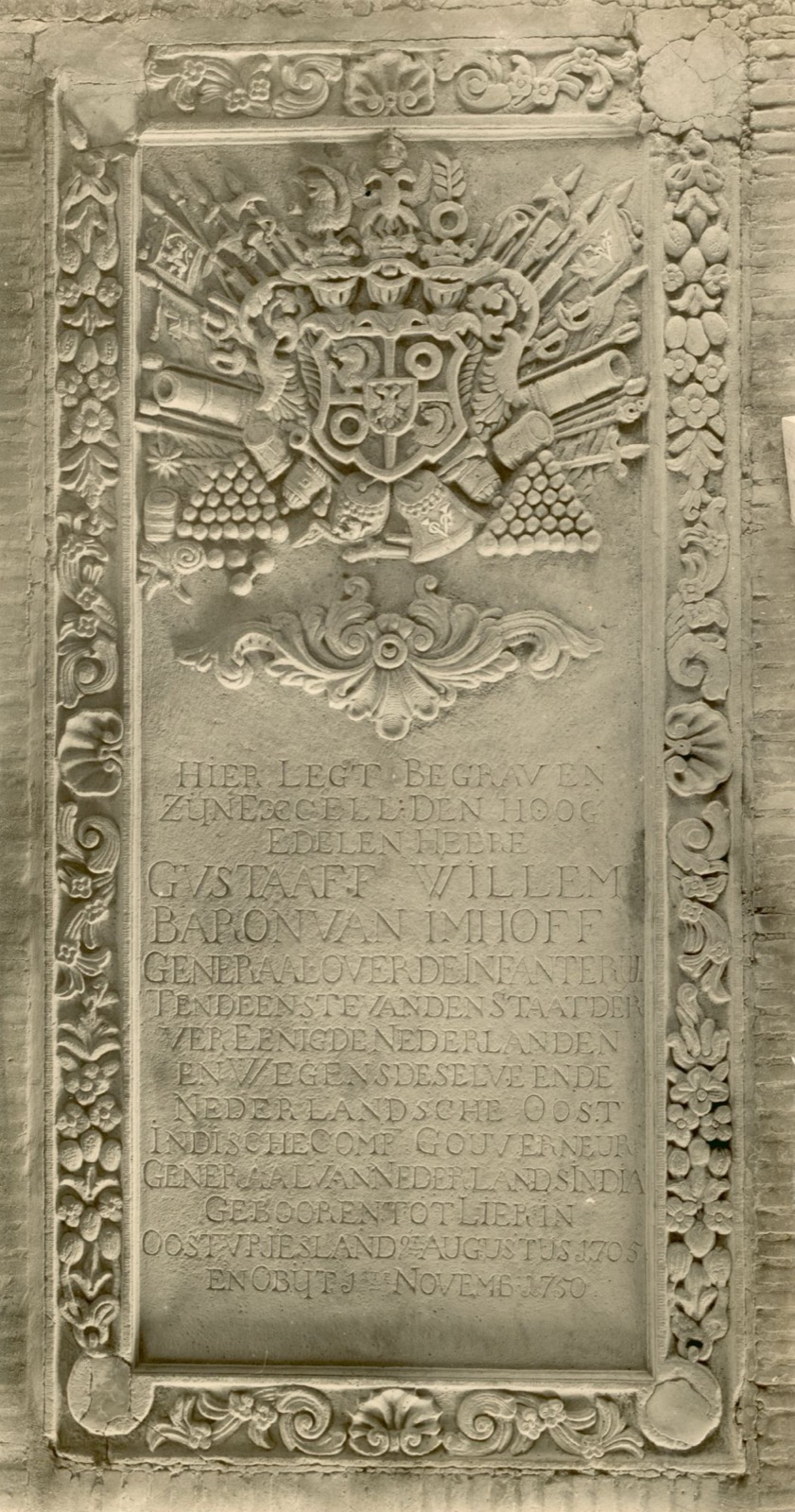
Van Imhoff was born in August 1705 in Leer in East Frisia, less than twenty kilometres from the Groningen border. The family came from the patriciate of Nuremberg. His father, Willem Hendrik van Imhoff (1663–1725), came to East Frisia in the early 1690s in the retinue of Princess Eberhardine Sophie, a southern German princess from Oettingen who had married the prince of East Frisia; in 1697 he was made a baron by the emperor, and he was privy councillor to the prince and bailiff (drost) of Leer. His mother, Isabella Sophia Boreel (1667–1728), was a daughter of the Amsterdam burgomaster Jacob Boreel (1630–1697); he learned Dutch from her. The family had ten children. Through his mother’s family Gustaaf Willem and several of his brothers ended up with the VOC.17 In January 1725, aged nineteen, he left for Batavia on the Cockengen as a junior merchant. There he rose quickly: within seven years he went from junior merchant to extraordinary member of the Council of the Indies, the government of the VOC in Asia.18 In 1736 the High Government sent him as governor to Ceylon, where a rebellion had broken out. He stayed there until 1740, travelled around the island and on his departure wrote a long memoir for his successor.19

Back in Batavia he clashed with Governor-General Adriaan Valckenier (1695–1751). The quarrel was about the Chinese in and around the city. In July 1740 Van Imhoff persuaded the Council of the Indies to arrest all “suspecte” [suspect] Chinese, even if they had a residence permit; Valckenier was against it. The rumour that those arrested were being drowned at sea drove the Chinese outside the city to revolt. At the beginning of October Van Imhoff wanted only suspect houses to be searched and the other Chinese to be left alone. Valckenier thought that all Chinese should be treated as enemies and that the city had to be purged “van binnen” [from within]. On 9 and 10 October soldiers, citizens and enslaved people murdered thousands of Chinese inside the walls; the prisoners were killed on Valckenier’s orders. Van Imhoff did not intervene. A week later he submitted a statement that he had no part in the massacre and left the responsibility to those who had given the orders. In the weeks that followed the two clashed over the command of the troops. On 6 December 1740 Valckenier had Van Imhoff and two other councillors arrested for “despotiek gedrag” [despotic conduct] and in January put them on a ship to the Dutch Republic. Four days earlier the Gentlemen Seventeen had already appointed him as Valckenier’s successor. In September 1741 Van Imhoff arrived in the Republic, where the directors received him with honour. He wrote a detailed plan for them to reform the Company, had his portrait painted by Jan Maurits Quinkhard (1688–1772) and on 27 October 1742 left as governor-general on a ship that had been named the Hersteller [Restorer] specially. On 26 May 1743 he was in Batavia.20

As governor-general Van Imhoff founded a new hospital, a Latin school, a seminary for ministers, an academy for naval officers, a post office and a pawn bank. He had the first newspaper of Batavia published and a country estate laid out on the cooler plateau south of the city, which he called Buitenzorg. Buitenzorg lasted: his successor Mossel bought it from Van Imhoff’s estate, it became the country residence of the governors-general and is now the presidential palace in Bogor. Most of the other institutions did not last long; in Batavia mockers renamed his ship the Versteller [Patcher], because in their view it was all patchwork and his measures solved nothing of substance. His actions on Java contributed to a new war over the throne of Mataram, which did not end until 1755, and to a revolt in Bantam.21 In 1751 there was a rumour in Batavia that he had received 80,000 Spanish reals from the queen regent of Bantam for his support in the succession to the throne.22

His best-known achievement was the founding of the Amfioensociëteit (Opium Society). The VOC bought opium (amfioen) in Bengal and sold it in Batavia, but much of the trade bypassed the Company, through smuggling by its own servants. In 1745 Van Imhoff placed the trade with a society of 300 shares, which went to the Company’s servants in Batavia. According to him the VOC would earn “een millioen gulden sjaars” [a million guilders a year] from it, and the shares were sold in two days.23 Money, incidentally, he already had: as governor of Ceylon he transferred 878,160 guilders to the Republic in 1737.24

“Een troep slaven”
Batavia was a city of enslaved people, and under Van Imhoff it stayed that way. The Company needed people. In March 1744 the High Government decided not to enforce, for the time being, a ban on bringing in enslaved people from Celebes, because of “een ongemeen gebrek aan volk en vooral aan werklieden” [an unusual shortage of people and above all of workmen].25 The Generale Missiven of 1748 report that the slave trade of Makassar had gone well: Batavia had received 152 enslaved people from there.26 Van Imhoff’s own institutions also ran on their labour. The rector of his Latin school always had to have twelve enslaved men available for the school’s household, “goede en daartoe capable” [good and capable of it].27

On 19 August 1749 the High Government, with Van Imhoff at its head, decided that from then on it would pay 60 rixdollars for the enslaved people its members picked out for themselves from each “troep slaven” [batch of enslaved people] brought in. Until then it had been 50. According to the decision, the governors-general had had this right of first choice “sedert immemoriale tyden” [since time immemorial]. The Company itself paid on average 70 to 80 rixdollars per person.28 It seems likely that some of the sixty people Helena Pieters inherited came into his household this way.
“Uijt hoofde dat in Holland is geweest”
After his death his children were to go to the Dutch Republic “ten eersten” [at the first opportunity], to be brought up in The Hague. They were each to take two enslaved servants with them, as well as the two ajas, Malatie and Pangia. In the Republic, among others his sister Mrs Van Manneel (?–1779), Jacob Boreel Janszoon, and his brother-in-law, Captain-Lieutenant Hervé de Vaillant (1696–1776), would supervise them.29
None of his enslaved servants would go free on his death, he wrote in the same codicil of July 1750, except “die het selfs pretendeeren kunnen, om dat zij in holland geweest zijn” [those who can claim it themselves, because they have been in Holland]. Of Malatie he wrote that she was “reeds vrij” [already free], “uijt hoofde dat in holland is geweest” [on account of having been in Holland].30 So in this July codicil Van Imhoff himself freed no one. He merely assumed that anyone who had been in the Republic was free in their own right, and that as owner he no longer had any say in the matter.
He was right about that. From 1714 the VOC’s rule was that enslaved people who had been in the Dutch Republic remained free on their return to Asia.31 Van Imhoff himself was in the Republic from September 1741 to October 1742. Malatie probably travelled with him then.
Jan Willem had already left on the Hersteller a few days before his father’s death. Isabella Anthonia was to follow.32 The legitimation Van Imhoff had asked for came on 7 June 1757, by letters of the States General.33
The sister in Oudeschans
The will also includes a farm near Bellingwolde. Van Imhoff left his eldest sister, Christina Sophia, “de bouwplaats bij Bellingwolde en het daarbij gekochte land” [the farm near Bellingwolde and the land bought with it], which she already managed for him. She received the usufruct for as long as she lived, after which it went to his heirs. She also received an annual pension, to be paid by the orphan masters in Batavia.34
Christina Sophia had been living close to that farm for more than twenty years. On 12 September 1728 she became a member of the church in Oudeschans, with a certificate of membership from Leer. The church register calls her the “huijsvr. van den Heer Commandeur Maneel” [wife of the Lord Commander Maneel].35 That was Johan Gerard Georg van Maneil (1696–1770), captain in the Oranje Stad en Lande regiment and commander of the Bellingwolderschans, now Oudeschans; he later became a colonel.36 As the crow flies, Oudeschans is less than 25 kilometres from Leer. In the years that followed other Van Imhoff brothers and sisters came too. Henriette Louise (1707–1779), the widow of a lieutenant, married the Hervé de Vaillant mentioned above in Oudeschans on 29 July 1736; their son Jan Willem (1736–1786) was baptised there that year. Louise Isabella, Gustaaf Willem’s twin sister, married Lieutenant Van der Feltz on 18 January 1739, one day after the marriage settlement was signed. Hieronymus van Imhof became a church member in Oudeschans on 10 January 1734 and at once received a certificate “naer Oostindien” [to the East Indies].37
From Batavia Van Imhoff kept an eye on the family in the north. In 1745 he set aside one fifteenth of the proceeds of two shiploads for the children of De Vaillant and Van der Feltz. Of his brother-in-law Van der Feltz, who lived in Drenthe, he wrote to Jacob Boreel that he thought only of “jagen en vischen, kinder maken” [hunting and fishing, making children].38 In 1749 Willem Fockens asked his father in Groningen for letters of recommendation, among others from “Mevrouw Maneil Geb. Baronesse van Imhoff” [Mrs Maneil, born Baroness van Imhoff], whose “vermogen sig tot in dese verre gewesten uytstrekt” [power extends even to these distant regions].39 There was a Van Maneil in Batavia too: Warmolt van Maneil (1713–1765), a relative of the commander, worked at the secretariat of the High Government from 1743. In 1749 he became senior merchant and shahbandar (harbour master, who also collected the import and export duties), according to Fockens one of the “profitabelste” [most profitable] posts in Batavia.40 He walked in the procession at Van Imhoff’s funeral.41
In 1749 Christina Sophia was already managing the farm near Bellingwolde. Her husband resigned as commander at his own request in 1757 and died in Oudeschans in 1770.42 A year later Christina Sophia made her will. Her sole heir was her nephew, Jan Willem van Imhoff, the son of Helena Pieters and Gustaaf Willem van Imhoff.43 She died in Groningen in 1779.44
A baron from Batavia
When his aunt made her will in 1771, Jan Willem had been married for five years and was living in Groningen. In May 1764 he enrolled at the University of Groningen as “Indo Batavus” [from the Indies, of Batavia].45 On 4 October 1766 he registered his intention to marry Christina Emerentiana Lewe van Aduard (1747–1808), daughter of Baron Berend Lewe van Aduard (1710–1791); the clerk wrote that he came “van Batavia” [from Batavia]. On 19 October they married in Groningen.46 A year earlier his sister Isabella Anthonia had married their cousin Jan Willem de Vaillant in Rouveen, the boy who had been baptised in Oudeschans in 1736.47
Jan Willem van Imhoff became an officer in the States Army: in 1768 ritmeester (cavalry captain), later colonel. When the stadholder and his wife made their entry into Groningen in 1777, he rode in the procession in his coach. He lived in a large house on the east side of the Heerestraat.48 Together with his brother-in-law De Vaillant he bought land around his aunt’s farm in the 1770s: in Den Ham in 1772 and 1777, on the Koudehoek in 1776.49
He died in July 1791 and was buried in Arnhem. His heirs accepted the estate under benefit of inventory: they first wanted to know whether the debts did not exceed the assets. The house in the Heerestraat was auctioned, as were four other houses and the household contents. In September 1792 his books, maps, a telescope, a microscope and globes followed.50 On 12 March 1793 the farm on the Koudehoek “kort by de Bellingwolder Schans” [close to the Bellingwolder Schans] also went to auction: seventy deimten of land with a house and a barn. On 7 June 1793 Albertje van Oosten, widow of Hero Jans, bought the whole for 24,300 guilders. Half of it belonged to Jan Willem’s son Gustaaf Willem, the rest to the De Vaillant heirs.51
That son, baptised in Groningen in 1767, was governor of Groningen from 1814 until his death in 1830.52 He was the grandson of a woman who had been sent from Bone to Batavia as a gift in 1743.

Notes
-
Nationaal Archief, VOC (1.04.02), inv. 6849, will no. 768, scans 0183–0193, https://hdl.handle.net/10648/88d184da-e82c-102c-a22f-005056a23d00. Superscription by the notary Albertus Domburg, 21 October 1750, “ter woonplaatse van Zijn Excellentie” [at the residence of His Excellency]: “een met vier zegelen gecachetteerd en een open papier”. The will is dated Batavia 25 March 1749, with codicils of 21 October 1749, February 1750, 16 July 1750 and 21 October 1750.↩
-
Will of 25 March 1749, art. 2 (scan 0184): “Wijders verklaare ik de voorsz: helena Pieters waar uijt de voorsz: twee kinderen Jan willem en Isabella Antonia gebooren zijn, buijten haar eijgen vrijdom in zoo verre dat noodig mogte weesen, als zijnde door de Koninginne van Boenij inden jaare 1743 aan mij gesonden […] bij deesen te legateeren alle de juweelen, goud en silvere werken”. https://www.nationaalarchief.nl/onderzoeken/archief/1.04.02/invnr/6849/file/NL-HaNA_1.04.02_6849_0184↩
-
Generale missiven van gouverneurs-generaal en raden aan heren XVII der Verenigde Oostindische Compagnie, deel XI (RGP Grote Serie 232, Den Haag 1997), missive of 31 December 1743, p. 41–42, https://resources.huygens.knaw.nl/retroboeken/generalemissiven/11/1.↩
-
J.A. van der Chijs, Nederlandsch-Indisch Plakaatboek 1602–1811, deel V, decision of 15 December 1744.↩
-
Will, art. 2 (see note 2): “na de ordres van d’E Comp: op ’t stuk vande geschenken der Inlandsche Grooten, daar voor een dequivalant in gelde door mij aande Comp: voldaan”.↩
-
Nederland’s Adelsboek 41 (1943), genealogy Van Imhoff, https://resolver.kb.nl/resolve?urn=MMKB26:000749001:00065: Catharina Magdalena Huysman, born Cassimbazar 11 June 1708, died Batavia 22 July 1744. The youngest child, Jacob Willem, was born in 1735; nothing further is known of him.↩
-
Jhr. P.A.N.S. van Bloys van Treslong Prins, additions to Van Rhede van der Kloot, De Nederlandsche Leeuw 48 (1930), col. 313, https://www.knggw.nl/raadplegen/de-nederlandsche-leeuw/1930-48/161/. For Gustaaf Hendrik the online text gives “1761” and “1762”, and for Van Imhoff’s death “1760”: in that text every 5 has become a 6.↩
-
Will, art. 1 (scan 0184).↩
-
Will, art. 10. In the VOC hierarchy a junior merchant (onderkoopman) ranked below a merchant (koopman); anyone holding that rank had a career as an administrator or trader.↩
-
Codicil of 21 October 1750, art. 4 (scan 0192). The rixdollar was the VOC’s money of account in Asia. Mangadoa (Mangga Dua) lay outside the city wall of Batavia.↩
-
Codicil of 21 October 1750, art. 5 (scan 0192).↩
-
Codicil of 16 July 1750 (scan 0190). An aja (baboe) looked after the children of a European household; in Batavia she was usually enslaved or freed.↩
-
Willem Fockens to A.A. van Iddekinge, Batavia, 28 September 1751, in G.J. Schutte (ed.), Seer teder beminde Heer Vader en Vrouw Moeder! Brieven van de Groninger familie Fockens in de Oost, 1748–1783 (Hilversum 2014), letter 13, p. 151: “Heeft niet zijn Excellentie Van Imhoff … tot zijn eijgen disreputatie vervoert door de clanditieuse aanloklijkheeden zijner swarte concubine, voormaals slavinne van den selven, door welke al te zeer wierd bestiert en geregeert, want die bij haar zijn Hoff wist te maken en rijkelijk te beschenken met praesenten &a, … had geen gevaar van geen bediening te sullen krijgen”. Schutte infers the addressee from the content. In a note he calls Helena “Euraziate” [Eurasian]; the will says she came from Bone (note 2).↩
-
Wilhelmina Sophia: De Wapenheraut 1 (1897), p. 73. Death of Van Imhoff “aan de Z.O.Zijde van den Jacatraschen weg op zijn tuinhuis”: Bloys van Treslong Prins 1930 (see note 7).↩
-
Jacob Fockens to his parents, Batavia, 5 November 1760, in Schutte 2014 (see note 13), letter 45, p. 227: “juffrouw Leentje, geweezene beminde van Zijn Excellentie Van Imhoff”. In the codicil of 21 October 1750 she is also called “Leentje”.↩
-
Bloys van Treslong Prins 1930 (see note 7): Helena Pieters made a will together with her husband on 30 July 1759 (notary Steven Lieve Garrison); buried 4 September “op het Holl. Kerkhof … uit haar huis in de Nieuwpoortstraat”. The year 1759 follows Nederland’s Adelsboek 1943 (see note 6); the online text of De Nederlandsche Leeuw gives 1769 and 1709 here.↩
-
Neue Deutsche Biographie 10 (1974), p. 149–150 (G.W. van der Meiden), https://www.deutsche-biographie.de/sfz36370.html: father Wilhelm Heinrich (1663–1725), “ostfries. Rat, Drost z. Leer”, mother Isabella Sophia Boreel (1667–1728), daughter of Jacob Boreel (1630–1697), burgomaster of Amsterdam; Van Imhoff joined the VOC “Dank seiner verwandtschaftlichen Beziehungen mütterlicherseits”. Biographisches Lexikon für Ostfriesland IV (Aurich 2007), p. 228–232 (M. Tielke), https://bibliothek.ostfriesischelandschaft.de/wp-content/uploads/sites/3/dateiarchiv/2299/Imhoff-Gustav-Wilhelm.pdf: the father came to East Frisia in the early 1690s with Princess Eberhardine Sophie and became a baron of the Empire (Reichsfreiherr) in 1697; “er hatte fünf Brüder und vier Schwestern”; he learned Dutch from his mother. The NNBW (see note 18) calls the father “geheimraad van den vorst van Oost-Friesland”. His date of birth is given as 8 August (NNBW, BLO) or 9 August 1705 (NDB, ADB).↩
-
Nieuw Nederlandsch Biografisch Woordenboek 7 (1927), col. 631–634, https://www.dbnl.org/tekst/molh003nieu07_01/molh003nieu07_01_1192.php: departure 19 January 1725, arrival in Batavia 22 November 1725; merchant 1726, senior merchant 1729, water fiscal 1730, extraordinary member of the Council of the Indies 1732. A water fiscal (waterfiscaal) was the public prosecutor who supervised the port and shipping of Batavia and prosecuted smuggling. The Council of the Indies governed the VOC in Asia together with the governor-general; together they were called the High Government.↩
-
NNBW 7 (see note 18). The memoir has been published in translation: Memoir left by Gustaaf Willem Baron van Imhoff, Governor and Director of Ceylon, to his successor, Willem Maurits Bruynink, 1740, trans. Sophia Pieters (Colombo 1911), https://archive.org/details/tdl.34861-memoir-left-by-gustaaf-willem-baron-van-imhoff-governor-and-director-o.↩
-
NNBW 7 (see note 18): appointment by the Gentlemen Seventeen on 2 December 1740, arrest 6 December, departure 13 January 1741, arrival in the Republic 19 September 1741, the “Consideratiën over den tegenwoordigen staat van de Ned. O.I. Comp.” presented on 24 November 1741, arrival at the Cape 21 January 1743 and in Batavia 26 May 1743. The Chinese and the quarrel: J.K.J. de Jonge, De opkomst van het Nederlandsch gezag in Oost-Indië IX (1877), introduction, p. LI–LXXVI, https://archive.org/details/deopkomstvanhet04devegoog, based on the minutes of the High Government. P. LI on 25 July 1740: “van Imhoff was de man, die den raad van Indie tot dezen buitengewonen maatregel overhaalde, de Gouverneur-Generaal Valkenier was er tegen”; p. LXI on 9 October: the decision was taken “contrarie het sentiment van den Gouverneur-Generaal”, who wanted to “suyveren” [purge] “ons van binnen” [us from within]; p. LXIV: the prisoners killed on Valckenier’s orders; p. LXVII: Van Imhoff’s statement of 17 October; p. LXXIV: “despotiek gedrag”. See also A.W. Stellwagen, “Eene onstuimige vergadering van den Raad van India en hare gevolgen”, Elsevier’s Geïllustreerd Maandschrift 5 (1895), https://www.dbnl.org/tekst/_els001189501_01/_els001189501_01_0020.php. Historians differ on who was to blame: J.Th. Vermeulen, De Chineezen te Batavia en de troebelen van 1740 (Leiden 1938) places the blame mainly on Valckenier; L. Blussé, De Chinezenmoord (2023) follows a Chinese chronicle that sees Van Imhoff as the evil genius.↩
-
NNBW 7 (see note 18). The war is the Third Javanese War of Succession (1749–1755); it began after Van Imhoff had publicly rebuked Prince Mangkubumi.↩
-
Willem Fockens to his parents, Batavia, 20 October 1751, in Schutte 2014 (see note 13), letter 14, p. 152–153: “daarvoor den Generaal Van Imhoff (digito compesce labellum) van de Koninginne soude genoten hebben tachtig duijsent Spaanse reaalen”. Digito compesce labellum: hold your tongue (Juvenal). The queen regent was Ratu Sjarifa Fatima.↩
-
Letter from Van Imhoff to Jacob Boreel Jansz., 8 November 1745, in: H. van Malsen (ed.), “Brieven van G.W. van Imhoff aan Mr. Jacob Boreel Janszoon (1738–1750)”, Bijdragen en Mededeelingen van het Historisch Genootschap 50 (1929), p. 383–384, https://www.dbnl.org/tekst/_bij005192901_01/_bij005192901_01_0011.php: “dese societeyt is ongemeen van de smaak der gemeente geweest en zij hebben deselve in twee dagen gesubjexibeert”. A share was 2,000 rixdollars.↩
-
F.S. Gaastra, Particuliere geldstromen binnen de Verenigde Oostindische Compagnie (1976), p. 26, cited in Schutte 2014 (see note 13), p. 14, n. 8.↩
-
Van der Chijs, Plakaatboek V, https://archive.org/details/nederlandschind07chijgoog: decisions of 10 March 1744 (p. 139) and 15 December 1744 (p. 176–177).↩
-
Generale missiven XI (see note 3), missive of 31 December 1748, p. 644 and 650: enslaved people “op Maccasser voor 40 rds” [at Makassar for 40 rixdollars].↩
-
Plakaatboek V (see note 25), p. 245, regulations of the Latin school (1745), art. 18: the rector received 3 rixdollars a month for each of the twelve; two worked in the kitchen, two in the storeroom, two in the house.↩
-
Plakaatboek V (see note 25), p. 618–619, decision of 19 August 1749: “de slaven, welke de Gouverneur-Generaal en de overige leden der Hooge Regering voor zich uitzochten uit eiken, te Batavia aangebragten troep slaven”. At each arrival the farmer of the import duties had to give the governor-general a list with the number, the sex and the names of the owners.↩
-
Will of 25 March 1749, art. 7, and codicil of 16 July 1750 (scans 0186–0190, see note 1). Each aja received 100 rixdollars. The guardians were the orphan masters of Batavia; as supervising guardians in the Republic the will names Mrs Van Manneel, Mr. Jacob Boreel Jansz., De Vaillant and a councillor and clerk of the stadholder.↩
-
Codicil of 16 July 1750 (scan 0190, https://www.nationaalarchief.nl/onderzoeken/archief/1.04.02/invnr/6849/file/NL-HaNA_1.04.02_6849_0190): “voorts zullen van mijne lijfeygenen alleen op mijn afsterven diegeene vrij wesen, die het selfs pretendeeren kunnen, om dat zij in holland geweest zijn, dog uijt andere zonder onderscheijd zal ten dienste van de voorsz. Helena Pieters als moeder van mijne kinderen moeten werden uijtgesogt een getal van 10 oud jong groot en kleen mans en vrouwen”, and further on: “maar van Malatie reeds vrij is uijt hoofde dat in holland is geweest”. In the last codicil, of 21 October 1750, he did make two exceptions: Tsjindra became free on his death, Poetie after three years (see note 11).↩
-
Resolutions of the Gentlemen Seventeen of 9 October 1714 and 28 September 1715, included in the Nieuwe Bataviase Statuten of 1766, chapter Lijfeigenen, art. 77: “Slaven, die in Nederland geweest en derhalve vry geworden zyn, sullen by hun retour in dese gewesten sonder nieuwe en wettige oorsaak niet wederom verkogt of tot dienstbaarheyd gedwongen werden, maar voor althoos hun vrydom moeten blyven behouden”. Van der Chijs, Plakaatboek IX, p. 588, https://archive.org/details/BZKIT01AF27014318910009.↩
-
Orphan masters of Batavia to Jacob Boreel, 30 November 1750, in Van Malsen 1929 (see note 23), p. 425: “Het zoontje Jan Willem is jongst of weynig dagen voor ’t overlijden … per het schip De Herstelder na ’t vaderland vertrocken”.↩
-
De Wapenheraut 1 (1897), p. 73: “door hem bij brieven van 7 Juni 1757 erkende kinderen”. The documents are in the Groninger Archieven, toegang 2406 (familie Van Imhoff), inv. 22.↩
-
Groninger Archieven, toegang 2406 (familie Van Imhoff), inv. 9, https://hdl.handle.net/21.12105/6F4258624F0D4E35A89E918A859EF2D4. In the copy in the VOC archive this is art. 5 of the will of 25 March 1749 (scan 0186, see note 1).↩
-
Groninger Archieven, toegang 732, inv. 1074, fol. 104v, church members Oudeschans, 12 September 1728, https://www.openarch.nl/show.php?archive=gra&identifier=7c8ff10e-2c3c-4ed9-aa98-d7709eb04711. Her full name appears at the baptism of a Van der Feltz child in Assen, 6 December 1739: “Christina Sophia baronesse Maneel van Imhof” (Drents Archief 0176.01, inv. 4).↩
-
W.J.J.C. Bijleveld, “Bijdrage tot de geschiedenis van het geslacht van Maneil”, De Nederlandsche Leeuw 43 (1925), col. 109, https://resolver.kb.nl/resolve?urn=MMKB30:022071005:00005. Bijleveld did not know which Van Maneil Van Imhoff’s sister had married; he thought of a brother of Johan Gerard Georg. The church register of Oudeschans settles it: on 9 March 1734 “de Heer Jan Georg Maneel Commandeur” [the Lord Jan Georg Maneel, Commander] himself became a church member there (Groninger Archieven, toegang 732, inv. 1074, fol. 106). Schutte calls her “weduwe van kolonel J.G.G. van Maneil en woonachtig in Groningen”: Schutte 2014 (see note 13), p. 127, n. 54.↩
-
Groninger Archieven, toegang 732, inv. 1074, fol. 106–107 (church members), fol. 212 (marriage contract 17 January 1739) and fol. 304v (marriages 29 July 1736 and 18 January 1739); baptism of Jan Willem de Vaillant, Oudeschans 16 September 1736, https://www.openarch.nl/show.php?archive=gra&identifier=b46edf40-fb30-5dca-b6a0-7e0245786a0a. Twin sister: Biographisches Lexikon für Ostfriesland IV (see note 17), after F.-W. Hesse, Die Familien der ev.-luth. Kirchengemeinde Leer (Aurich 2003), no. 7534, where Gustaaf Willem and Louise Isabella are baptised together on 20 December 1710.↩
-
Van Malsen 1929 (see note 23), p. 367–368 (12 March 1745) and 374 (8 November 1745).↩
-
Willem Fockens to his parents, Batavia, 10 May 1749, in Schutte 2014 (see note 13), letter 3, p. 127.↩
-
Willem Fockens to his parents, Batavia, 22 September 1749, in Schutte 2014 (see note 13), letter 4, p. 129: “een der honorabelste so niet teffens de profitabelste deser hoofdplaatse”. The shahbandar (sjahbandar) was the harbour master of Batavia; he also collected the import and export duties.↩
-
Opregte Groninger courant, 22 and 23 June 1751. In 1743 Warmolt van Maneil was collationist ter generale secretarie: he checked copies against the originals.↩
-
Opregte Groninger courant, 22 March 1757; Bijleveld 1925 (see note 36).↩
-
Groninger Archieven, toegang 2406, inv. 25 (will, 1771) and inv. 24 (letter from C.S. Maneel-van Imhoff to Jan Willem, 1766).↩
-
Schutte 2014 (see note 13), p. 127, n. 54.↩
-
Album studiosorum Academiae Groninganae (Groningen 1915), col. 218, 14 May 1764.↩
-
Groninger Archieven, toegang 124, inv. 182, fol. 158, registration of intention to marry, 4 October 1766, https://www.openarch.nl/show.php?archive=gra&identifier=09d84b33-0422-45b0-edc1-0db04f3ea56d (indexed as “Jinhoff”); marriage settlement Hoogkerk 2 October and marriage 19 October 1766: Bloys van Treslong Prins 1930 (see note 7).↩
-
De Wapenheraut 1897 (see note 33): “gehuwd te Rouveen 2 September 1765 met Jean Guillaume de Vaillant”.↩
-
Leeuwarder courant, 12 March 1768; Groninger courant, 5 September 1777; Groninger courant, 30 December 1791.↩
-
J. Huizing and L. Jongsma, “Drugsgeld in Bellingwolde belegd in bouwland”, Terra Westerwolda 2026-2, p. 30–34. A deimt was a little less than half a hectare.↩
-
Groninger courant, 16 August 1791, 30 December 1791 and 9 March 1792; Ommelander courant, 14 August 1792. Buried in Arnhem on 28 July 1791: Nederland’s Adelsboek 1914.↩
-
Groninger courant, 5, 8 and 12 March 1793; sale on 7 June 1793: Huizing and Jongsma 2026 (see note 49).↩
-
Parlement.com, “Mr. G.W. baron van Imhoff”, https://www.parlement.com/biografie/mr-gw-baron-van-imhoff.↩