
A director without a chamber
In the summer of 1648 the Delft chamber of the VOC refused to admit a new director: the Groninger Johan Barthold Sohnius (1595–1676). His appointment was valid. The States of Stad en Lande had appointed him director of the Dutch East India Company for six years, and the States General had sent him to Delft.1 After almost half a century of waiting, Groningen at last had a governor of its own in the VOC, and now the chamber where he was supposed to sit would not let him in.
But which chamber was he supposed to sit in? The VOC consisted of six chambers, in Amsterdam, Middelburg, Delft, Rotterdam, Hoorn and Enkhuizen. Each chamber had its own directors, ships and warehouses. The new charter of 1647, with which the States General granted the Company its monopoly, gave Stad en Lande a director, but did not say where he was to meet.2 On 30 May 1648 the States General decided that Sohnius would go to Delft.3
Delft refused him. The chamber would not admit him, not even when the States General ordered it “te admitteren” [to admit him], and not when the States of Stad en Lande and the Heren XVII, the highest board of the Company, intervened.4 The Delft directors held that Sohnius belonged in Middelburg. The Zeeland Chamber was the only chamber that did not yet have an extraordinary director, a governor on behalf of a province without a chamber of its own.5 Behind that argument there was also plain unwillingness. A Groninger at the table meant one more vote from outside, in a company that the merchants of Holland and Zeeland regarded as their own. Sohnius himself was no merchant; he had been a councillor of the count of Oldenburg.6 The historian J.E. Heeres, who unravelled the story in 1893, called him “den Groningschen dwarskijker” [the Groningen busybody] and “den zwerveling” [the wanderer].7


On 23 September 1648 the Zeeland Chamber finally admitted him.8 Pieter van Dam, advocate of the VOC for more than fifty years, later summed it up drily: Sohnius was “na lang omswerven, dan by d’ een, dan by de andere Camer, eyndelijk (…) geplaatst in de Camer van Zeeland” [after long wandering, now with one chamber, now with another, finally placed in the Zeeland Chamber].9
Why did Groningen want a seat at that table so badly? For the answer we have to go back to 1602.
Shut out
When the States General granted the first charter of the VOC on 20 March 1602, anyone in the Republic could buy shares. But all the directors came from Holland and Zeeland. They were the governors of the older companies that had been sailing to Asia for years, and they divided the new enterprise among their own towns.10 Anyone from another province could put in money, but had no say.


Groningen had been part of the Republic for only eight years. The city had joined it only with the Reduction of 1594.11 In the years that followed the city grew: in 1614 it got a university, in 1619 it bought Westerwolde. Set against the wealth that Holland and Zeeland drew from the “wijde wereld” [wide world], Groningers felt, according to Van Winter, like the “have-nots” who were slighted by the “haves”.12
Stad en Lande made this known. In 1606 the directors wanted to tighten the monopoly: no seaman or pilot from the Republic was to sail to the East Indies any more, except in the service of the VOC. Friesland and Stad en Lande protested. They held on to their right “omme schepen vuijt hare provinciën naer Oostindien te senden, als hen dat sal goet beduncken” [to send ships from their provinces to the East Indies whenever they saw fit].13 In 1612 the provinces without a director asked for a seat, because their inhabitants held “notable partijen” in the Company: substantial shares. One by one they got their way. Gelderland, Utrecht and Friesland in 1614, Overijssel in 1638.14 Groningen did not.
On 14 December 1617 the Groningen deputies Gruijs and Gockinga declared in the States General that the charter did not really bind Stad en Lande, because the province “int oprichten van deselve Compaignie nijet bewilligd had” [had not consented to the founding of that Company].15 A year later, when the Republic was negotiating with England about cooperation between the English and the Dutch East India companies, Groningen would agree only if it first received “contentement” [satisfaction]. The province had been kept out of the VOC, although “wegen die gelegentheijt van haere revieren ende vernamentlijck van den Eems” [because of the situation of its rivers and above all of the Eems] it was very well suited for fitting out ships.16 That was no empty claim. In 1672, when the Republic was at war with England, France and the bishops of Münster and Cologne, fourteen to nineteen East India return ships lay “op de Eems stroom omtrent Delfzijll” [on the river Eems near Delfzijl].17

When the West India Company was founded in 1621, Stad en Lande did get what it lacked in the VOC: a chamber of its own, with its own directors, in Groningen. Even then the States hoped that “alle sulcke widere voordelen soe wel in de Oostindische als in de Westindische Compagnie” [all such further advantages, in the East India as well as in the West India Company] could be secured.18 In the VOC it stayed at protest. When the charter was extended in December 1622, Stad en Lande agreed, but only on condition that this did not affect its freedoms in the East India trade.19
The exchange of 1647
The chance came with the next extension. The charter of 1623 had to be extended again, and on 30 April 1641 the States General decided that it could be extended only if all the provinces agreed.20 That gave every province a veto. Friesland, which did not want to take away its inhabitants’ right to sail to the East Indies, was the most obstructive. For years the States General kept extending the charter for a few weeks at a time.21
Groningen used that deadlock for two aims at once: a director in the VOC, and money for the WIC. The WIC was in deep trouble, above all because of the revolt of the Portuguese planters in Dutch Brazil (1645). On 17 January 1647 the Groningen deputy Eijbe proposed dealing with the charters of the two companies together, with a new subsidy for the WIC. On 18 March Stad en Lande repeated its demand for a seat on the board of the VOC.22 On 22 March the States General decided in principle to extend both charters. In return the VOC had to pay the state 15 tons of gold, one and a half million guilders, for the WIC. A committee, in which Eijbe and Clant sat for Stad en Lande, was to settle the remaining disputes. On 4 June it reported that the provinces that “tot noch toe” [until now] had no director could appoint one. Heeres added: “en dit gold alleen Groningen” [and this applied only to Groningen].23
That is how it went into the charter of 1647. Stad en Lande, “welcke Provincie voor desen geen Bewinthebbers in de voorsz Compagnie en heeft gehadt” [which province has not previously had directors in the said Company], received a director with a salary of twelve hundred guilders a year, the same as the directors in Delft, Rotterdam, Hoorn and Enkhuizen.24 In return he himself had to be a shareholder for three thousand guilders.25 On 21 April 1648 the States of Stad en Lande appointed Johan Barthold Sohnius.26 Not until September did he find a chamber that would have him.
A director at a distance
In Middelburg met the Zeeland Chamber, after Amsterdam the largest chamber of the VOC, accounting for a quarter of the business.27 Sohnius went to live there with his family; two of his daughters were born there.28 In the spring of 1649 he and his wife Anna van Heeck (c. 1615–1675) borrowed three thousand guilders in Groningen: exactly the amount a director had to have invested in the Company. In the deed he is already called “Bewinthebber vande Oost Jndische Compagnie inde Camer Middelborch in Zeelandt”.29 His wanderings had also cost money. At the end of 1649 the provincial executive (Gedeputeerde Staten) of Stad en Lande asked for his expenses to be reimbursed. Pieter van Dam (1621–1706), who was advocate of the VOC for more than fifty years and wrote a description of the Company on the orders of the Heren XVII, noted that the request was shelved, “sonder dat daarvan iets is geworden” [without anything coming of it].30
The resolutions of the Zeeland Chamber for 1639–1650 are lost, so we can only follow him properly from 1651.31 On 2 January 1651 Sohnius is on the attendance list, and in February he chaired the meeting and signed the resolutions.32 Half a year later he was moving house. On 14 August 1651 he told the chamber that he intended “sich met syn familie ende meubilen te transporteren naer Groeningen” [to move with his family and furniture to Groningen], and asked for the use of the Company’s yacht. That was allowed, “mits t’selve geschiede tot synen coste” [provided it was done at his own expense].33
From then on Sohnius was a director at a distance. He lived in Groningen, where his children Johanna and Mattheus were baptised in 1652 and 1654.34 He came to Middelburg when there was work: in summer and autumn, when the return ships from Asia came in. Then he sometimes chaired the meeting, and went on board with other directors to arrange the unloading or to search the crew’s chests for trade goods they had brought back for themselves.35 In August 1656 he wrote to the chamber from the return ship de Provintie, which lay in the roads.36 In 1653 he did not come at all, in 1655 once. His salary as director kept coming; in January 1655, in a letter “uit Groeningen” [from Groningen], he asked for it to be handed to the courier of that letter.37 Between 1651 and 1658 he attended the meeting 75 times, the last time on 3 October 1658.38
On 12 October 1657 the Heren XVII laid down which chamber the directors of the provinces without a chamber of their own would sit in from then on. Until then every new director had caused a quarrel: each chamber tried as far as possible to shift him onto another, and the provinces held this against the Company. From then on the Zeeland Chamber took the director of Stad en Lande.39 Sohnius had been in Middelburg that summer, but at the meeting of the Heren XVII, in October in Middelburg itself, he was absent.
Stad against Ommelanden
Sohnius’ appointment was for six years. In February 1654 the Landdag asked for a successor, because his term was running out.40 Stad en Lande consisted of two members, the City of Groningen and the Ommelanden. Together they formed the States, the government of the province, and they divided the provincial offices between them. On 1 March 1654 the Ommelanden nominated jonker Sweer Asinga Clant, and the City agreed.41 Clant never appeared in Middelburg. In November 1655 the City urged, for the umpteenth time, that the Ommelanden send someone who would actually take up the seat, because otherwise the province might lose its right. The Ommelanden put it off until the next Landdag.42 Meanwhile, on 13 December 1655, the provincial executive decided that Sohnius would keep his seat until a successor had actually taken it.43
On 28 February 1656 the States settled it. From then on the director would be appointed for life. City and Ommelanden would draw lots for who chose first, and after that they would appoint in turn. The lot fell to the City, and it chose Sohnius again.44 In July 1656 he presented the letter from the States in Middelburg, and the chamber recognised him as director once more.45
After October 1658 Sohnius no longer came to Middelburg. At the chamber’s last sale an intermediary had bought goods for him, and someone else had stood surety for the payment. Sohnius had received the goods but not paid for them, and the Company had brought a lawsuit over that surety. In June 1659 Sohnius asked the chamber by letter for a postponement and promised to pay capital and interest within six months, but the chamber did not release the surety.46 Shortly afterwards he gave up his directorship. On 29 January 1660 the States appointed Hendrick van Eych (c. 1606–1666) in the place of Sohnius, who had resigned his office.47 Van Eych, also spelled Van Eijck, was not an Ommelander jonker but a wine merchant in Amsterdam. There he placed the province’s loans and stood surety for them. His sister lived in Groningen as a widow.48 In August 1660 he took his seat in Middelburg, in September he was there once more, and never again after that.49
Under-merchant
In the summer of 1663 Sohnius stood once again in the meeting room of the Zeeland Chamber, this time as an applicant. On 2 August he applied for a post as merchant to the Indies. The chamber recommended him to the Heren XVII for the office of fiscal or another post.50 It turned out to be a lower rank. On 18 October he was taken on as under-merchant on the ship Hof van Zeeland, for forty guilders a month.51 A week later he was allowed to take his wife Anna and five children with him, among them “Sara Sonhius van Groeningen out 16 jaren” and “Anna Catharina Sonhius van Middelburgh out 12 jaren”.52 The first Groninger to help govern the VOC sailed to Asia for that Company himself fifteen years later.
It can hardly have been otherwise: Sohnius was short of money, with a purchase he could not pay for, an office given up, and an application in the room where he had once presided. There is no letter in which he says so himself. In Asia he did well. He served on the Coromandel Coast, in 1672 as a member of the council in Pulicat and after that as fiscal, the official charged with tracking down smuggling and abuses. At the Cape, in February 1676, he became fiscal of the return fleet that reached the Republic in July of that year.53 In April 1675 he and Anna had still made a will together in Batavia; by September 1676 she had died. On 2 September 1676 Sohnius made a new will in Groningen, with Johanna and Mattheus as heirs.54 Within three years he was dead. On 15 September 1679 two others were administering the estate of the late Sohnius.55

Of two of his children we know more. His son Mattheus (1654–1680), according to a genealogy, became a bookkeeper for the VOC in Hougly in Bengal.56 Sara (1647–1675) married Joan Seroyen, under-merchant and second-in-command of the trading post Palakollu on the Coromandel Coast. She died there on 30 October 1675, six months after their little daughter Catharina. Their epitaphs were published in 1897.57
A seat for Amsterdammers
On paper Van Eych remained director until 1666. In September of that year, because he was ill, the provincial executive gave him permission to transfer his seat to Jeremias van Raey. A few weeks later he was dead.58 Van Raey was probably the Amsterdam merchant of that name who in 1671 had the double house built on the Keizersgracht that is now Museum Van Loon.59 He bought the required share of five hundred pounds Flemish (3000 guilders) and took his seat on 11 November 1666.60 After that he came only eight more times, always in summer, the last time certainly in August 1676 and perhaps once more in 1691.61 In 1671 the chamber decided that the Groningen director would no longer get a turn as chairman.62 At the end of 1677 Van Raey disappeared from Amsterdam: his creditors had a ship seized in Amsterdam, and the Zeeland Chamber froze the shares in his name. Even so he remained director.63


After Van Raey came two more Amsterdammers. As early as 1694 Van Raey transferred his seat to the lawyer Adam Bessels, and the Ommelanden, whose turn it was under the rota, nominated Bessels. Van Raey, however, remained director until his death in 1705. Only in September of that year did the chamber admit Bessels; he never came and was dead half a year later.64 Mr. Jacob de Winter, son of an Amsterdam notary, succeeded him in 1706. He sat at the table a few times in August 1706 and never again after that, although he did buy coin and precious metal in Amsterdam for the chamber. In 1724 he was buried in Bloemendaal.65 In a Groningen regeringsboek (register of office-holders) from the archive of the Polman Gruys family, which records all the offices of the province year by year, there is from 1694 onwards a box for “de bewindhebber bij de VOC in Zeeland” [the director with the VOC in Zeeland]. Until 1724 that box is empty.66 Yet in those years the seat was filled.
In 1724 the States filled the place again: “Tot Bewinthebber van de oost Indische Compagnie ter Camer van Zeeland is op de Landdag van den 28 April 1724 angestelt de Heer Barent Gerbrand Homoet.” [Mr Barent Gerbrand Homoet was appointed director of the East India Company in the Zeeland Chamber at the Landdag of 28 April 1724.]67 Homoet (1695–1768) was not a Groninger either.68 He was born in 1695 as the son of Albert Homoet from Culemborg, and married Anna Horneman in Amsterdam in 1720.69 In May 1724 he bought the required share, and on 29 June the chamber admitted him in the place of the late De Winter.70
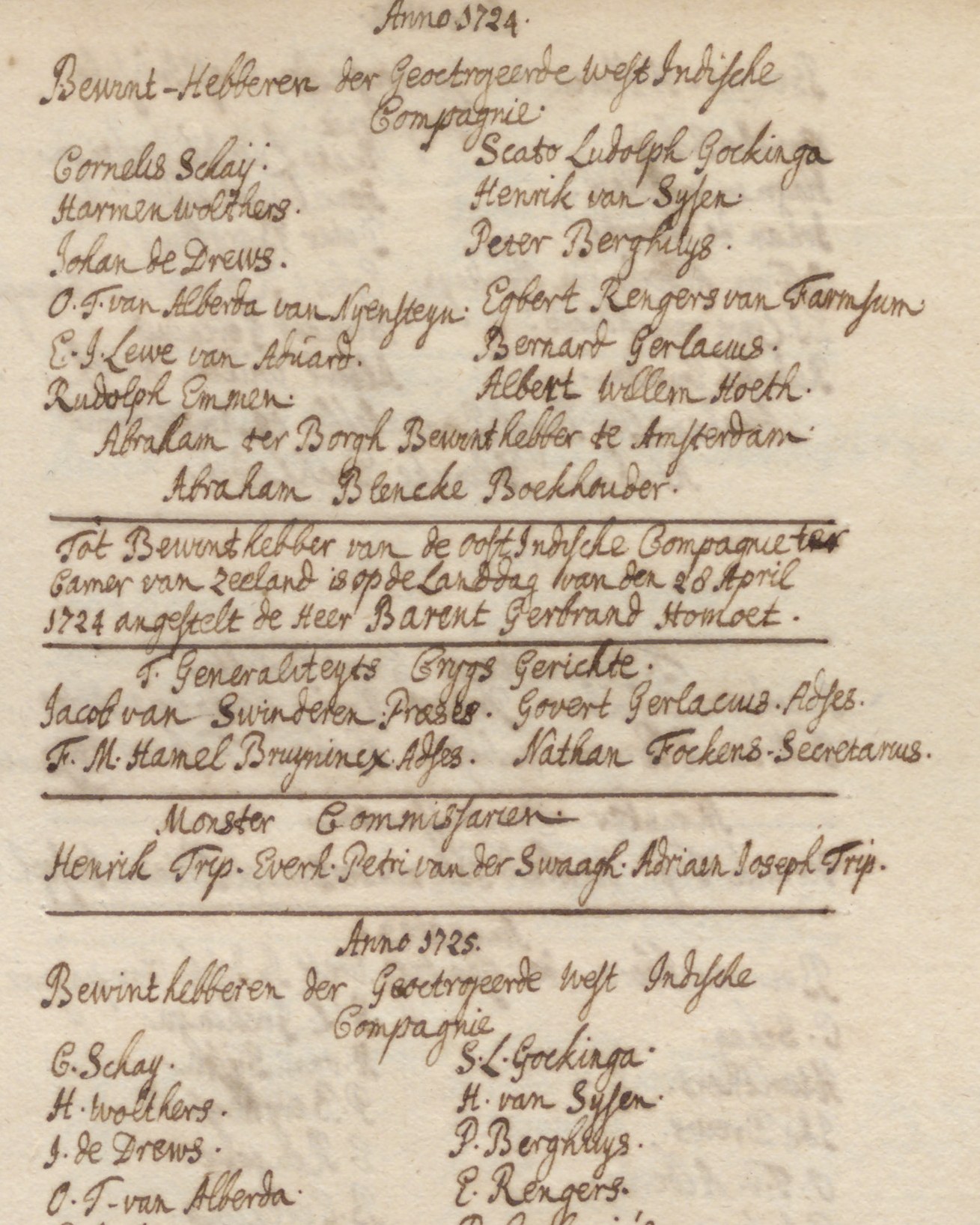
Unlike the three directors before him, Homoet went to work in Middelburg himself. From 1725 to 1728 he sat at the table almost every week, even when in the winter of 1726 the chamber met only on Mondays because of the frost. He was given a place in the treasury, was president in December 1725 and received return ships.71 The directors sat and voted in a fixed order of rank. When the Zeelander Pieter van Hoorn took his seat in October 1727 and was given a place above Homoet, Homoet protested that he was being cut short in his rank. From January 1728 he again stood before Van Hoorn in the attendance lists.72 In April 1729 he was allowed to use a Company ship at his own expense to transport his belongings. He probably moved back to Amsterdam: from 1730 he had others collect his dividend in Middelburg.73 After that he came only four more times, the last in June 1735. He never became a member of the Heren XVII. He did remain on the chamber’s lists as the delegate of Stad en Lande: the last surviving list, of 1745, still names him. He remained director until his death in 1768.74

In Amsterdam he lived on the Keizersgracht. There he became extraordinary treasurer in 1748 and orphan master in 1758, and in November 1767 he suddenly went blind. At his burial in May 1768 the register called him “Bewinthebber der Oostindische Compagnie wegens Groningen & Ommelanden ter Kamere Middelburg in Zeeland”.75
Homoet’s money, too, was in the colonies. His share in the Zeeland Chamber was five hundred pounds Flemish, three thousand guilders: exactly the amount the charter of 1647 required of the Groningen director. He also held two bonds of a thousand guilders each on two plantations in Suriname, Korte Vreugd and Kleinhoven. Such a bond was a loan to plantation owners, secured on the plantations, and with them on the enslaved people who worked there. The interest came from their labour. After the deaths of Homoet and his wife, her executors disposed of both in 1770: the bonds they sold publicly to Jan Willeumier, the share they transferred to Jan van de Kruysse, merchant in Middelburg.76
A few Groningers who went to Asia for the VOC sailed on Zeeland ships. Willem Fockens (1727–1779) left in 1746 as a corporal on the Woitkensdorp, and later became governor of Ambon.77 His money, too, ran through Middelburg. According to a power of attorney of 1767, Willem, as governor and director of Ambon, was owed 3,295 guilders in pay by the Zeeland Chamber. His father Nathan was allowed to collect and invest that money, and keep the interest.78 Willem Arnold Alting (1724–1800) left in 1750 as under-merchant on the Middelburg, and later became the last governor-general of the VOC.79 J.E. Heeres, the historian who in 1893 had worked out how Stad en Lande got its seat, also wrote about Alting in 1911. He wondered whether Alting’s departure from Zeeland “misschien verband houden (zou) met de omstandigheid, dat Stad en Lande het recht had (…) om een Bewindhebber van de O. I. C. in de Kamer Zeeland te benoemen” [might be connected with the fact that Stad en Lande had the right to appoint a director of the VOC in the Zeeland Chamber].80 The resolutions show nothing of the kind. Officers were nominated by the director whose turn it was, and after 1726 Homoet had no more turns. No nominator is recorded at Alting’s appointment, and Homoet was not in Middelburg that day. Groningers who later received an officer’s post in Zeeland were nominated by Zeeland directors.81

The last director
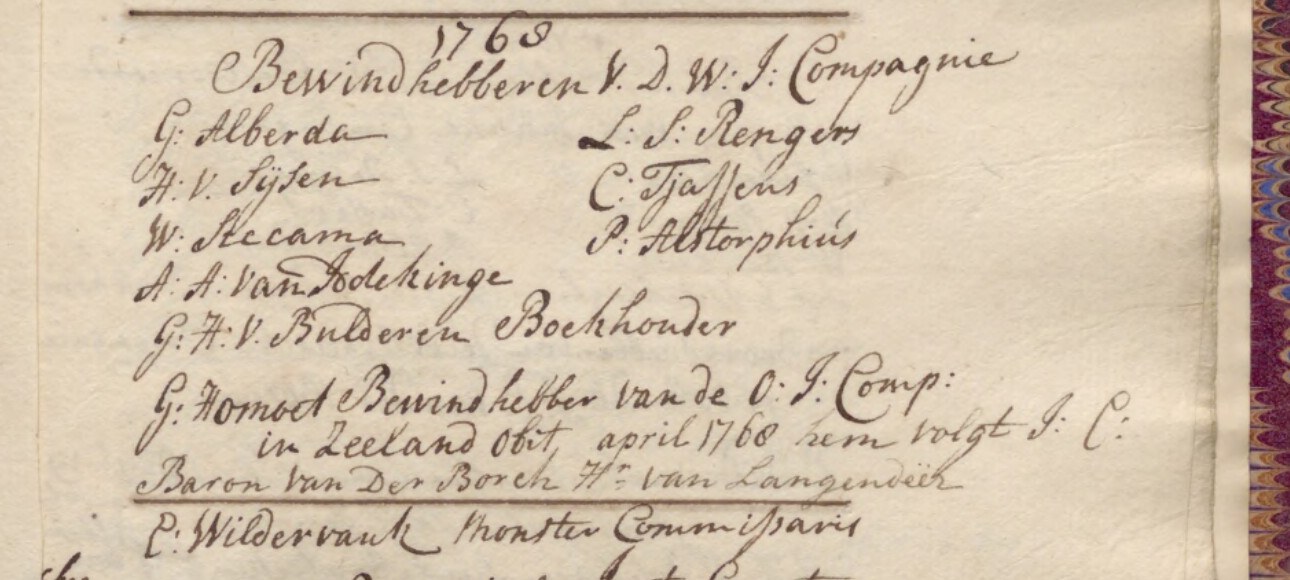
After Homoet’s death J.C. van der Borch (1734–1797), lord of Langendreer, succeeded him in 1768.82 This was Jan Carel van der Borch (1734–1797), a nobleman with a Groningen grandmother from the Clant family, who represented the Ommelanden quarter of Fivelingo in, among other bodies, the States General.83 His father, Allard Philip van der Borch (1690–1766), was himself a director of the WIC; of which chamber is not known. Through his grandmother, Gesina Clant (born 1660), he was also linked to the Groningen WIC network. Her father Johan Clant and her grandfather Adriaan Clant were principal shareholders in the Stad en Lande chamber, and her sister Helena married the director Reint Jan Lewe van Middelstum.84 In 1769 the Zeeland Chamber admitted Van der Borch as the delegate of Groningen.85 According to the regeringsboek he remained director until 1794, while from 1782 he was also envoy of the Republic in Stockholm.86 He cannot have had much time for Middelburg in those years.
In 1795 the Republic of the Seven United Netherlands fell, and a year later a committee of the Batavian Republic took over the management of the VOC. On 31 December 1799 the charter expired.87 With it the Groningen seat disappeared too, a century and a half after Stad en Lande had fought for it.

In that century and a half the Groningen seat was almost always filled, but seldom by someone who actually sat in it. Sohnius lived in Middelburg for three years and after that came in the summers. Homoet sat there every week for four years. The others were mostly a name on the list, and from 1660 usually an Amsterdammer who took over his predecessor’s seat. The States of Stad en Lande went on appointing the director and each time sent a letter to Middelburg.
Notes
-
J.E. Heeres, “Hoe Stad en Lande een bewindhebbersplaats in de Oost-Indische Compagnie machtig werd”, Bijdragen voor Vaderlandsche Geschiedenis en Oudheidkunde, 3e reeks, VII (1893), p. 301–309, here p. 308, after the resolution of the States General of 30 May 1648, https://resolver.kb.nl/resolve?urn=MMKB07:000776001:00318. The appointment by the States of Stad en Lande dates from 21 April 1648: P.J. van Winter, De Westindische Compagnie ter kamer Stad en Lande (Den Haag 1978), p. 43 n. 30.↩
-
Charter of 1647, Nationaal Archief, VOC, toegang 1.04.02, inv. 7235, https://www.nationaalarchief.nl/onderzoeken/archief/1.04.02/invnr/7235/file/NL-HaNA_1.04.02_7235_0001: “de Provincie van Stadt ende Landen (: welcke Provincie voor desen geen Bewinthebbers in de voorsz Compagnie en heeft gehadt :)”. Heeres, “Bewindhebbersplaats”, p. 308: “Ongelukkig was niet, zooals ten aanzien der andere gewesten, bepaald, in welke Kamer deze afgevaardigde zou zitting nemen” [Unfortunately it had not been laid down, as for the other provinces, in which chamber this delegate would take his seat].↩
-
Heeres, “Bewindhebbersplaats”, p. 308.↩
-
Heeres, “Bewindhebbersplaats”, p. 308, after the resolutions of the States General of 12 June to 18 July 1648.↩
-
P. van Dam, Beschryvinge van de Oostindische Compagnie, ed. F.W. Stapel, boek I, deel 1 (Den Haag 1927), p. 177 and 188: “dat geseyde Camer Delff had geweygert aen te nemen de Bewinthebber van Stad en Lande, sustineerende dat deselve behoorde gerenvoyeert te worden na de Camer van Zeeland tot Middelburg”, https://resources.huygens.knaw.nl/retroapp/service_vandam/vandam_1_1/html/vandam_1_1_gs63_0188.html.↩
-
Van Winter, Westindische Compagnie, p. 43, calls him “gewezen raadsheer van de hertog van Oldenburg” [former councillor of the duke of Oldenburg]. Oldenburg was then a county, under count Anton Günther (1603–1667); it became a duchy only in 1774.↩
-
Heeres, “Bewindhebbersplaats”, p. 308.↩
-
Heeres, “Bewindhebbersplaats”, p. 308, after the resolution of the States General of 23 September 1648.↩
-
Van Dam, Beschryvinge, I,1, p. 188.↩
-
Heeres, “Bewindhebbersplaats”, p. 302: the directors were “op het tijdstip der oprichting uitsluitend Hollanders en Zeeuwen” [at the time of the founding exclusively Hollanders and Zeelanders], although all inhabitants were allowed to invest, https://resolver.kb.nl/resolve?urn=MMKB07:000776001:00312; Van Winter, Westindische Compagnie, p. 1: “In het octrooi werden de bestuurders van de vroegere Compagnieën als bewindhebbers voor die kamers aangewezen.”↩
-
With the Reduction of Groningen the city came under the Republic in 1594. Until then Groningen had taken the side of the Spanish king. In July 1594 the States army under Maurice and William Louis took the city after a siege. City and Ommelanden together became a province of the Republic as Stad en Lande.↩
-
Van Winter, Westindische Compagnie, p. 4 and n. 9.↩
-
Heeres, “Bewindhebbersplaats”, p. 304, after the resolution of the States General of 8 September 1606, https://resolver.kb.nl/resolve?urn=MMKB07:000776001:00314.↩
-
Heeres, “Bewindhebbersplaats”, p. 305, after the resolutions of the States General of 30 July 1612, 25 July 1614, 30 December 1619 and 11 May 1638, https://resolver.kb.nl/resolve?urn=MMKB07:000776001:00315. A bewindhebber (director) was a governor of a chamber of the Company, chosen from among the largest shareholders. A director on behalf of a province without a chamber of its own was called an extraordinaris (extraordinary) director.↩
-
Heeres, “Bewindhebbersplaats”, p. 305, after the resolution of the States General of 14 December 1617.↩
-
Heeres, “Bewindhebbersplaats”, p. 305–306, after the resolution of the States General of 18 November 1618; see also Van Winter, Westindische Compagnie, p. 4.↩
-
Groninger Archieven, Staten van Stad en Lande, toegang 1, inv. 403 (1672–1673), volgnrs. 48–55. The provincial executive then asked the directors in Amsterdam for muskets, gunpowder and shot from those ships for the beleaguered province.↩
-
Van Winter, Westindische Compagnie, p. 4 n. 10, after the “Poincten ende articulen voor de landdag van 15 sept. 1618”, archive of the Staten van Stad en Lande.↩
-
Heeres, “Bewindhebbersplaats”, p. 306, after the resolution of the States General of 23 December 1622, https://resolver.kb.nl/resolve?urn=MMKB07:000776001:00316.↩
-
Heeres, “Bewindhebbersplaats”, p. 306.↩
-
Heeres, “Bewindhebbersplaats”, p. 306–307.↩
-
Heeres, “Bewindhebbersplaats”, p. 307, https://resolver.kb.nl/resolve?urn=MMKB07:000776001:00317.↩
-
Heeres, “Bewindhebbersplaats”, p. 307–308, after the resolution of the States General of 29 March 1647 and the report of 4 June 1647. A ton goud (ton of gold) was a unit of account in the Republic of a hundred thousand guilders.↩
-
Charter of 1647, Nationaal Archief, VOC, toegang 1.04.02, inv. 7235: “De Bewinthebbers vande cleijne Cameren derselver Compagnie, soo opde Maze als in het Noorderquartier respective, elcx twaelff hondert guldens. De Bewinthebbers vande respective Provincien ende Leden, de Provincie van Stadt ende Landen (: welcke Provincie voor desen geen Bewinthebbers in de voorsz Compagnie en heeft gehadt :) nu mede daeronder begrepen, elcx twaelff hondert gelijcke guldens des Jaers”.↩
-
Heeres, “Bewindhebbersplaats”, p. 308; Van Dam, Beschryvinge, I,1, p. 188 and 190. Van Winter, Westindische Compagnie, p. 43, assumes at least f 6,000, but that applied to the ordinary directors in Amsterdam and Zeeland. According to Van Dam (p. 190) the extraordinary directors, including “die van Stadt en Lande in Zeelant”, could make do with f 3,000.↩
-
Van Winter, Westindische Compagnie, p. 43 n. 30, after the resolutions of the States of Stad en Lande of 21 April 1648.↩
-
Heeres, “Bewindhebbersplaats”, p. 302.↩
-
At the departure for Asia in 1663 the list of his children names “Cornelia[?] Sonhius van Middelb[urgh] out 15 jaren” and “Anna Catharina Sonhius van Middelburgh out 12 jaren”: Nationaal Archief, VOC, toegang 1.04.02, inv. 7248, scan 150 (25 October 1663), https://www.nationaalarchief.nl/onderzoeken/archief/1.04.02/invnr/7248/file/NL-HaNA_1.04.02_7248_0150. The first name Cornelia is not a certain reading.↩
-
Debt register (schuldprotocol) of the city of Groningen, registered between 29 March and 9 April 1649: Sohnius borrows “de rato caverende voor Anna van Heeck anders Sonius sijn huisvrouwe” 3000 carolus guilders from Trijntjen Cransen, widow of Jan Hilbrants; the surety is Jacob Haijkens. According to a note in the margin the bond was cancelled in 1651. FamilySearch, “Groningen, Court Records 1648–1649”, https://www.familysearch.org/ark:/61903/3:1:3QHK-93G5-49SX. On the three thousand guilders: see note 25.↩
-
Van Dam, Beschryvinge, I,1, p. 188; Heeres, “Bewindhebbersplaats”, p. 309 n. 2, after the resolution of the States General of 27 December 1649. The Van Dam edition dates that resolution to 27 December 1647, but Sohnius had not yet been appointed then.↩
-
Nationaal Archief, VOC, toegang 1.04.02: the copy resolutions of the Zeeland Chamber run in inv. 7246 until 1638 and begin in inv. 7247 in 1651.↩
-
Nationaal Archief, VOC, toegang 1.04.02, inv. 7247, scan 4 (2 January 1651) and scans 6–8 (February 1651: “Jan Barthold Sonnius praeses”), https://www.nationaalarchief.nl/onderzoeken/archief/1.04.02/invnr/7247/file/NL-HaNA_1.04.02_7247_0006.↩
-
Nationaal Archief, VOC, toegang 1.04.02, inv. 7247, scan 22 (14 August 1651), https://www.nationaalarchief.nl/onderzoeken/archief/1.04.02/invnr/7247/file/NL-HaNA_1.04.02_7247_0022.↩
-
Baptism of Johanna, A-kerk Groningen, 4 March 1652, https://www.openarchieven.nl/gra:1c17458d-1147-3d64-3b12-3311c4626ef5; baptism of Mattheus, A-kerk, 12 July 1654: “Matthes, soon van Joh: Bartholt Sonhius & Anna van Heecke”, https://www.openarchieven.nl/gra:6d89f9f0-a46c-45b0-86f6-ae3f69d78990.↩
-
Nationaal Archief, VOC, toegang 1.04.02, inv. 7247, scan 47 (29 June 1652: “gecommitteert naer Rotterdam, op de visitatie by kisten by ’t schip Rotterdam”), scan 135 (2 September 1654: on board for the unloading of Orangie and Prins Willem) and scan 232 (19 July 1657: “tot ’t visiteren van kisten van Officieren, Soldaten en Matroosen” of the Prins Willem). Those on board were allowed to bring only a small quantity of trade goods of their own; the inspection searched for whatever they had smuggled in beyond that.↩
-
Nationaal Archief, VOC, toegang 1.04.02, inv. 7247, scan 203 (10 August 1656): “een Missive van d’Confrater Johan Barthold Sonhius, geschreven den 6 augusti 1656 int schip de Provintie liggende op ’t Vlack”.↩
-
Nationaal Archief, VOC, toegang 1.04.02, inv. 7247, scan 153 (14 January 1655): “eene missive vande Hr Johan Barthelt Sonhius uit Groeningen 25 decembr.”, with the request to pay his salary “[aen] handen [van den] bringer des brieffs te betalen, twelck soo toegestaen is” [into the hands of the bearer of the letter, which was so granted].↩
-
Count from the attendance lists in Nationaal Archief, VOC, toegang 1.04.02, inv. 7247 (1651–1657) and inv. 7248, scans 24–26 (September–October 1658): 26 times in 1651, 9 in 1652, 14 in 1654, 1 in 1655, 9 in 1656, 10 in 1657 and 6 in 1658.↩
-
Resolution of the Heren XVII, Middelburg, 12 October 1657, Nationaal Archief, VOC, toegang 1.04.02, inv. 104, fol. 254–256, https://www.nationaalarchief.nl/onderzoeken/archief/1.04.02/invnr/104/file/NL-HaNA_1.04.02_104_0241; Van Dam, Beschryvinge, I,1, p. 188; Heeres, “Bewindhebbersplaats”, p. 309 n. 1. Amsterdam was given the directors of Gelderland, Holland and Utrecht, Delft and Rotterdam that of Overijssel, Hoorn and Enkhuizen that of Friesland. The reason: each chamber sought to shift such a director “soo veel mogelijck van hem af te schuijven” [as far as possible off onto others], to the “groot misnoegen” [great displeasure] of the provinces. On Groningen: “De Camer van Zeelandt de Bewinthebber vande Provintie van Stadt en Landen.”↩
-
Proposition for the Landdag of February 1654, art. 12, Groninger Archieven, Staten van Stad en Lande, toegang 1, inv. 12, scan 118. The Landdag was the assembly of the States of Stad en Lande.↩
-
Resolution of the States of Stad en Lande, 1 March 1654, Groninger Archieven, toegang 1, inv. 12, scan 144: “hebben de Heeren van d’Ommelanden daertoe genomineert Jr Asinga Sw[eer]de Clant, welcke nominatie de Heeren vande Stadt haer hebben laten welgevallen”. The first name is not a certain reading. It is probably jonker Sweer Asinga Clant of Harkstede, who married Sibilla van Ewsum in 1649.↩
-
Resolution of the States of Stad en Lande, 24 November 1655, Groninger Archieven, toegang 1, inv. 12, scan 457.↩
-
Nationaal Archief, VOC, toegang 1.04.02, inv. 7247, scan 189 (27 January 1656), after the act of the provincial executive of 13 December 1655: Sohnius would “syn bewinthebberschap [sal] behouden ende moet waernemen, ter tyt en soo lange een ander effectivelijck sal syn gesubstitueert”.↩
-
Resolution of the States of Stad en Lande, 28 February 1656, Groninger Archieven, toegang 1, inv. 12, scan 528: “dat de te nominerende Bewinthebber syn functie ad vitam sal hebben te bekleeden, ende dat daerover tusschen beyde Leden tot de bestellinge het lot sal worden geworpen, so nochtans dat het Lidt so d’eerste mael de bestellinge daervan coomt te missen de tweede bestellinge sal hebben en so vervolgens bij tourbeurten ommegaen”.↩
-
Nationaal Archief, VOC, toegang 1.04.02, inv. 7247, scan 200 (3 July 1656): the States had “den 28 Febr. 1656 in haer Ed. Mog. vergaderinge hebben gecontinueert ad vitam”; the chamber decided that he “volgens den inhouden vant Octroy wert erkent en geadmitteert als bewinthebber”, https://www.nationaalarchief.nl/onderzoeken/archief/1.04.02/invnr/7247/file/NL-HaNA_1.04.02_7247_0200.↩
-
Nationaal Archief, VOC, toegang 1.04.02, inv. 7248, scan 41 (10 July 1659), after his letter of 27 June 1659 to Pieter Boudaen Courten, about “de goederen (…) in de jonghste vercoopinge ter Caemer alhier ghecocht en ontfanghen”. They had been bought by Jan Gillis Coppens “voor den voorsz. Heer Sonnius”; the surety was “d’Sr. Coomans”. Neither name is an entirely certain reading.↩
-
Nationaal Archief, VOC, toegang 1.04.02, inv. 7248, scan 71 (19 August 1660), after the letter of the States of Groningen “gedateert den 29 January 1660 oude stile”, https://www.nationaalarchief.nl/onderzoeken/archief/1.04.02/invnr/7248/file/NL-HaNA_1.04.02_7248_0071. In the new style that is 8 February 1660.↩
-
Town register (stadsprotocol) of Groningen, 30 May 1663, fol. 139: “Anna van Eick wed.e ten Over, geadsisteert met haer broeder Hendrick van Eick, uit de name van dese provincie mede bewinthebber van d’Oostindische Comp.e ter Camer in Zelant”, FamilySearch, https://www.familysearch.org/ark:/61903/3:1:3QHV-13G5-T3HT. In 1659 the Groningen town registers call him “Hendrick van Eijck Wijnhandelaer tot Amsterdam”, https://www.familysearch.org/ark:/61903/3:1:3QHK-93G5-V4M. After his death his widow Jacomina van Helmont received 1073 guilders from the province in 1667 “wegens ’t negotieren voor dese Provincie door haer eheman tot Amsterdam gedaen”: accounts of the province 1667, fol. 344, https://www.familysearch.org/ark:/61903/3:1:3Q9M-C3MX-W3WS-R. It has been suggested earlier that he was Henricus van Heeck (baptised 1641), a son of burgomaster Hindrick van Heeck and a nephew of Anna van Heeck, but in 1660 he was only eighteen and the deed of 1663 names someone else.↩
-
Nationaal Archief, VOC, toegang 1.04.02, inv. 7248, scan 72 (13 September 1660). He does not appear in the attendance lists of 1661 to 1666.↩
-
Nationaal Archief, VOC, toegang 1.04.02, inv. 7248, scan 143 (2 August 1663): “H. Johan Bartholt Sonnius, binnen staende presenteert syn dienst voor Coopman naer India”, and scan 146 (6 August 1663). A fiscaal (fiscal) was the VOC official who watched for smuggling, fraud and breaches of the rules.↩
-
Nationaal Archief, VOC, toegang 1.04.02, inv. 7248, scan 149 (18 October 1663): “Jan Barthelt Sonnius van Groeningen is aengenomen voor onder Coopman opt Hoff a 40 f ter maendt”. An onderkoopman (under-merchant) was a lower rank in the VOC’s trading service, above the assistant and below the merchant.↩
-
Nationaal Archief, VOC, toegang 1.04.02, inv. 7248, scan 150 (25 October 1663), see note 28. The resolution calls the wife “Anna v. Heel[?]”, probably a slip for Van Heeck: it was with Anna van Heeck that he made his will in Batavia in 1675 (note 54).↩
-
Shafaat Ahmad Khan, Sources for the History of British India in the Seventeenth Century (London 1926), p. 301 (8 October 1672, signed “J. B. Sonhius” in Casteel Geldria at Pulicat), https://archive.org/details/in.ernet.dli.2015.459918; H.C.V. Leibbrandt, Précis of the Archives of the Cape of Good Hope. Journal 1671–1674 & 1676 (Cape Town 1902), p. 285–286 (5 February 1676: fiscal of the return fleet, as “merchant and ex-fiscal of the coast”), https://archive.org/details/precisofarchives15capeiala. The fleet under Verburg arrived on 16 July 1676: Dutch Asiatic Shipping, https://resources.huygens.knaw.nl/das/detailVoyage/96587.↩
-
Will of Johan Bartholt Sohnius and Anna van Heeck, Batavia, 13 April 1675, notary David Dispontijn; they made each other heir. A.A.M. Stols, “Enkele aanteekeningen over de families Sohnius en Fermin”, De Nederlandsche Leeuw 62 (1944), col. 17–23, after the file of the Weeskamer Amsterdam, https://www.noordelingen.nl/1944.pdf. Stols also mentions the will of 2 September 1676 before the burgomasters and council of Groningen, and dates Anna’s death between the two wills.↩
-
Debt register of the city of Groningen, 15 September 1679: Debora van Heeck, widow Junius, and captain Roeleff Foccoma, “beijde in qlte als administratoren van d’ goederen van wylen d’E. Heer Johan Bartolt Sonhius” [both in their capacity as administrators of the goods of the late Johan Bartolt Sonhius], lend out 500 carolus guilders. FamilySearch, “Groningen, Court Records 1680–1681”, image 487, https://www.familysearch.org/ark:/61903/3:1:3QHV-B3GR-34SZ.↩
-
A.C.P.J. van Zon, Genealogie van Zon, relation cluster 9577, after De Nederlandsche Leeuw 62 (1944), https://www.genealogie-van-zon.nl/Clusters.php?ID=9577.↩
-
D.G. van Epen, “Grafschriften in Voor-Indië”, De Wapenheraut 1 (1897): “Juffr. Sara Sonhius … gebore tot Groeningen den: 16 July: 1647: overleden den 30en October: 1675”, https://resolver.kb.nl/resolve?urn=MMKB26:000380001:00223.↩
-
Nationaal Archief, VOC, toegang 1.04.02, inv. 7249, scan 45 (8 November 1666), after the letter of the provincial executive of 21 September 1666. On 16 October 1666 the provincial executive reported that “S.r Hendrick van Eijck waer coomen t’overlijden” [Mr Hendrick van Eijck had died]: resolutions of the Gedeputeerde Staten, https://www.familysearch.org/ark:/61903/3:1:3QHV-R3KC-9GSY. He is probably the “Heyndericx van Eyck op de Keysersgraft” who was buried in the Nieuwe Kerk in Amsterdam on 7 October 1666: Stadsarchief Amsterdam, toegang 5001, inv. 1055, p. 171vo, https://www.openarchieven.nl/saa:b800919b-4a9d-4771-9202-4849d232742f.↩
-
The identification rests on the name, on his Amsterdam business with his successor Adam Bessels (notarial deeds of June and October 1704, Stadsarchief Amsterdam, toegang 5075) and on his burial in Amsterdam on 7 May 1705, which fits “wijlen” [the late] in the Groningen letter of August 1705: https://www.openarchieven.nl/saa:99e87e1a-666a-2bb2-e053-b784100a6a2e.↩
-
Nationaal Archief, VOC, toegang 1.04.02, inv. 7249, scan 45 (11 November 1666): Van Raey had “de £500 Capitael actie die hy inde Oostindische Comp. moet hebben om Bewinthebber te mogen worden van wegen Stadt en Landen”. A pound Flemish was six guilders.↩
-
Nationaal Archief, VOC, toegang 1.04.02, inv. 7249, scans 63 and 164–165 (July–August 1667 and September 1671), and inv. 7250, scan 93 (20 August 1676). Possibly also 7 June 1691 (inv. 7252, scan 137), where his name at a nomination cannot be read with full certainty.↩
-
Nationaal Archief, VOC, toegang 1.04.02, inv. 7249, scans 143–144 (1 January 1671): “dat aende selve geen tourbeurt als president [sal] werden gegeven” [that he shall be given no turn as president].↩
-
Nationaal Archief, VOC, toegang 1.04.02, inv. 7250, scan 128 (December 1677): the Amsterdam Chamber reported “dat Jeremias van Raije hem hadde moeten absenteren” [that Jeremias van Raije had had to absent himself]; the Zeeland Chamber decided that “de actien die op de naem vande gemelde van Raije in dese Camer” stood [the shares in the name of the said Van Raije in this chamber] were to be “in arrest te stellen” [seized].↩
-
Nationaal Archief, VOC, toegang 1.04.02, inv. 7254, scans 111–112 (7 September 1705), with the letter of the States of Stad en Lande of 27 August 1705: “Alzoo door ons op de tourbeurte en nominatie der heeren vande Ommelanden vanden 26 april 1694 by transport van wijlen de heer Jeremias de Raij, wederom indesselfs plaatse de heer Adam Bessels der beyden Regten doctor (…) is vercoorn”. The letter of the States of 15 March 1706 speaks of “de overledene Adam Bessels” [the late Adam Bessels] (scan 127).↩
-
Nationaal Archief, VOC, toegang 1.04.02, inv. 7254, scans 127 (9 April 1706) and 138 (August 1706); inv. 7255, scans 114, 116 and 180 (1711 and 1713, purchase of specie in Amsterdam). Buried in Bloemendaal on 14 March 1724: Maandblad De Nederlandsche Leeuw 34 (1916), https://resolver.kb.nl/resolve?urn=MMKB30:022068004:a00005.↩
-
Regeringsboek, c. 1780, Groninger Archieven, toegang 751, inv. 9, years 1694–1723, https://hdl.handle.net/21.12105/E93AE22AA2AB4C22BB3D4892BD078E69.↩
-
Regeringsboek, Groninger Archieven, toegang 751, inv. 9, scan 50.↩
-
J.E. Heeres, “Mr. Willem Arnold Alting, een Groningsche gouverneur-generaal van Nederlandsch Indië (1780–1797)”, Groningsche Volksalmanak 1911, p. 190 n. 2: “geen Groninger, volgens eene mededeeling van Jhr. Mr. J. A. Feith” [not a Groninger, according to information from Jhr. Mr. J.A. Feith], https://resolver.kb.nl/resolve?urn=MMKB26:000486001:00222.↩
-
Verreyt, “Aanteekeningen betreffende het geslacht Homoet”, Algemeen Nederlandsch Familieblad 5 (1888), https://resolver.kb.nl/resolve?urn=MMKB26:000047001:00069; marriage banns, Amsterdam, 10 May 1720, Stadsarchief Amsterdam, toegang 5001, inv. 712, p. 156.↩
-
Nationaal Archief, VOC, toegang 1.04.02, inv. 7257, scan 83 (29 June 1724), with the letter of the States of 3 May 1724, https://www.nationaalarchief.nl/onderzoeken/archief/1.04.02/invnr/7257/file/NL-HaNA_1.04.02_7257_0083; present for the first time on 28 September 1724 (scan 92). The share was transferred to him on 25 May 1724 from the name of David Lopes Pereira: estate inventory of Anna Horneman, Stadsarchief Amsterdam, toegang 5075, inv. 13459, https://www.openarchieven.nl/saa:24f7322f-97c7-e2cb-fd64-7d0b47e8fca4.↩
-
Nationaal Archief, VOC, toegang 1.04.02, inv. 7257, scans 107–204 (1725–1728), with the place in “het Comptoir van de Thesaurij” on scans 114–115 (August 1725) and the presidency on scans 126–127 (December 1725). The thesaurie (treasury) managed the chamber’s funds.↩
-
Nationaal Archief, VOC, toegang 1.04.02, inv. 7257, scan 177 (6 October 1727): Homoet felt “in des selfs rang (…) vercort” [cut short in his rank].↩
-
Nationaal Archief, VOC, toegang 1.04.02, inv. 7257, scan 235 (11 April 1729): “D’Heer Homoed heeft versoght het schip Maje tot transport van zyne Goederen buyten costen van de Comp.e”. No destination is given. Dividend collected by agents in Middelburg, 1730 and 1732: Stadsarchief Amsterdam, toegang 5075, inv. 9750 and 9752.↩
-
Last attendance: Nationaal Archief, VOC, toegang 1.04.02, inv. 7258, scan 240 (6 June 1735). Lists of directors 1738, 1741 and 1745: inv. 7260, 7261 and 7262, each at scan 4. No lists have been found in the volumes after 1745. He does not appear in the attendance lists of the Heren XVII from 1724 to 1767 (inv. 163–178).↩
-
Leydse Courant, 14 October 1748 (extraordinary treasurer), https://resolver.kb.nl/resolve?urn=ddd:010908997:mpeg21:a0006; “Wees-Meester deeser Stad” [orphan master of this city], 1 March 1758, Stadsarchief Amsterdam, toegang 5075, inv. 11372B, https://www.openarchieven.nl/saa:b21a5c6d-aa8c-6a83-e053-b784100a6e32; diary of Jacob Bicker Raye, 24 November 1767, https://www.dbnl.org/tekst/bick002dagb01_01/bick002dagb01_01_0034.php. Buried 6 May 1768, Oude Lutherse Kerk, Stadsarchief Amsterdam, toegang 5001, inv. 1135, p. 56vo–57: “Barend Gerbrand Homoet Commissaris deser Stad, mitsgaders Bewinthebber der Oostindische Compagnie wegens Groningen & Ommelanden ter Kamere Middelburg in Zeeland, op de Keyzersgraft”, https://archief.amsterdam/indexen/deeds/cd29598c-6bf3-4645-8002-ac32dab6ae2d.↩
-
Estate inventory of Anna Horneman, Stadsarchief Amsterdam, toegang 5075, inv. 13459 (see note 70): two bonds “yder groot in capitaal Een duyzend Guldens, beyde gedateert den eersten Maart 1766, en genegotieert door Johannes Klein Junior de eene No 47 ende andere No 48”. Transfer, 20 March 1770, and authorisation, 23 March 1770, notary Willem Decker jr., toegang 5075, inv. 13460, https://www.openarchieven.nl/saa:2cb2cb39-c927-a21b-02b8-00e5fe9eecb2 and https://www.openarchieven.nl/saa:dd7cbacc-d7cb-1a1a-78bf-94f0b978f3b3.↩
-
VOC Opvarenden, Nationaal Archief: Willem Fockens, first corporal, entered service 5 July 1746, Woitkensdorp, Zeeland Chamber, inv. 13020, https://archief.nl/doc/nt/nt00444/opvarenden/361113.↩
-
“Concept van een volmacht om te ontvangen bij de bewindhebbers ter kamer Zeeland, de soldijrekening groot 3295 guldens, welke Willem Fockens, gouverneur en directeur van Amboina te goed heeft”, 17 August 1767, Groninger Archieven, toegang 2041 (Register Feith-stukken), nr. 190, https://hdl.handle.net/21.12105/4DDA1E60C403403E830186388DA74E31.↩
-
VOC Opvarenden, Nationaal Archief: Willem Arnold Alting, under-merchant, entered service 18 October 1750, Middelburg, Zeeland Chamber, inv. 13047, https://archief.nl/doc/nt/nt00444/opvarenden/364706.↩
-
Heeres, “Willem Arnold Alting”, p. 190 n. 2.↩
-
Appointment of “Willem Arnout Alting geboortig van Groninge”, 1 October 1750: Nationaal Archief, VOC, toegang 1.04.02, inv. 7263, scan 121. Nomination by “den Heer aan den tour” [the gentleman whose turn it is]: inv. 7262, scan 115 (23 February 1747); Homoet’s last turn in 1726: inv. 7257, scan 147. Groningers nominated by Zeeland directors include Jurriaan Zuydland (1756, by Vander Poort) and Jan Hendrik Harringha (1757, by Hurgronje): inv. 7264, scans 78–116.↩
-
Regeringsboek, Groninger Archieven, toegang 751, inv. 9, scan 74: “obit, april 1768 hem volgt J: C: Baron van Der Borch Hr. van Langendreer”.↩
-
The identification rests on the initials, the lordship of Langendreer (Langentrier) and the family. As “J. C. van der Borch, Heer van Langentrier” he succeeded L.S. Rengers as a member of the States General in 1779: https://resolver.kb.nl/resolve?urn=ddd:010106665:mpeg21:a0003. Van Duijn’s genealogy confirms it: “Jan Carel van der Borch, heer van Langendreer”, born in Arnhem on 3 December 1734, envoy in Stockholm and died there on 1 May 1797: D. van Duijn, “De nakomelingen van Johan van Oldenbarnevelt”, De Nederlandsche Leeuw 85 (1968), col. 395–396.↩
-
Van der Borch genealogy (Genealogieonline, “West-Europese adel” I241564 and “Noblesse Européenne” I344496, after Nederland’s Adelsboek): Jan Carel, son of Allard Philip van der Borch and Reiniera Charlotta van Goltstein; grandmother “Josine Clant van Stedum” (1660–1731). Allard Philip was baptised in the Martinikerk on 4 May 1690 as the son of Frederik Willem van der Borch and Gesina (Josina) Clant, who married in Stedum in 1684; Nederland’s Adelsboek (1905) calls him lord of Langentrier and Verwolde, married in 1734 to Reiniera Charlotta van Goltstein. Johan Carel is not in the list of children in the Adelsboek (“o.a.” [among others]), but Van Duijn lists him as a son of Allard Philip, whom he also calls “bewindhebber der West-Indische Compagnie” [director of the West India Company]: D. van Duijn, “De nakomelingen van Johan van Oldenbarnevelt”, De Nederlandsche Leeuw 85 (1968), col. 391–392 and 395–396.↩
-
Naamregister der bewindhebberen (1781), p. 68: “Gedeputeerde wegens Groningen: Johan Carel Baron van der Borch, Heer van Langentrier”, https://www.delpher.nl/nl/boeken/view?identifier=dpo:2840:mpeg21&page=68.↩
-
Regeringsboek, Groninger Archieven, toegang 751, inv. 9; D. Kuiken, Regeringsboek gezagsdragers 1594–1811 (Groninger Archieven 1700, inv. 16); Nationaal Archief, Legatie Zweden, toegang 1.02.07.↩
-
F.S. Gaastra, De geschiedenis van de VOC (Zutphen 1991).↩