
The West India House
In 1741 Quintyn Pabus brought together in his Lof der Stadt Groningen everything fine and impressive the city had to offer. To the West India Company he devoted two lines:
Hier van ’t West-Indisch Huis daar waait de hooge vlag.
Die Moor en Indiaan houdt onder haar gezag.1
[Here from the West India House flies the lofty flag that holds Moor and Indian under its sway.]
That house stood on the Munnekeholm, on the spot where the old main post office now stands.2 The Company had not built it itself. When the WIC was founded in 1621, Stad en Lande was given a chamber of its own, one of five. In October 1622 the largest shareholders of the province elected the first fourteen directors.3 They did not yet have premises of their own. In its first year the chamber was housed somewhere in the Ebbingestraat.4 On 4 September 1623 the States of Stad en Lande gave permission to occupy, from May 1624, part of the refugium of the abbey of Aduard: the abbot’s house, with the brewhouse and the stables.5 The abbey had ceased to exist with the Reduction of 1594,6 and its property had passed to the province. The Company never paid rent for it.4

Behind the house lay a large plot reaching to the Schuitemakersstraat and the Reitemakersrijge. The stables served as a warehouse, and the Reitemakersrijge was then called the Westindische Opslag. The water of the A was close by, so that a lighter (a small inland vessel) could come right up to the quay of the storage yard.4 The house itself held the meeting room and the office. The bookkeeper lived behind and above it.7 At the end of the eighteenth century the directors met there “alle 14 dagen op Donderdag ten 1 uur” [every fortnight on Thursday at one o’clock].8
We know what that meeting room looked like because inspectors from The Hague described it in 1795, four years after the Company had been dissolved. They saw a long table under a worn cloth and thirteen chairs upholstered in green trijp (wool plush) that had suffered badly, all bearing the emblem of the chamber. On the walls hung fifteen prints of the forts and posts overseas. For decoration there were three old ship’s blunderbusses with brass muzzles.7
One ninth
That Groningen got a chamber of its own was not a matter of course. When the VOC was founded in 1602, the Groningen delegates of the States of Stad en Lande had no mandate to consent, and the East India Company came into being without them. Van Winter compares the Groningers of those years to “have-nots”, who felt slighted by the “haves” in Holland and Zeeland. They wanted to take part in a West India Company at all costs, if only as compensation for “de onbillijke behandeling in 1602” [the unfair treatment in 1602].9 The Holland draft for the WIC provided for four chambers, without the north. One director in a chamber of their choice for every 100,000 guilders they put in was not enough for Groningen and Friesland. If they did not get a chamber of their own, their States would vote against the foundation in the States General.10
The charter of 3 June 1621 divided the Company among five chambers. Amsterdam received four ninths, Zeeland two ninths, the Maze and the Noorderkwartier one ninth each, and “de vijfde Kamer in Vrieslandt, mitsgaders Stadt ende Landen” [the fifth chamber in Friesland, together with Stad en Lande] also one ninth. This came with a condition, recorded “in het Register van onse Resolutien”.11 In February 1621 the States General had sent that condition as a deed to Friesland and Groningen: together the two provinces were to raise half a million guilders.12 Amsterdam had demanded at least four million for the Company as a whole. With the half million from the north that became four and a half million, of which half a million is exactly one ninth.13 In Holland few believed it:
Wat apparentie (is er) dat de provincies van Vriesland ende Stadt Groningen ende Ommelanden sullen opbrengen de vijff hondert duyzent guldens […]?13
[What likelihood is there that the provinces of Friesland and of Groningen and Ommelanden will raise the five hundred thousand guilders?]
The Frisians soon had doubts. In March 1621 the States of Friesland stipulated that Frisians could also invest in the chambers of other provinces.14 In Groningen things went better. There 350,000 guilders had already been subscribed, and the province promised to make up whatever was lacking from the half million.15 On 31 July 1622 the Provincial Executive decided to press the States General for a chamber for Groningen alone: in Stad en Lande much had been subscribed, in Friesland almost nothing.16 So the fifth chamber became a Groningen chamber. Groningen also paid on time. In May 1624 the Company reported to the States General that it had received the first instalment of the provinces’ subsidy only from a few Holland towns and from Stad en Lande.17 In the end the Groningen chamber brought in 836,975 guilders. That was more than the Noorderkwartier (505,627) and not much less than the Maze (1,039,202).10
Most of the money came from the authorities. This is clear from the list of principal shareholders of 23 June 1643. The province appears on it twice, with half its stake on each side: 216,625 guilders with the city and the same amount with the Ommelanden. Further, the city appears with 108,750 and the Ommelanden with 64,300 guilders. At the bottom are the totals: 515,969 guilders for the city side and 442,262 for the Ommelanden side, together over 958,000 guilders. A good 600,000 of this came from the authorities, over 350,000 from 39 townspeople and 20 Ommelanders.18 The largest private investor was Allard Gaykinga of Terborch (c. 1600–1674) near Warfhuizen, with 33,750 guilders. He also held shares in the Amsterdam chamber. Next came Johan Sickinghe of Warffum (1576–1652) with 20,000 guilders. Albert Coenders (1586–1644), who lived at the house of Aduard, and the house of Nienoord were each listed for 10,000 guilders. On average the Ommelander jonkers were entered for larger sums than the townspeople. In the city Hemmo Huninga (1625–1648) had the most, 9,750 guilders. He came from a military family. After him came former burgomaster Gerard Swart (1603–1665) with 9,000.18
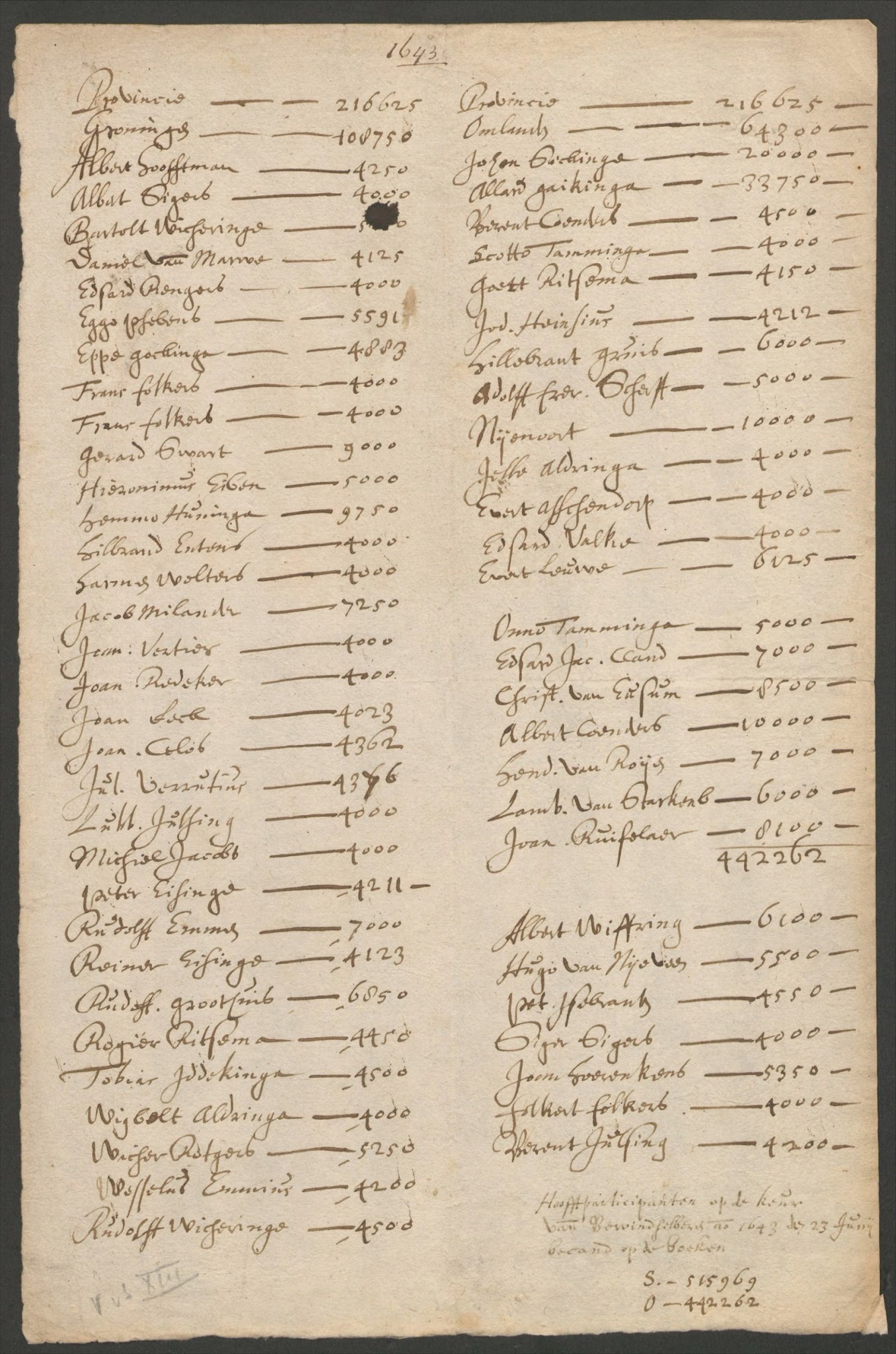
Small investors took part too. The Fraterhuis and the St. Anthony-Gasthuis, which housed people with mental illness, held shares of 450 and 400 guilders in the 1630s. The gasthuis had taken its share in 1631 for the maintenance of Lubbert Engelkens.19 The church of Zuidwolde had a share, and the lists include fifteen ministers and farmers such as Jan Aapkens, who represented Farmsum at the landdag from 1620 to 1645.2019 In 1662 the deacons’ poor relief in Groningen received a bond of 750 guilders that the cooper Jan Albers van Waerendorp had left to the poor. He had received it as a reward for his work on the ship Graef Hendrick, which returned from Brazil for the chamber in 1640.21 On the same ship, in 1643, 435 enslaved Africans were embarked at Luanda for Brazil. An estimated 262 arrived alive.22 Whether Jan Albers sailed on that voyage, we do not know.
The province’s money came from monastic property. After the Reduction of 1594 the lands of the monasteries had been secularised, and the province had received the greater part of them. These monastic estates were to be spent “ad pios usus”, for pious purposes. According to the States the WIC fell under this too, since it allowed the struggle against Spain and “de paapse religie” [the popish religion] to be waged with greater force.23 The Groningen stake in the Company was thus partly paid from former monastic property, as was the house on the Munnekeholm, the refugium of the abbey of Aduard, where the chamber took up residence.
The charter also laid down how the board was chosen. The chamber received fourteen directors. Anyone who wished to become a director or to have a say as principal shareholder had to invest at least 4,000 guilders himself.11 On 26 October 1622 the principal shareholders elected the first fourteen directors. Burgomaster Abel Coenders (1564–1629) and syndic Scato Gockinga (1566–1641)24 supervised on behalf of the province. Each principal shareholder wrote down fourteen names, the vote was secret, and each had to declare that he had not voted for himself.25 Six jonkers were elected and five members of the city government, as well as professor Nicolaus Mulerius (1564–1630), the “schrijver” [clerk] Willem van Viersen (c. 1583–1630) and the merchant Berend Jansen of the Drie Webben on the Vismarkt.15 Berend Jansen remained the only merchant ever to become a director of the Groningen chamber.25
Three days later the Provincial Executive approved the credentials of the chamber’s delegates to The Hague and Amsterdam, for the meeting of the nineteen directors.16 They were burgomaster Joachim Altingh (1556–1625) and jonker Johan Sickinghe. In November the two also acted in The Hague as deputies of the province to the States General.1512 In the central board of the Company each small chamber had two seats. The first draft of the charter still provided for seventeen members, the Heren XVII, as with the VOC. That it became nineteen, the Heren XIX, was because Stad en Lande also received two seats.11 Van Winter sees in this “het duidelijke blijk van Groningse vasthoudendheid” [the clear proof of Groningen tenacity].1526
Even so, Groningen remained the junior partner. As early as 1638 jonker Hillebrand Gruijs warned that without equal rights the chambers would end up in a leonina societas, a partnership in which the lion takes the most.27 Those who could also bought shares in Amsterdam: they were worth more there. At a sale in December 1651 Amsterdam subscriptions fetched 18 per cent, Groningen ones 9¾.28
A weapon against Spain
The WIC did not begin as a slave-trading company. It was a weapon in the war against Spain, and since Spain and Portugal had shared a king since 1580, also against Portugal and its possessions in Africa and Brazil. That the Company was founded in 1621 was no coincidence: that year the Twelve Years’ Truce expired. As long as Oldenbarnevelt was steering towards peace or a truce with Spain, there was, according to Van Winter, room for “geen organisatie die duidelijk bedoeld was als instrument van verweer en agressie” [no organisation clearly intended as an instrument of defence and aggression].29
In the early years the main business was privateering. The greatest prize was the Spanish silver fleet, captured by Piet Hein in 1628. “According to the stories”, 14,514 pounds of silver and 150 chests of sugar and other merchandise came to Groningen as the chamber’s share, probably on inland vessels. The WIC stable in the Schuitemakersstraat was too small for it.30 The province received 17,000 guilders in dividend, which was immediately set off against the last instalment it still had to pay.23 The city of Groningen, which held shares of its own, also booked income from the WIC for the first time in 1628 and 1629: 11,250 and 22,500 guilders. In 1629 that was over 9 per cent of all the city’s income.31 “Zulk een buitenkans is er later niet meer geweest” [there was never such a windfall again], wrote Van Winter.30
The salt trade also came under the Company. In wartime salt from Spain and Portugal could not be had, and skippers sailed to the salt pans of Punta de Araya and the Caribbean islands. In 1622 this salt trade was brought under the WIC charter.32 It did not yield much. During the Truce the Spaniards had protected Punta de Araya with a fort, and by the end of 1633 the WIC had lost the struggle for Caribbean salt.10 The salt carriers moved on to islands such as Sint Maarten and Curaçao, which the Company conquered in 1634.33 The Groningen directors were quick to act. The city’s salt boiler held the monopoly on the sale of salt in the city. When he died in 1623 or early 1624, his widow asked for an extension, but at the directors’ insistence it was refused. From then on everyone would be free “de voorsz. handel alhijr binnen dese stadt te driven” [to carry on the said trade here within this city]. “Also, and above all, the Company,” Van Winter remarks.34
Only after 1630, when the WIC conquered Pernambuco in Brazil, did slavery begin to play a larger role. Willem Usselincx, one of the founders of the Company, had still argued for plantations worked by Dutch labourers: “Een man van desen lande sal meer wercks aflegghen, als dry Swerten, die groot gelt costen” [a man of this country will do more work than three Blacks, who cost a great deal of money].33 The sugar plantations there ran on the labour of enslaved Africans, and the Company began to bring them in itself.
Fulcra non minima
At the top of this story is a silver medal that the directors of the chamber had struck in 1683. Why in that year is explained in different ways. When the WIC was relaunched in 1674, the States of Stad en Lande were allowed to decide for themselves how many directors the chamber would have. In 1675 they chose twelve, two fewer than in the first WIC. The sitting directors stayed on, and each time two had dropped out, one new one was to be added. But the board shrank faster: by 1679 only ten were left, and after that more died or left. In 1682 and again in 1683 three new directors were added, and so in 1683 the twelve were complete. Van Winter sees this as the occasion.35 An article from 1940 gives another reason. The Amsterdam chamber had kept part of the dividend for itself, bypassing the other chambers. The States General ruled against Amsterdam, and to mark that success, and the dividend that had meanwhile risen, the Groningen chamber had the medal struck.36 According to yet others it was paid for from a piece of gold that a governor of Elmina had left to the directors in his will.36
On one side are the coats of arms of the twelve directors, in a wreath around the Company’s monogram, with a G above and an O below: Groningen and Ommelanden. Each of them appears with his own family arms. They are the burgomasters Arnold van Nijeveen (1626–1683), who had already died when the medal was finished, Samuel Emmius (1624–1684), Johan van Julsinga (1624–1703) and Johan de Drews (1630–1709), the councillors Geert Gruijs (1640–1694), Reneke Busch (1633–1710), Johan Eeck (1637–1713) and Cebes Werumeus (1640–1706), the rentmeester (receiver) Gerard ten Berge (1644–1699), and the jonkers Egbert Clant of Nijenstein (1634–1709), Gijsbert Harmen Ripperda of Oosterwijtwerd (1638–1695) and Onno Tamminga of Bellingeweer (1650–1689). All but one appear on the list of the wealthiest inhabitants of Stad en Lande in 1672; only councillor Geert Gruijs is missing from that list.37 In Groningen wealth and government went together. In 1648 the jurist Bernhard Alting described how this worked. With the money from the breweries, Groningers bought country estates and built large houses. That brought standing, and those who had standing entered the government. In the past, Alting wrote, the city sometimes had to force its rich citizens to sit on the council. Whoever was elected could not even buy his way out. That the opposite was true in his own day, he lets the reader infer.38
Taking part in the board of the WIC was not only about profit, but also about status and prestige. You see this in many traces of this past. On the memorial stone of the church of Heveskes, renewed in 1778, the titles of Lammert Schotto Rengers (1726–1779), lord of Farmsum, include that he was “BEWINDHEBBER DER WESTINDISCHE COMPAGNIE TER KAMER STAD EN LANDE”.39 The hatchment40 of Gerhard Alberda (1705–1784) in the church of Pieterburen names him lord of Dijksterhuis and director of the WIC. Gravestones mention it too. The stone of Joan Rufelaert, who died in 1671, states in Latin that he was Societatis Indiae Occidentalis curator: director of the West India Company.41 The stone comes from the demolished Broerkerk. It now hangs on the wall of a corridor between service rooms in the basement of the Academiegebouw, next to the canteen: a place hardly anyone goes. And so also on this medal, which had to bear their own arms.

On the other side is Elmina, the castle of São Jorge da Mina on the Gold Coast, with a large ship in the foreground. Elmina was the headquarters of the WIC in West Africa and the most important point in the Dutch slave trade there. Groningen, especially in the eighteenth century, often played an important part in the government of Elmina. William Butler (1686–1731) was director-general there from 1718 to 1722, Pieter Woortman from 1767 until his death in 1780. Both had strong ties with Groningen. Butler bought the borg (fortified manor house) Overwater near Hoogezand and is buried in the Martinikerk.
Around the castle runs the motto FVLCRA NON MINIMA: not the least of supports. In other words: could be worse. So the feeling for understatement Groningen is known for was already there at the time. Suriname and Curaçao do not appear on the medal, only Elmina, because Elmina “door zijn winstgevenden slavenhandel wel de voornaamste steun en bron van inkomsten was” [through its profitable slave trade was indeed the chief support and source of income] for the Company.36
Regents and jonkers
The twelve on the medal were no exception. The directors came almost without exception from the same circle of regents and jonkers. Merchants did not belong to it, and that was intended. The charter forbade directors to supply ships or goods to the Company or to buy goods from it, on pain of a year’s commission and dismissal.42 After the death of Berend Jansen in 1628 no merchant was ever elected in Groningen again.43 Being a principal shareholder brought standing.
How closed that world became is shown by Peter Hoisema (c. 1606–1666), the keeper of the Raad- en Wijnhuis. There the city government ate and drank during meetings, committees and the annual elections. In 1651 the gezworenen (sworn councillors) had him elected as one of their number, while he remained keeper. So the gentlemen’s servant himself sat at the green table. In 1659 he was again keeper and at the same time gezworene, and in 1663 he was even one of the three taalmannen, the spokesmen of the gezworen meente.44 In 1649 he was also on the list as a principal shareholder of the WIC, and when he died in 1666 he was auditor of the chamber.45 Burgomasters and Council intervened. In the keurwet (election ordinance) of 26 August 1668 they laid down that whoever leased the Wijnhuis could not be elected gezworene. According to De Blécourt that article was made because of Hoisema.44
The network on this site reflects that circle. Of the more than 120 directors of the chamber in the family tree, over two thirds also held a place in the government of the city or the province: as burgomaster, councillor, member of the Provincial Executive or of the States General. Tamminga and Van Iddekinge each supplied five directors, and Alberda, Gockinga, Emmen and Rengers also appear more than once.46 The family tree has, however, been built up from that elite: those without family in this circle are mostly not in it.
The harbour
The chamber met on the Munnekeholm, but its work lay by the water. In 1632 and 1633 Company ships came to the city for the first time: a yacht and a larger ship. They could not pass through the two water gates that had been left open in the new city wall at the Kranepoort. For the yacht one gate was widened. With the ship it went so far that the water gates were demolished shortly afterwards.47 In October 1633 a West India ship could only enter the city after still more had been pulled down.48 On the Haubois map it is still lying there. C.H. Peters wrote about it in 1906:
Het groote W. I. schip Groningens trots en hoop in die dagen ligt nog kalm te wachten, hoewel de poort al weggebroken is.49
[The great W.I. ship, Groningen’s pride and hope in those days, still lies calmly waiting, though the gate has already been broken away.]

The route to the sea was improved as well. In 1629 the Kromme Raken, a winding stretch of the Reitdiep near Garnwerd, had already been cut off.47
For the large expeditions to Brazil the city was not always the best port. As early as December 1623 the Seepaert left Delfzijl for the Zeeland chamber, with a hundred soldiers for Brazil. The Company had piles driven in off the shore to moor ships, without the zijlvest of the Drie Delfzijlen knowing about it.50 When the schepperen, the board of the zijlvest, found out, they had everything removed at once.51 In 1629 the Company made a contract with the zijlvest. Willem van Viersen signed it on behalf of the chamber. For twenty guilders a year the Company got, for twenty years, a plot of marshy ground on the Mude, the water just outside the sluices, between the great sluice and the Molenberg. It was allowed to raise the ground for a warehouse and to drive dolphins into the water: clusters of piles to which ships could moor.52 Whether the warehouse was ever built is not known; it does not appear on the plans of Delfzijl from that time. We do know that ships and soldiers came. In 1629 soldiers of the Company were waiting in Delfzijl to leave. When the Spanish invaded the country that year to break the siege of Den Bosch, the province took eighty of them into service. In 1630 the Goede Hoop of Groningen lay ready on the Eems with troops, money and munitions, and in 1632 soldiers went on board the Pegasus at Delfzijl for Brazil.53 Van Winter suspects that the city preferred to have the foreign soldiers, who could be quite rough, in the fortress of Delfzijl rather than within its own walls. Delfzijl was not equipped to handle the return cargoes. Later it was mainly a port of refuge for ships that sailed around England in wartime, and so ships from Africa and the West Indies sometimes came in too. On 6 August 1665 Michiel de Ruyter anchored off Delfzijl, back from the Gold Coast and the West Indies, with 682 marks of gold, 16,000 pounds of ivory and, as a prisoner, Francis Selwyn, who had been general of the English on the Guinea coast. For days thousands of people came to look.54

On the north side of the Noorderhaven the city in 1634 assigned a site for a “timmer boede” of the Company: a carpentry shed, where shipwrights could work and timber and tools were stored. It was part of the city’s timber yard. The Werfstraat still recalls it.55 Haubois drew a ship on the slipway there and the monogram of the chamber. Around 1639–1640 the yard built landing craft for an expedition in Brazil: two “kloucke boots ongekielt” [keelless sloops] at 1,300 guilders and two “groote chaloupen” [large shallops] at 3,000 guilders each. After that the yard fell into disuse. In 1670 a private person was allowed to use the site, on condition that he would clear it if “die Westindische Compagnie weder in fleur mochte comen” [the West India Company should flourish again].56

Next to the yard, this later state of the map shows the soltketel (salt works) and the tuchthuis (house of correction). Salt remained linked to the Company: when a ship was fitted out for the Africa trade, the salt came from “de Groninger zoutkeet van Buttinga” [the Groningen salt works of Buttinga].57 The tuchthuis in the Zoutstraat was built in 1664.58 There Brazilian dyewood, also known as brazilwood, was rasped.59 Van Winter suspects that this was already done in Groningen in the 1630s, “zoals later, na 1660, in het tuchthuis kan worden aangewezen” [as can later, after 1660, be shown in the house of correction].60
Between the yard and the salt works, on the corner of the Spinhuisstraat, the present Zoutstraat, there stood as early as 1635 a house (probably an inn) called Fernambuco, after Pernambuco in Dutch Brazil. Opposite, on the south quay facing the city crane, stood the house Olinda, after the capital of Pernambuco.61 Inns and other houses in harbour districts were often named after a place where many of their customers had been. Fernambuco and Olinda will therefore have owed their names to the sailors and soldiers who went to Brazil with the Company.
On the south side of the Noorderhaven, near the corner of ’t Ameland, the chamber got its own warehouse. Permission came in 1636, by 1639 it was standing, and the province contributed 20,000 guilders to the costs.62 The chamber never owned any other building. It remained the property of the Company and its successors until 1793.63 In June of that year it was auctioned: “Een extra groot PAKHUIS, (het Westindische Pakhuis genaamd,) met de opene Grond daar agter en ter zyden” [an extra large warehouse (called the West India Warehouse) with the open ground behind and at the sides], then in use by J. Akerma.64 Akerma bought it for 6,170 guilders.63 On that spot now stands a warehouse from the early twentieth century, with DE COMPAGNIE in large white letters on the façade.
Just behind the warehouse lies the Vishoek. In 1735, when the warehouse still belonged to the Company, that little street was called the Bocht van Guinee (Bight of Guinea), after the great bay on the West African coast where the Company’s ships fetched gold, ivory and enslaved people. On the other side of the city another corner bore the same name.65

Brazil, the Gold Coast and Curaçao
In Brazil the chamber had its own share in the war and the trade. On that trade it held a decided opinion. From 1630 private traders were allowed, for a fee, to trade with Brazil; only dyewood, slaves and ammunition remained reserved for the WIC. Stad en Lande, together with Zeeland and the Maze, fiercely opposed this. In 1636 the three chambers got the States General to ban the trade again, but the ban did not hold.66 Between 1643 and 1646, for example, the Omlandia, the Gouden Leeuw, the Graef Hendrick and the Eijkeboom returned from Brazil for the Stad en Lande chamber.67 To keep the sugar mills turning, the WIC brought enslaved Africans from Allada on the Slave Coast and from Luanda in Angola. The ships of the Groningen chamber did so too. In 1642 the Omlandia and the Matança took 70 and 349 people from Allada, and the Groningen 34 from Luanda. In 1643 the Graef Hendrick embarked 435 people at Luanda, of whom an estimated 262 arrived alive in Brazil.22 How war and the slave trade were intertwined in Angola is shown by the journal of an expedition the Groningen made shortly before. In December 1641 the ship sailed with the Mauritius and 150 soldiers from Luanda to Benguela, where the Portuguese had a post. The soldiers landed, put the defenders to flight and began to build a fort. On 26 December two African leaders from the surrounding area came to make peace. They promised to go to war alongside the Dutch, as they had done before for the Portuguese, and to hand over half of everything they took from their enemies, “soo van slaven als anders” [slaves as well as other things]. The Dutch accepted them as vassals. Then fever struck. By mid-January fewer than ten soldiers were healthy. The ships left a commander behind and sailed back to Luanda; on the way more soldiers, sailors and a captain died.68
Groningers themselves also went to Brazil. Christianus Wachteloo (c. 1606–1666), who had studied in Groningen, left shortly after 1630 as a minister for Pernambuco. Around 1636 he was dismissed for misconduct and sent back. In October of that year he was registered in Delfzijl as “Christianus Wachtloo, gewesen predicant in Brasyll” [former minister in Brazil].69 A year later the Amsterdam church council was surprised at his good testimonial, for there were “verscheiden quade geruchte nopens sijn leven ende wandel” [various bad rumours about his life and conduct].70 From 1639 he was minister at Vriescheloo, where he died in 1666.71 The chamber also had its own people in the government and army of the colony. Ipo Eyssens went to Brazil in 1634 as political councillor on behalf of Stad en Lande and became governor of Parahyba; he was killed there in October 1636. Daniël Alberti (1605–1679) sat on the Political Council under Johan Maurits from 1639. In 1645 the chamber nominated him as president of Brazil, but he received too little support in the Heren XIX. Back in Groningen he became drost of the Oldambt. As late as 1663 he submitted a claim to the States General for what he had lost in Brazil.7273 The chamber also paid soldiers. Captain Ludolph Harckema (c. 1589–1649) commanded a Groningen company of 54 men in 1642. He was killed in February 1649 in the second battle of Guararapas. Reinier Sickema was taken prisoner of war as a lieutenant in 1638 and in 1647 was commander of Fort Oranje on the island of Itamaracá.7273 Former burgomaster Wolter Schonenborgh (1591–1672) rose much higher: from 1646 to 1654 he was president of the Hoge en Secrete Raad (High and Secret Council), the government of Dutch Brazil.74 Under his leadership the colony was lost to Portugal in 1654.
In Africa, too, the chamber had a territory of its own. Each chamber was assigned a stretch of coast, and Groningen got the mouth of the Gambia. According to De Laet the chamber sent goods worth over 153,000 guilders there between 1627 and 1636, and in those years over 257,000 guilders’ worth came back: ivory, wax and above all hides.75 In 1658 hides from Gambia were still being auctioned in Groningen. After that the chamber leased its rights to Gambia for 3,000 guilders a year to an Amsterdam consortium led by the house of Wickevoort.76

With the second WIC of 1674 the slave trade became the main business. The chambers sailed in turn: of every nine voyages, the eighth was for Stad en Lande.77 The ships were fitted out in Amsterdam. “Stad en Lande esquipeert tot Amsterdam” [Stad en Lande fits out at Amsterdam], declared the Amsterdam director Bors van Waveren in 1711.78 Between 1675 and 1738 Johannes Postma attributed 33 slave voyages to the Groningen chamber, carrying a total of 16,868 enslaved Africans. That was 12.6 per cent of all WIC slave voyages in those years, more than the ninth share the chamber was entitled to.77 That figure is a minimum. The voyages of the first WIC before 1675, such as those to Brazil, are not included, nor are the voyages after 1738 or those for which Postma did not know which chamber they sailed for. According to Postma, all Dutch slave ships together, of the WIC and later of private traders, brought some 457,000 people alive to the Americas between 1600 and 1815.79 Most ships went to Curaçao, from where the people were sold on to Spanish America, and to Suriname.
Various ships sailed to Africa for the Groningen chamber. One of them was named after the chamber itself: the Stad en Lande. In 1687 it returned from Elmina with “409 mark Gout, party Limoen-sap en 20 Civet Katten” [409 marks of gold, a quantity of lime juice and 20 civet cats].80 In August 1696 letters from Curaçao reported that “van de Guineasse Kust het Schip Stad en Lande met 100 Slaven” [from the Guinea Coast the ship Stad en Lande with 100 slaves] had arrived.81 Later the chamber got a new Stad en Lande. In 1762–1765 it had this ship built at a yard in Groningen: a snow,82 which left for Elmina on 5 November 1765 with goods of the chamber.83
In 1712 the St. Clara embarked 585 people at Ouidah for the chamber. 452 arrived alive on Curaçao.84 Of these only 298 were counted as “volwaardig” [fully valued].85 Three years later captain Thomas van Seeratt (c. 1676–1736) sailed with the Nieuwe Post to the African coast to fetch people for Curaçao. Seeratt bought people, but he also robbed them. He captured a Zeeland smuggler, the Vlissingens Welvaren, and four Portuguese ships, all of which had enslaved people on board. Most of the 559 people on the Nieuwe Post came from those ships; Seeratt had bought about 180, at Cape Lahou and at Loango.86 On the two ships together there were 753 people: 559 on the Nieuwe Post and 194 on the Vlissingens Welvaren. Of the 559 on his own ship he brought 513 alive to market; on the captured ship, 52 of the 194 people were sick and weak.8784 The Zeeland ship afterwards sailed for the Company as the Compagnie’s Welvaren.88 It was Seeratt’s last voyage; in Groningen he became commies-provinciaal (provincial clerk) and turned his attention to the dikes.
The most terrible voyages of a Groningen ship were probably those of the Leusden. In 1735 the ship bought 687 people, of whom 280 arrived alive in Suriname. That year the Company carried almost three thousand people from Africa to Suriname. Because of an epidemic on two large ships, only some two thousand reached the market in Paramaribo.89 At the end of 1737 the Leusden left Elmina again, with 700 people on board. Early in 1738 it ran onto a sandbank off the mouth of the Marowijne. The crew escaped alive, but of the people in the hold only fourteen or sixteen survived.8490 Both voyages had been sent out by the Groningen chamber.91 According to Leo Balai the crew closed the hatches, so that the people in the hold drowned.92
After 1734 the WIC left the slave trade largely to private traders.93 But the chambers went on sending ships in turn: these carried goods and supplies for the forts on the Gold Coast, and sometimes still enslaved people. On paper the rota ran until 1814, and after 1773 Stad en Lande even received extra turns.94 In 1749 the Ouderkerk embarked 401 people at Elmina for the Stad en Lande chamber. Captain Michiel de Groot died on the way. On Curaçao 383 arrived, and they were sold there at public auction on the chamber’s account.778495 The last slave ship on a Groningen turn appeared off Suriname in 1790: a Company ship that landed 380 enslaved people alive there, the Pelicaan, “gehuurd alweer voor een beurt van de Groningse kamer” [hired once again for a turn of the Groningen chamber]. It was sent on to Demerara.96 In Africa, according to Slave Voyages, 439 people had been embarked; 59 of them died on the way.84
The end
In 1791 the charter of the second WIC expired. It was not renewed, so the company was dissolved and the States General took over its possessions. Three directors of the Groningen chamber were left at that time. Johan van Hoorn (1709–1791) died that same year. Hendrik van Sijsen (1705–1801) and Wiardus Siccama (1713–1797), aged 86 and 79, continued in 1792 as commissioners for the West India trade for the new Raad van Coloniën (Council of the Colonies).97
In June 1792 they announced in the Groninger Courant that anyone still holding shares in the “gewezene Generale Geoctroyeerde West-Indische Compagnie ter Kamer Stad en Lande” could transfer them to the States General “tegens dertig per Cent van het Capitaal” [at thirty per cent of the capital]. This took place in the West India House, Monday to Thursday from half past one to four.98 It was not the first time that the Groningen investors had lost most of their money. At the relaunch of 1674 the shareholders of the first WIC received new shares worth 15 per cent for their old ones, and only if they paid in an extra 4 per cent of the old value. Bondholders received 30 per cent in new shares, against an extra payment of 8 per cent. In the Stad en Lande chamber, 1,312,884 guilders in old shares thus became 196,932 guilders of new capital, and 222,479 guilders in bonds became 66,743 guilders. Of a share from before 1674, on paper less than 5 per cent was left in 1792.99 In 1793 the city of Groningen received for its shares five bonds of 5,000 guilders and one of 946 guilders, at 3 per cent interest.100 That interest was paid out in the West India House until 1799.101
The house remained in use for a few more years. In 1793 the department of the West India trade was still buying smoked bacon there and having oxen slaughtered in its own slaughterhouse.102 That same year the warehouse on the Noorderhaven was auctioned. After 1795 bookkeeper Hendrik Gerrit van Bulderen (1724–1806) sat there for the Westindisch Comité, with an allowance of 2,000 guilders. “Er viel daar nauwelijks meer iets te doen” [there was hardly anything left to do there], wrote Van Winter.103 Van Bulderen lived in the house and had a wallpaper factory behind the West India House, in the Schuitemakersstraat. He had bought it with his son Jan Keizer on 1 September 1792 from Jacob Woortman, a son of the director-general in Elmina, for 7,400 guilders including all the tools; the garden of the West India House bordered on it. He also had a large country house near Paterswolde, Brinkhoven.103
In 1795 the archive of the chamber still lay in the West India House: capital books of the shares, journals and ledgers from 1674, invoice books of what had been bought for the ships, the accounts of the monthly wages of the staff overseas, and copy books of outgoing letters. The oldest ledgers still found in 1801 dated from 1623. Van Bulderen wrote to the new Raad der Amerikaanse bezittingen (Council of the American Possessions) that it was not necessary to keep everything: after sorting, it could better be “aan de vlam opgeofferd worden” [sacrificed to the flames]. Little came of that sorting. Practically everything was destroyed.104 Of the chamber’s own archive, a single item survives in the Nationaal Archief.105 The furnishings of the house, too, were in 1801 “oud, versleten en defect” [old, worn and defective].7
Only in the city accounts of 1810 does the WIC no longer appear.100 On 1 November 1801 the West India House passed to the university, which was to use it as an academic hospital.106 It was rebuilt in 1817 and 1852. When the new hospital on the Oostersingel came into use in 1903, what was left of the West India House was demolished.103 Since 1909 the old main post office has stood on that spot.
In 1741, according to Pabus, “de hooge vlag” [the lofty flag] still flew from the West India House. Half a century later there stood thirteen worn chairs bearing the emblem of a Company that no longer existed. The traces left behind are scattered: a silver medal in the Groninger Museum, a memorial stone in the church of Heveskes, a gravestone in a basement of the Academiegebouw, a warehouse with DE COMPAGNIE on its façade, and many documents in various family and estate archives spread over several archival institutions. Of the thousands of Africans carried off on the chamber’s ships, we know only a few names. In the Company records that survive, they are numbers.
Notes
-
Q. Pabus, Lof der Stadt Groningen (Groningen 1741), quoted in P.J. van Winter, De Westindische Compagnie ter kamer Stad en Lande (Den Haag 1978), p. 180.↩
-
Van Winter, Westindische Compagnie, p. 62: “ter plaatse waar nu het hoofdpostkantoor is”. The post office on the Munnekeholm was built in 1909.↩
-
Van Winter, Westindische Compagnie, p. 5–9.↩
-
Van Winter, Westindische Compagnie, p. 62–64, based on P.G. Bos, “Het Academisch ziekenhuis op het Munnekeholm”, Groningsche Volksalmanak 1902, and H.P. Coster in Oudheidkundig Jaarboek 8 (1928), p. 183–188; [H. Hofsnider], Kronyk van Groningen ende Ommelanden (Groningen 1743), p. 34, https://books.google.nl/books?id=JIc6AAAAcAAJ&pg=PA34 ↩ ↩2↩3
-
Bos, “Het Academisch ziekenhuis op het Munnekeholm”, after the resolution of the States of Stad en Lande of 4 September 1623. https://www.delpher.nl/nl/tijdschriften/view?identifier=MMKB26:000476001:00196↩
-
With the Reduction of Groningen the city came under the Republic in 1594. Until then Groningen had sided with the Spanish king. In July 1594 the States army under Maurits and Willem Lodewijk took the city after a siege. City and Ommelanden together became the province of Stad en Lande in the Republic. The Reformed (Calvinist) faith became the only public religion. Catholic worship was banned and the monasteries were dissolved. Their property went to the province. With that property, among other things, the academy (1614) and, as here, the WIC chamber were later housed.↩
-
Van Winter, Westindische Compagnie, p. 63, after the report of Mulders and Lohman (1795) in the archive of the Westindisch Comité (Nationaal Archief), inv. 69d. ↩ ↩2↩3
-
Naamregister van de ed. mog. heeren Gecommitteerde Raden in de Collegien ter Admiraliteit, als mede de […] bewindhebberen van de Oost- en West-Indische Compagnie (1789), p. 92: “Ter Kamer STAD en LANDE. Vergaderende alle 14 dagen op Donderdag ten 1 uur.” https://resolver.kb.nl/resolve?urn=dpo:2881:mpeg21:0092↩
-
Resolutiën der Staten-Generaal XII, ed. N. Japikse (RGP 92, 1950), no. 290, 20 March 1602, p. 297: the Groningen delegate Alberda declares that he is “hiertoe niet gelast te zijn” [not instructed to do so]. https://resources.huygens.knaw.nl/retroapp/service_statengeneraal/12_OR/html/staten-generaalor-12-gs92_297.html; the interpretation and the quotation about 1602 from Van Winter, Westindische Compagnie, p. 3–4.↩
-
H. den Heijer, De geschiedenis van de WIC (3rd edition, Zutphen 2002), p. 30–31 and 33 (table 1, after J.I. Israel, The Dutch Republic and the Hispanic World 1606–1661 (Oxford 1982), p. 128). ↩ ↩2↩3
-
Octroy, by de Hooge Mogende Heeren Staten Generael, verleent aende West-Indische Compagnie, 3 June 1621, art. XI–XIV and XVIII. Text in A.J.F. van Laer (ed.), Van Rensselaer Bowier Manuscripts (Albany 1908), p. 86–115, art. XI on p. 94. https://archive.org/details/vanrensselaerbow01newy ↩ ↩2↩3
-
Resolutiën der Staten-Generaal, Nieuwe reeks, vol. 5 (1621–1622), no. 231 (5 February 1621, p. 41) and no. 4527 (19 November 1622, p. 706). https://resources.huygens.knaw.nl/retroboeken/statengeneraal/ ↩↩2
-
Charter of 3 June 1621, art. XI, in Groot Placaet-boeck I (1658), col. 565 ff., https://books.google.nl/books?id=QmFkAAAAcAAJ&pg=PA565; Resolutiën der Staten-Generaal, nieuwe reeks V, no. 165 (26 January 1621), p. 28, https://resources.huygens.knaw.nl/retroapp/service_statengeneraal/5/html/staten-generaalnr-7-gs187_0028.html. The literal quotation after Van Winter, Westindische Compagnie, p. 5–6. ↩↩2
-
J.A. de Chalmot, Register der resolutien en placaaten van de heeren Staaten van Friesland, vol. 2 (1784), entry Westindische Compagnie, 24 March 1621. https://www.delpher.nl/nl/boeken/view?identifier=dpo:5321:mpeg21:0464&coll=boeken↩
-
Van Winter, Westindische Compagnie, p. 7–8; see also note 16. ↩ ↩2 ↩3↩4
-
Groninger Archieven, toegang 1 (Staten van Stad en Lande), inv. 118, resolutions of the Provincial Executive (Gedeputeerde Staten), 31 July and 29 October 1622. ↩↩2
-
Resolutiën der Staten-Generaal, nieuwe reeks VI, no. 3202 (3 May 1624), p. 524. https://resources.huygens.knaw.nl/retroapp/service_statengeneraal/6/html/staten-generaalnr-7-gs208_0524.html; cf. Van Winter, Westindische Compagnie, p. 12.↩
-
List of the principal shareholders, 23 June 1643, Groninger Archieven, toegang 2 (Ommelander Archieven), inv. 1020 (in Van Winter: Ommelander archief 1020 II). The count of townspeople and Ommelanders and the comparison between jonkers and townspeople follow Van Winter, Westindische Compagnie, p. 27–28 and appendix I. ↩↩2
-
Van Winter, Westindische Compagnie, p. 36–37 and 44, after the accounts of the Fraterhuis, the St. Anthony-Gasthuis and the church of Zuidwolde. ↩↩2
-
The States of Stad en Lande consisted of two members: the City and the Ommelanden. The landdag was the assembly of the Ommelanden member. Who had a vote there depended on landownership. The vote belonged to the large farms (heerden), and anyone who owned enough land could vote in his jurisdiction or represent it at the landdag. That is why, besides jonkers, wealthy landowning farmers such as Jan Aapkens also sat there. The decision of the landdag counted as the vote of the Ommelanden in the provincial States.↩
-
Van Winter, Westindische Compagnie, p. 38, after the accounts of the deaconry (archive of the municipality of Groningen).↩
-
SlaveVoyages, Trans-Atlantic Slave Trade Database, voyages 11258 (Ommelandia), 11262 (Matança), 11327 (Groningen) and 11337 (Graaf Henrick); numbers on arrival partly estimated. https://www.slavevoyages.org/voyage/11337 . Van Winter, Westindische Compagnie, p. 158, note 3, names the same voyages after the archive of the Oude WIC (Nationaal Archief, 1.05.01.01), inv. 57 and 58. ↩↩2
-
A syndic was a lawyer permanently employed by the Ommelanden. He guarded their rights and privileges, gave legal advice and spoke on behalf of the Ommelanden, in the province and beyond. Gockinga thus acted for the Ommelanden, and burgomaster Coenders for the City.↩
-
Under the charter of 1621 Amsterdam sent eight members to the Heren XIX, Zeeland four, the Maze, the Noorderkwartier and Stad en Lande two each, and the States General one. Without a chamber of its own in the north there would have been seventeen, as with the VOC. The two seats of Stad en Lande turned the Heren XVII into the Heren XIX.↩
-
H. Gr[uijs], Consideratien als dat de negotie op Brasil behoort open gestelt te worden (1638; Knuttel 4570), “Nootwendigh appendix”: otherwise “soude … gheen ghelijcke, maer wel een Leonina societas soude volghen”. https://books.google.nl/books?id=p_NmAAAAcAAJ; cf. Van Winter, Westindische Compagnie, p. 13 and 84.↩
-
Van Winter, Westindische Compagnie, p. 21.↩
-
Van Winter, Westindische Compagnie, p. 3.↩
-
[H. Hofsnider], Kronyk van Groningen ende Ommelanden (Groningen 1743), p. 229, https://books.google.nl/books?id=JIc6AAAAcAAJ&pg=PA229; Van Winter, Westindische Compagnie, p. 64 and 131. ↩↩2
-
Groninger Archieven, toegang 1605 (Stadsbestuur van Groningen, 1594–1815), city accounts 1628 and 1629 (f. 158–159); all WIC entries in the city accounts 1620–1810 collected by L. Jongsma.↩
-
Resolutiën der Staten-Generaal, nieuwe reeks V, no. 2910 (24 March 1622), p. 444, and no. 3476 (10 June 1622), p. 532, https://resources.huygens.knaw.nl/retroapp/service_statengeneraal/5/html/staten-generaalnr-7-gs187_0532.html; the placard in Groot Placaet-boeck I, col. 579 ff.↩
-
R. Spruit, Zout en slaven. De geschiedenis van de Westindische Compagnie (Houten 1988), p. 24–25. ↩↩2
-
Van Winter, Westindische Compagnie, p. 9, after the resolution of Burgomasters and Council of Groningen of 12 March 1624.↩
-
Van Winter, Westindische Compagnie, p. 88–92 and 263–264; for the number he refers to the archive of the States of Stad en Lande, inv. 1399, 1 July 1675. The charter of 1674 halved the number of directors in Amsterdam, Zeeland and the Maze. Stad en Lande could keep as many as before, or as many as the States of the province wished. In 1675 there were still sixteen: the fourteen of the first WIC and two newly elected directors. Den Heijer, De geschiedenis van de WIC, p. 116, writes that the chamber kept fourteen directors, but the name registers of the directors give twelve places for Stad en Lande: in 1781 seven names and five blank lines, in 1789 four names and eight blank lines. Naamregister (1781), p. 92, https://resolver.kb.nl/resolve?urn=dpo:2840:mpeg21:0092; for 1789 see note 8. The thirteen chairs in the meeting room (note 7) fit this too: twelve for the directors and one for the bookkeeper, who was also secretary (Van Winter, p. 105).↩
-
“Een gouden penning van het erkentelijk Elmina aan den Luit.-Kolonel Ridder F. Last”, Jaarboek van het Koninklijk Nederlandsch Genootschap voor Munt- en Penningkunde 27 (1940), p. 75–76 and note 7, with reference to G. van Loon, Beschryving der Nederlandsche historipenningen III, p. 303–304. https://jaarboekvoormuntenpenningkunde.nl/jaarboek/1940/1940d.pdf ↩ ↩2↩3
-
Van Winter, Westindische Compagnie, p. 92, after the resolutions of the States of Stad en Lande of 24 April and 9 August 1680 and 3 June 1681, and L.J. Noordhoff, “De vermogendste ingezetenen van Stad en Lande in 1672”, Groningse Volksalmanak 1972–1973. Only Geert Gruijs is not on that list.↩
-
B. Alting, De pilaren, ende peerlen van Groningen (Groningen 1648), cap. VI, “De Brouwerye”, quoted from the reprint (Groningen 1710), p. 182–183: “rijckdommen gaven middel tot aenkoop van heerlijcke ende statelijcke goederen, tot timmeringe van grote huysen, tot aensien ende respect by de menschen, ende tot begeerlickheyt van eeren-staten (ut sunt divites honoripetae) tot bekledinge van de regeringe” [riches gave the means to buy lordly and stately estates, to build large houses, to standing and respect among people, and to the desire for offices of honour (ut sunt divites honoripetae) to fill the government]. And: “soo verre was het van daer, dat men sijn geldt verkuypte om daer in te komen” [it was so far from that, that one spent one’s money to get in].↩
-
Memorial stone in the church of Heveskes (1780), in A. Pathuis, Groninger gedenkwaardigheden. Teksten, wapens en huismerken van 1298–1814 (Assen/Amsterdam 1977), p. 375, no. 1942; online edition R. Alma. https://www.redmeralma.nl/heveskes.htm#1942↩
-
A hatchment (Dutch rouwbord) is a painted board with the coat of arms of a deceased person, hung in the church after the funeral. Many still hang in the village churches of the province of Groningen.↩
-
Gravestone of Joan Rufelaert (†1671), placed by M. Alting: “OML. DELEGATO SOC. IND. OCC. CURATORI”. Pathuis, Groninger gedenkwaardigheden, p. 856, no. 4730. https://www.redmeralma.nl/universiteit.htm↩
-
Charter of 3 June 1621, art. XXXI, in Van Laer, Van Rensselaer Bowier Manuscripts, p. 106. https://archive.org/details/vanrensselaerbow01newy↩
-
Van Winter, Westindische Compagnie, p. 78.↩
-
A.S. de Blécourt, “Het Heeren-Wijnhuis in Groningen”, Groningsche Volksalmanak 1900. https://www.delpher.nl/nl/tijdschriften/view?coll=dts&identifier=MMKB26:000469001:00159 ↩↩2
-
Van Winter, Westindische Compagnie, p. 29, after A.S. de Blécourt, “Het Heeren-Wijnhuis in Groningen”, Groningsche Volksalmanak 1900, and the resolution of the Provincial Executive of 8 November 1666.↩
-
Own count in the family tree behind this site (October 2026): directors of the Stad en Lande chamber and their other offices, partly from the Regeringsboek of Groningen office-holders 1594–1811.↩
-
Van Winter, Westindische Compagnie, p. 63, after the resolutions of Burgomasters and Council of 31 December 1632, 3 August, 5 October and 4 November 1633 and 17 April 1634. ↩↩2
-
Van Winter, Westindische Compagnie, p. 150.↩
-
C.H. Peters, on the Haubois map, Groningsche Volksalmanak 1906, p. 155. https://www.delpher.nl/nl/tijdschriften/view?coll=dts&identifier=MMKB26:000481001:00181↩
-
In Groningen a zijlvest was a water board centred on a zijl, an outlet sluice. The zijlvest der Drie Delfzijlen managed the sluices at Delfzijl, through which the water of a large part of the hinterland drained into the Eems. It was governed by schepperen, who met on waardagen. Van Winter, Westindische Compagnie, p. 71–72; T.R. van Streun, Kronijk van Delfzijl (1858), p. 12–13. https://www.dbnl.org/tekst/stre040kron01_01/stre040kron01_01_0002.php↩
-
Van Winter, Westindische Compagnie, p. 71, after the notarial archive of Amsterdam (notary Bruyninx, 1 December 1623) and the waardagen [meetings] of the zijlvest der Drie Delfzijlen.↩
-
Van Winter, Westindische Compagnie, p. 72 and 76, after the archive of the zijlvest der Drie Delfzijlen (Groninger Archieven), inv. 14a (waardagen of August–October 1629) and inv. 68 (the agreement, dated 1 August 1629). The location follows from the plan in T.R. van Streun, Kronijk van Delfzijl (1858). https://www.dbnl.org/tekst/stre040kron01_01/stre040kron01_01_0005.php↩
-
Van Winter, Westindische Compagnie, p. 73, after the resolutions of the Provincial Executive of 10 August 1629 and 29 May 1632 and Nationaal Archief, Oude WIC (1.05.01.01), inv. 2, 7 September 1630.↩
-
G. Brandt, Het leven en bedryf van den heere Michiel de Ruiter (Amsterdam 1687), p. 389–392, https://www.dbnl.org/tekst/bran002leve01_01/bran002leve01_01_0011.php; Oprechte Haerlemse Courant, 11 August 1665, https://resolver.kb.nl/resolve?urn=MMNHA02:164939028:mpeg21:a00004:ocr; on Selwyn: Van Winter, Westindische Compagnie, p. 74.↩
-
Van Winter, Westindische Compagnie, p. 64, after the resolutions of Burgomasters and Council of 4 November 1633 and 7 January, 15 February and 17 May 1634.↩
-
Van Winter, Westindische Compagnie, p. 67.↩
-
Van Winter, Westindische Compagnie, p. 177.↩
-
K. Meijer Wiersma, “Eene bijdrage tot de geschiedenis van het ‘Provinciael Tugthuis’”, Groningsche Volksalmanak 1890, p. 124–125. https://www.delpher.nl/nl/tijdschriften/view?coll=dts&identifier=MMKB26:000468001:00151↩
-
Brazilwood was not named after Brazil; Brazil was named after the wood. As early as the Middle Ages red dyewood came to Europe from South and Southeast Asia: sappanwood. It was called brasil or bresil, probably after brasa, a glowing coal: a sawn trunk is glowing red inside. When the Portuguese found whole forests of related wood in South America after 1500, they named the land after the wood: Terra do Brasil.↩
-
Van Winter, Westindische Compagnie, p. 151.↩
-
D. Kuiken, Ingang op huis-, buurt- en veldnamen uit bronnen van het Gemeente-archief Groningen (Groninger Archieven, toegang 1700, nr. 5), s.v. Fernambuco and Olinda, after the Rechterlijke Archieven III and the city accounts of 1641. https://hdl.handle.net/21.12105/8ED63CFCE2D64E57BF6090DAEAAB40D9↩
-
Van Winter, Westindische Compagnie, p. 64.↩
-
Advertisement in the Groninger Courant, 28 May 1793 (repeated 4 and 11 June), https://resolver.kb.nl/resolve?urn=ddd:010110287:mpeg21:a0008; the proceeds according to Van Winter, Westindische Compagnie, p. 65–66. ↩↩2
-
Groninger Courant, 28 May 1793, p. 2. https://resolver.kb.nl/resolve?urn=ddd:010110287:mpeg21:a0008↩
-
J.A. Feith, “Wandelingen door het oude Groningen. De straten en hare namen”, Groningsche Volksalmanak 1892, p. 53–54, after the ordinance of Burgomasters and Council of 21 February 1735 (Groninger Archieven, toegang 2188, inv. 443). https://resolver.kb.nl/resolve?urn=MMKB26:000464001:00079↩
-
Den Heijer, De geschiedenis van de WIC, p. 45.↩
-
Van Winter, Westindische Compagnie, p. 153.↩
-
Nationaal Archief, Oude WIC (1.05.01.01), inv. 57, no. 121: copy of the journal of P. Zegers, 3 December 1641 – 23 January 1642; the agreement with the two leaders on 26 December is on scan 7, https://www.nationaalarchief.nl/onderzoeken/archief/1.05.01.01/invnr/57/file/NL-HaNA_1.05.01.01_57_121_0007. The inventory calls it a journal of “de reis van het schip Groningen naar Bengale” [the voyage of the ship Groningen to Benguela]; it does not concern the later crossing to Brazil. Zegers was not the skipper but probably the commies (Company clerk) Pieter Segers, to whom a letter from Luanda was addressed in September 1641 (inv. 56, no. 249).↩
-
Groninger Archieven, toegang 124 (DTB), inv. 512, church members Delfzijl, 9 October 1636.↩
-
Letter from the Amsterdam church council to the provincial synod of Stad en Lande, 1637, Groninger Archieven, toegang 692, inv. 187.↩
-
L. Jongsma, “Van Pernambuco naar Vriescheloo. Een ‘Braziliaans’ verleden”, Terra Westerwolda (July 2021), p. 14–15.↩
-
Van Winter, Westindische Compagnie, p. 121–125 and 228–230. ↩↩2
-
Nationaal Archief, Oude WIC (1.05.01.01), inv. 72 (Sickema at Fort Oranje, 1647), https://www.nationaalarchief.nl/onderzoeken/archief/1.05.01.01/invnr/72/file/NL-HaNA_1.05.01.01_72_0773; De Nederlandsche Leeuw 1887, p. 75 (claim of Alberti, 21 February 1663), https://www.knggw.nl/raadplegen/de-nederlandsche-leeuw/1887-5/83/ ↩↩2
-
Appointed on 18 November 1645 (Nationaal Archief, Staten-Generaal (1.01.02), commissieboek 1640–1650, fol. 164); arrived in Recife on 11 August 1646 and took office on 16 August: S.P. l’Honoré Naber (ed.), “Het dagboek van Hendrik Haecxs, lid van den Hoogen Raad van Brazilië (1645–1654)”, Bijdragen en Mededeelingen van het Historisch Genootschap 46 (1925), p. 186–187, https://www.dbnl.org/tekst/_bij005192501_01/_bij005192501_01_0009.php. See also Nationaal Archief, Oude WIC (1.05.01.01), inv. 65 (letters received from Brazil).↩
-
J. de Laet, Historie ofte Iaerlijck verhael van de verrichtinghen der Geoctroyeerde West-Indische Compagnie (Leiden 1644), appendix, p. 28–29, https://archive.org/details/historieofteiaer00laet/page/n661; cf. Van Winter, Westindische Compagnie, p. 168.↩
-
Van Winter, Westindische Compagnie, p. 169.↩
-
J. Postma, The Dutch in the Atlantic Slave Trade 1600–1815 (Cambridge 1990), p. 131 (table 6.2) and p. 357–361. ↩ ↩2↩3
-
Van Winter, Westindische Compagnie, p. 178.↩
-
J.M. Postma, The Dutch in the Atlantic Slave Trade 1600–1815 (Cambridge 1990); the total according to G.J. Oostindie, review in Bijdragen en Mededelingen betreffende de Geschiedenis der Nederlanden 108 (1993), p. 264–266.↩
-
Amsterdamse Courant, 21 June 1687, p. 2. https://resolver.kb.nl/resolve?urn=MMSAA06:165520219:mpeg21:a00009↩
-
Oprechte Haerlemsche Courant, 21 August 1696, p. 2. https://resolver.kb.nl/resolve?urn=MMNHA02:164948257:mpeg21:a00008↩
-
A snow (Dutch snauw) was a two-masted sailing ship, much like a brig, with a small extra mast just behind the mainmast for a fore-and-aft sail. It was a common type in eighteenth-century trade, including the slave trade.↩
-
Van Winter, Westindische Compagnie, p. 68 note 23, after Tweede WIC (1.05.01.02), inv. 776 (20 September 1762) and inv. 905 (9 November 1765).↩
-
SlaveVoyages, Trans-Atlantic Slave Trade Database, voyages 10302 (St. Clara, 1712), 10220 and 10221 (Leusden, 1735 and 1737–1738), 10231 (Nieuwe Post, 1716), 10332 (Vlissings Welvaren, 1716), 10922 (Ouderkerk, 1749) and 10928 (Pelicaan, 1790). https://www.slavevoyages.org/voyage/10221 ↩ ↩2 ↩3 ↩4↩5
-
Van Winter, Westindische Compagnie, p. 196–197.↩
-
Nationaal Archief, Tweede WIC (1.05.01.02), inv. 572 (letters from Curaçao 1715–1716), scans 404–405, report of the arrival on 9 February 1716 (“soo ingehandelt als uijt Eenige lorrendraaijers gerooft” [both bought and robbed from some smugglers]), https://www.nationaalarchief.nl/onderzoeken/archief/1.05.01.02/invnr/572/file/NL-HaNA_1.05.01.02_572_0404, and scan 425, the list giving the origin of the 559, https://www.nationaalarchief.nl/onderzoeken/archief/1.05.01.02/invnr/572/file/NL-HaNA_1.05.01.02_572_0425. Read via automatic handwriting recognition; the figures have not yet been checked against the scans.↩
-
Van Winter, Westindische Compagnie, p. 187.↩
-
Van Winter, Westindische Compagnie, p. 188.↩
-
Den Heijer, De geschiedenis van de WIC, p. 141. He does not name the two ships. That the Leusden was one of them seems obvious, but he does not say so.↩
-
The governor of Suriname wrote fourteen: Nationaal Archief, Sociëteit van Suriname (1.05.03), inv. 265, scans 18–19, https://www.nationaalarchief.nl/onderzoeken/archief/1.05.03/invnr/265/file/NL-HaNA_1.05.03_265_0019. Balai counts sixteen: eleven men, three women and two boys (Het slavenschip Leusden, p. 197).↩
-
Van Winter, Westindische Compagnie, p. 199.↩
-
L. Balai, Het slavenschip Leusden. Slavenhandel en de West-Indische Compagnie 1720–1738 (Zutphen 2011); also as a dissertation, University of Amsterdam: https://pure.uva.nl/ws/files/1369533/97455_thesis.pdf. Balai relies on the statement of captain Joachim Outjes and the crew of 27 January 1738, who said they had to “de luijken … besorgen om te beletten dat de slaaven niet op koomen soude om haer te vermoorden” [see to the hatches to prevent the slaves from coming up to murder them]: Nationaal Archief, Tweede WIC (1.05.01.02), inv. 1141, f. 168–175; Balai, p. 196 and appendix 26b.↩
-
Van Winter, Westindische Compagnie, p. 186.↩
-
Van Winter, Westindische Compagnie, p. 167–168.↩
-
Nationaal Archief, Tweede WIC (1.05.01.02), inv. 596 (letters from Curaçao 1749), scan 866, letter from director Isaac Faesch (“383 slaeven, dewelcke in publicque Vendutie gerendeert hebben P
38048„7 voor de Camer stad en Lande” [383 slaves, who fetched P 38,048 at public auction for the Stad en Lande chamber]), https://www.nationaalarchief.nl/onderzoeken/archief/1.05.01.02/invnr/596/file/NL-HaNA_1.05.01.02_596_0866; inv. 597, scan 532 (account of the proceeds).↩ -
Van Winter, Westindische Compagnie, p. 209. SlaveVoyages (voyage 10928) gives Berbice as the place of sale, not Demerara.↩
-
Van Winter, Westindische Compagnie, p. 103.↩
-
Groninger Courant, 12 June 1792, p. 1 (repeated 15 June 1792). https://resolver.kb.nl/resolve?urn=ddd:010110189:mpeg21:a0004↩
-
Den Heijer, De geschiedenis van de WIC, p. 108 and 113 (table 2, after Nationaal Archief, Tweede WIC (1.05.01.02), inv. 831, minutes of 10 January 1675). The conversion of bonds applied to loans from before 1656; those who had lent the Company money later received the full amount in new shares. 30 per cent of 15 per cent is 4.5 per cent; the extra payment and the dividends between 1674 and 1792 are not counted.↩
-
Groninger Archieven, toegang 1605 (Stadsbestuur van Groningen, 1594–1815), city accounts 1793 and 1810; collected by L. Jongsma. ↩↩2
-
Groninger Courant, 18 January 1799, p. 4. https://resolver.kb.nl/resolve?urn=ddd:010158989:mpeg21:a0018↩
-
Groninger Courant, 27 September and 15 October 1793. https://resolver.kb.nl/resolve?urn=ddd:010110323:mpeg21:a0008↩
-
Van Winter, Westindische Compagnie, p. 113. Purchase of the wallpaper factory: Groninger Archieven, toegang 1534 (Volle Gerecht), inv. 4127, fol. 77–78, deed of 1 September 1792: Woortman sells “een behangsel Fabrijk door verkoper nieuws getimmert, staande en gelegen in de Schuitemakers Straat” [a wallpaper factory newly built by the seller, standing and situated in the Schuitemakers Straat], with “de Tuin van het West Indische Huis” [the garden of the West India House] among the neighbours, for 5,200 guilders and 2,200 guilders for “de Instrumenten en gereedschappen” [the instruments and tools]. ↩ ↩2↩3
-
Van Winter, Westindische Compagnie, p. 113–114, after the report of Mulders and Lohman (1795) and the archive of the Amerikaanse Raad, inv. 113f.↩
-
Nationaal Archief, Tweede WIC (1.05.01.02), inv. 1321; according to the inventory, of the archive of the Stad en Lande chamber “slechts één archiefstuk bewaard gebleven” [only one archival item has survived].↩
-
P.G. Bos, “Het Academisch ziekenhuis op het Munnekeholm”, Groningsche Volksalmanak 1902, p. 194–197. https://www.delpher.nl/nl/tijdschriften/view?identifier=MMKB26:000476001:00196↩